



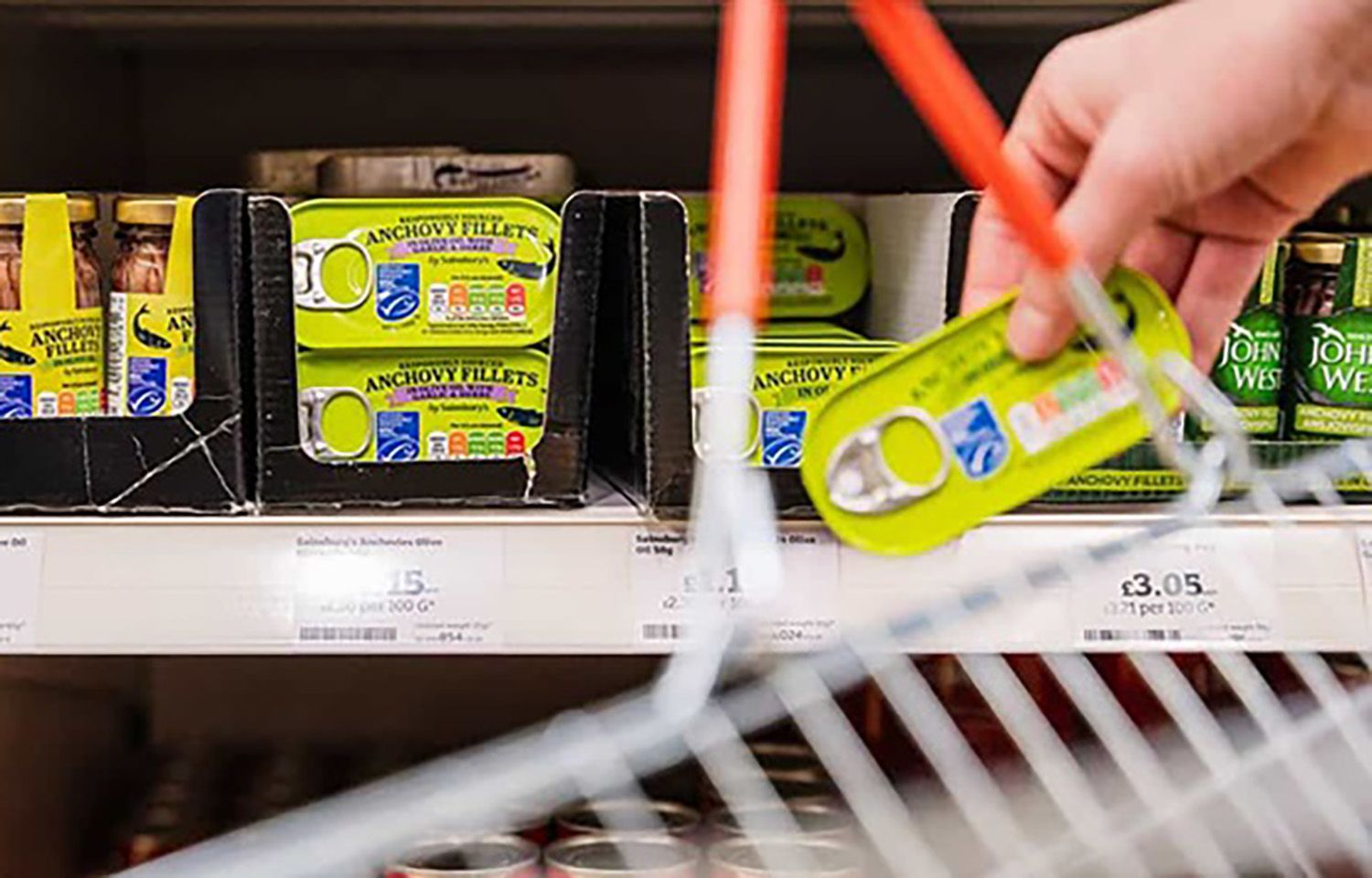
U.K. retailers recorded strong sales growth of certified sustainable seafood in 2024-25, with Marine Stewardship Council (MSC) eco-labeled products continuing to gain ground across supermarket shelves, according to the newly published “MSC U.K. and Ireland Market Report.”
The analysis found that U.K. consumers spent GBP 1.7 billion (USD 2.3 billion, EUR 2 billion) on 189,000 metric tons (MT) of MSC-labeled fish and seafood from the financial year spanning 1 April 2024 to 31 March 2025, representing a 14 percent increase on the previous year. It also determined that 63 percent of all wild-caught fish and seafood sold in U.K. supermarkets now carries the blue MSC eco-label, with 948 MSC-labeled own-brand products now available.
MSC U.K. and Ireland Senior Commercial Manager Seth McCurry said that with 22 percent of U.K. customers saying they won’t buy fish unless it’s sustainable, the rise in sales isn’t a surprise. As a result of that demand, he pointed out that the country’s retailers are working closer with the fishing industry to ensure there’s a wider range of MSC-certified species on their shelves, including more locally caught offerings.
However, the strongest growth came from non-native tuna, particularly skipjack. The number of MSC-certified skipjack tuna products on U.K. shelves doubled during the 12-month time frame, continuing an upward trend that has seen sales of MSC-labeled canned and jarred tuna climb from GBP 24.3 million (USD 33 million, EUR 28 million) in 2020-21 to GBP 269.1 million (USD 365.7 million, EUR 310.2 million) in 2024-25. The volume increased from 2,461 MT to 37,027 MT over the same period.
MSC said this growth reflects genuine progress within fisheries, rather than a simple reshuffling of demand.
“Fisheries generally make significant improvements before they are able to achieve MSC certification; then, once certified, many are required to further improve their practices as a condition of their certification,” McCurry told SeafoodSource. “These conditions are tracked, and the improvements made to reach best practice against the MSC Fisheries Standard will be documented and made publicly available.”
Therefore, McCurry said the recent upswing in tuna sales has been enabled by new certifications.
“The growth has not been driven by redistributing demand among already certified fisheries alone but also by new fisheries taking the necessary steps to achieve MSC certification,” he said.
Although skipjack dominates the recent increase, MSC continues to push for broader engagement across species.
“There are 738 fisheries engaged in MSC’s program globally … consisting of over 200 different species on all seven continents,” McCurry said. “So, there is a great diversity of MSC-certified sustainable options to choose from.”
In the U.K. alone, 49 certified species were sold in 2024-25, including banana prawns, Argentine red shrimp, and Chilean jack mackerel. MSC is also actively promoting “sustainable swaps” to encourage consumers to look beyond the market’s so-called “big five” species of cod, haddock, salmon, tuna, and prawns (shrimp).
MSC’s analysis also confirmed a lot of the recent growth in the U.K. market has come from frozen, canned, and value-added formats – segments that have fared well during the cost-of-living crisis.
“There are MSC-certified product options for a great array of price points and product formats,” McCurry said. “Giving all consumers a sustainable choice for the food that they want to eat helps to ensure that everyone is able to play their part. The growth in MSC-labeled sales within convenient and affordable product formats is a clear demonstration that sustainable options can remain relevant even amidst a cost-of-living crisis, rather than being a premium-only choice as it is sometimes perceived to be.”
Though retail penetration continues to rise, MSC certification remains relatively limited in foodservice.
“Retailers were early adopters of MSC’s program, and sustainability has been a prerequisite for seafood sourcing for many years,” McCurry said. “They are also well-resourced to integrate sustainability into their everyday operations and manage the demands of an MSC audit and the cost.”
By contrast, foodservice operators must invest directly in certification and ensure certified supply chains before using the MSC eco-label – a challenge that McCurry suggests has been made more acute by recent economic pressures.
“Becoming MSC-certified has probably become less of a priority,” he said.
However, he added that MSC is seeing “green shoots of interest,” including renewed uptake among fish and chip shops, pubs, and quick-service restaurants.
Meanwhile, as sustainability claims proliferate in the U.K. consumer space, MSC is setting itself apart in giving shoppers and its partners confidence in the rigor and credibility of the program, as well as the strength of the brand, McCurry said.
“The MSC is the only global wild-caught seafood eco-label for sustainability that simultaneously meets best practice requirements set by ISEAL, the United Nations Food and Agriculture Organization, and the Global Sustainable Seafood Initiative.”
He also emphasized that the MSC is adapting to an evolving regulatory environment around sustainability, particularly in the E.U. where the European Green Deal will require companies’ claims about sustainability to be clear, substantiated, and easily understandable.
In May 2025, MSC announced changes to the claims that accompany its eco-label. These changes were made to ensure MSC claims align with that E.U. legislation, but will impact all partners globally who use the MSC eco-label, McCurry said.
“Here in the U.K., the Green Claims Code is a set of guidelines from the Competition and Markets Authority (CMA) which is designed to prevent greenwashing by ensuring environmental claims are truthful, accurate, and substantiated,” he said.
He added that tightening regulation around environmental claims could ultimately work in favor of robust certification schemes.
“Increased regulation on claims and labels means those that are not based on a credible certification scheme with third-party verification … are at risk of falling foul of the regulations,” he said. “This may in turn reduce overall ‘label fatigue.’”
In terms of other growth avenues, MSC also sees significant untapped potential beyond the human food market.
“These categories are certainly not niche opportunities; they can be gamechangers,” McCurry said, referring to pet food and supplements.
According to MSC, U.K. and Irish sales of sustainable seafood supplements, such as marine collagen and cod liver oil, doubled last year, while the GBP 12.8 million (USD 17.4 million, EUR 14.8 million) spent by shoppers on supplements certified to the MSC sustainable fishing standard represented a 99 percent increase on the previous year’s total.
