



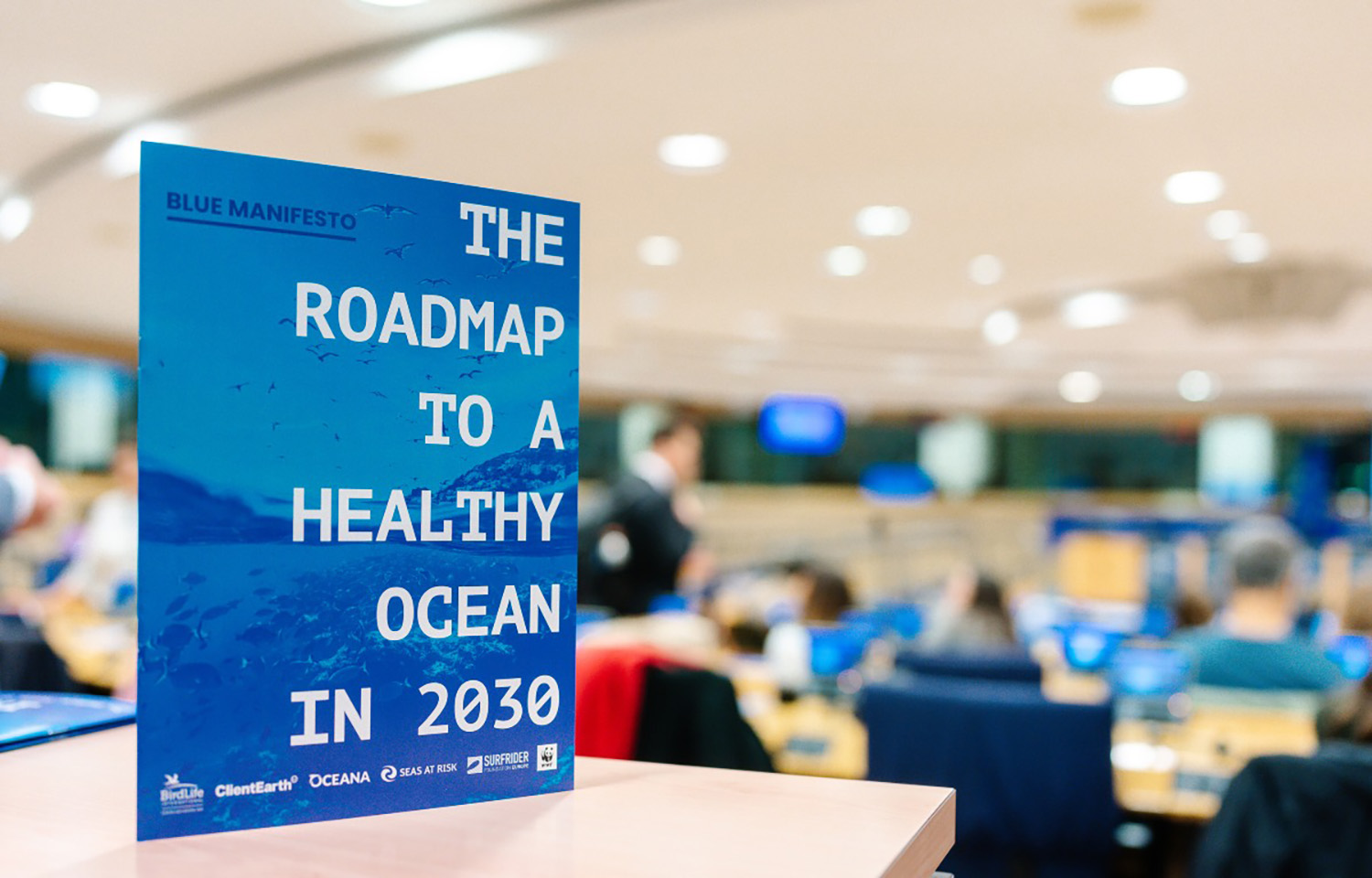
The European Union recently celebrated Ocean Week, which included debates, exhibitions, and other events in Brussels to celebrate Europe’s seas and determine the best path forward for protecting them.
During the event 140 organizations delivered a united call to the bloc’s leaders, including European Commission President Ursula von der Leye and newly appointed European Commissioner-designate for Fisheries and Oceans Costas Kadis, urging them to implement a series of new measures that stop the region’s waters and coastlines from being environmentally “pushed to the brink.”
The six NGOs that led the call – Oceana, Seas At Risk, Surfrider Foundation Europe, BirdLife Europe and Central Asia, ClientEarth, and the World Wildlife Fund – outlined plans for an E.U.-backed “Blue Manifesto” that would provide a step-by-step roadmap advocating for ocean health to be at the heart of E.U. conservation decision-making.
President von der Leye, who was reappointed to a new term in June, has seemed receptive to such pleas, even pledging to create a European Ocean Pact in July that, according to Oceana Europe Deputy Vice President Vera Coelho, shows recognition at the highest E.U. political level of the need for a coherent ocean protection strategy.
The NGOs said the announcement of the pact marks a step in the right direction, but aligning the pact with the policy roadmap outlined in the Blue Manifesto will be crucial to ensuring meaningful, long-term ocean protection, as will proper funding to support it.
“It is our firm opinion that [the pact] must provide an overarching, coherent framework that places the health of the ocean at the basis of a blue economy that works for people and the planet alike,” the NGOs said. “It must ensure that all E.U. policies with an impact on the ocean are coherently addressed so that they contribute to restoring and rebuilding an abundant ocean that can underpin thriving coastal communities and a blue economy within planetary boundaries.”
The NGOs also said that they expect the Ocean Pact will be published before the United Nations Ocean Conference (UNOC), which is due to take place in Nice, France, in June 2025, making it important to ensure the effectiveness of the pact now.
“Even though this does not leave much time, we expect the European Commission to present more than a general overview of why the ocean is important or a summary of all the policies that are already in place – and not properly implemented,” Coelho said. “The Blue Manifesto offers a detailed, ambitious, yet realistic roadmap of the policies that need to be developed, adopted, and/or implemented in order to deliver a healthy ocean by 2030. There is no time to lose with empty statements, and it would not benefit the E.U.’s image globally if all it had to present at UNOC was an ocean pact devoid of any real substance.”
As for funding, Coelho insisted that support should be based on two components: one dedicated to measures for the long-term restoration and conservation of the marine environment, and another dedicated to the just transition of ocean-related economic sectors toward more sustainable, fair, decarbonized, and low-impact activities.
“[A dedicated ocean] fund could bring together dispersed funding sources for the ocean, which are currently divided among multiple E.U. funds; very importantly, it should be fed with additional resources through the removal and redirection of subsidies which are harmful to the marine environment,” she said. “Taxpayers’ money should be invested in delivering the objectives of the E.U. in terms of a sustainable economy that works for all – rather than propping up destructive activities that benefit just a few.”
The manifesto also advises the E.U. improve ocean governance by introducing a framework for traceability and labeling of all seafood products in the bloc.
Coelho said that the region has “world-leading rules” on the transparency and traceability of seafood but that these don’t apply to processed products such as fish fingers or canned tuna.
This allows some actors to place high-risk seafood on the E.U. market and to reap significant profits, she said.
“The European Commission should propose new rules to extend transparency and traceability requirements to processed seafood to prevent this and to empower consumers to make informed and sustainable choices,” she said. “These rules should also apply to restaurants and mass catering facilities. Having these rules in place would ensure a level playing field in the access to the E.U. seafood market for those operators that follow stringent rules on sustainability, traceability, and labor standards, who are currently subject to unfair competition from others who are not held to the same standards.”
To ensure effective marine protection, the manifesto’s proposals include banning destructive activities, including bottom trawling in all E.U. marine protected areas, and restricting the import and trade of aquatic food products that cause harm to endangered species, including through bycatch. It also calls for a phase-out of fuel tax exemptions in fisheries, with the aim of redirecting those funds to finance a “just and fair transition” in the fisheries sector.
The Blue Manifesto was first launched in 2020 at the beginning of von der Leyen’s first term, and each year since, the six NGOs have tracked the E.U.’s progress in delivering a healthy and climate-resilient ocean by 2030.
According to the organizations, in this time, the E.U. has embraced the so-called “Green Deal,” and has adopted important legislation, such as the Nature Restoration Law, and key policy commitments, such as the climate neutrality target.
“However, the ‘blue’ has been largely missing from the ‘green.’ Specifically, the marine initiatives of the European Commission under the Green Deal were not legally binding; implementation and enforcement of existing ocean-related legislation is lagging behind; and there is still a significant lack of coherence between the different E.U. policies with an impact on the marine environment,” Coelho said. “In the meantime, the clock is ticking. The ocean is experiencing increasingly severe heatwaves, with consequences such as stronger storms and increased flooding on land. The climate and nature crises are accelerating, and the window of opportunity to prevent their worst impacts is rapidly closing. This new European Parliament and European Commission will be key in deciding whether the E.U. will meet its multiple targets for 2030 and whether we can change course toward a sustainable and liveable future.”
