


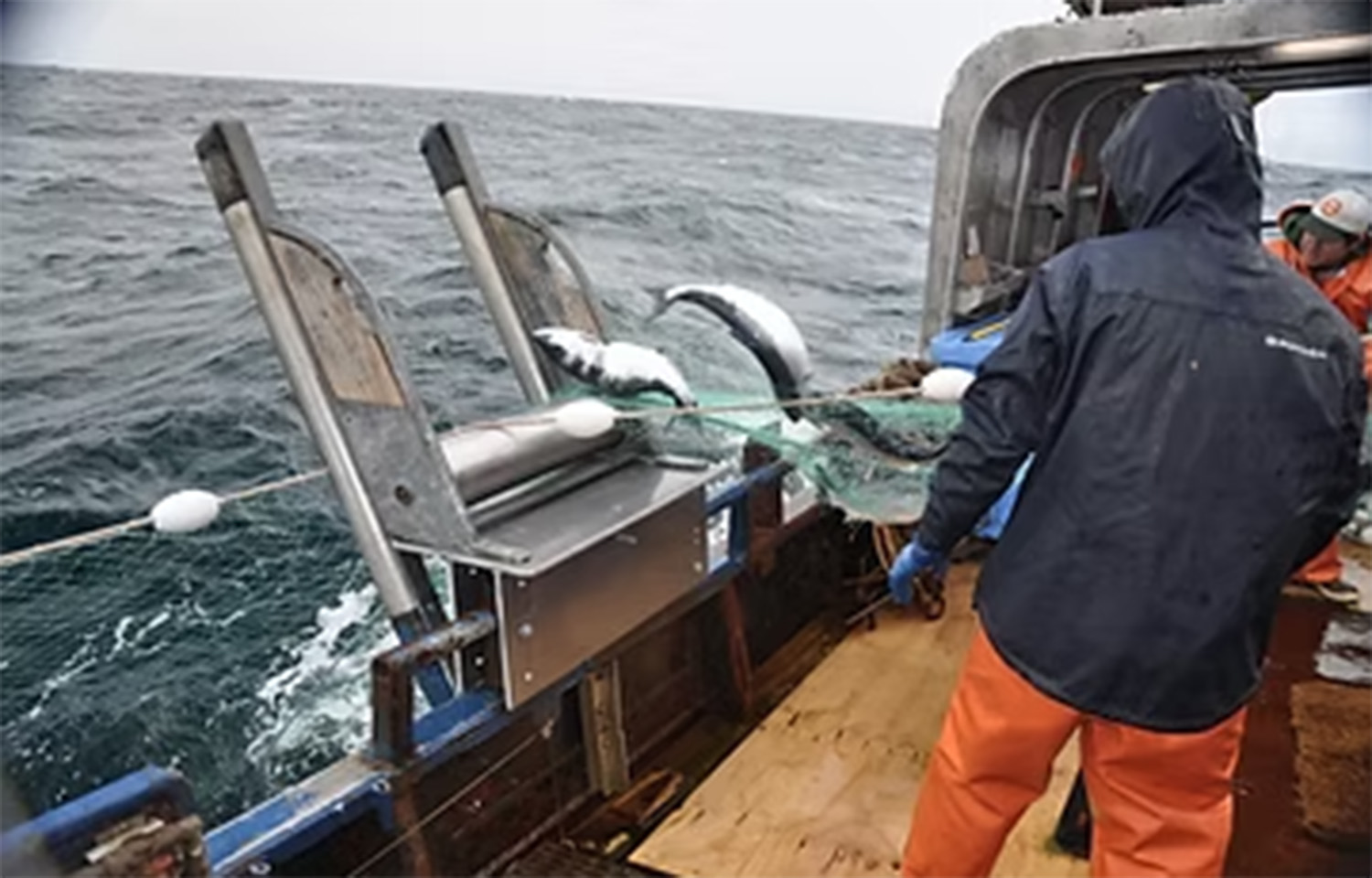
Since the summer of 1967, Port Moller Test Fishery has offered Alaska’s Bristol Bay an in-depth look into the stocks of sockeye salmon during the peak commercial season. Now celebrating its 60th year, the project might become fully state funded.
The PMTF is owned and operated through the Bristol Bay Science and Research Institute (BBSRI), which has been led by Executive Director Jordan Head for the last three years. Currently, the institute is being funded by a combination of sources including the fishing industry and state grants, but that could change soon if Alaska Governor Mike Dunleavy signs a bill granting it full funding.
ADF&G first developed and ran the test fishery six decades ago under the name “outside test,” with the goal of better understanding Bristol Bay’s stocks before, during, and after the salmon season. Then from 1985 to 2002, the University of Washington Fisheries Research Institute ran the project, before passing it off to BBSRI.
Head, originally from Washington, started with the Alaska Department of Fish & Game (ADF&G) in 2012 as a college intern while studying at Western Washington University. He spent 10 years working with ADF&G in the AYK region, Cook Inlet, and Bristol Bay as assistant manager of the Nushagak District, Togiak District, and then as area research biologist.
“In my time, I very quickly became attuned with what Port Moller Test Fishery (PMTF) is, and its value for managers because I was one of the people doing the managing,” Head said. “In February 2023, I stepped away from the state and to BBSRI where I became the executive director and that’s what I’ve been doing since.”
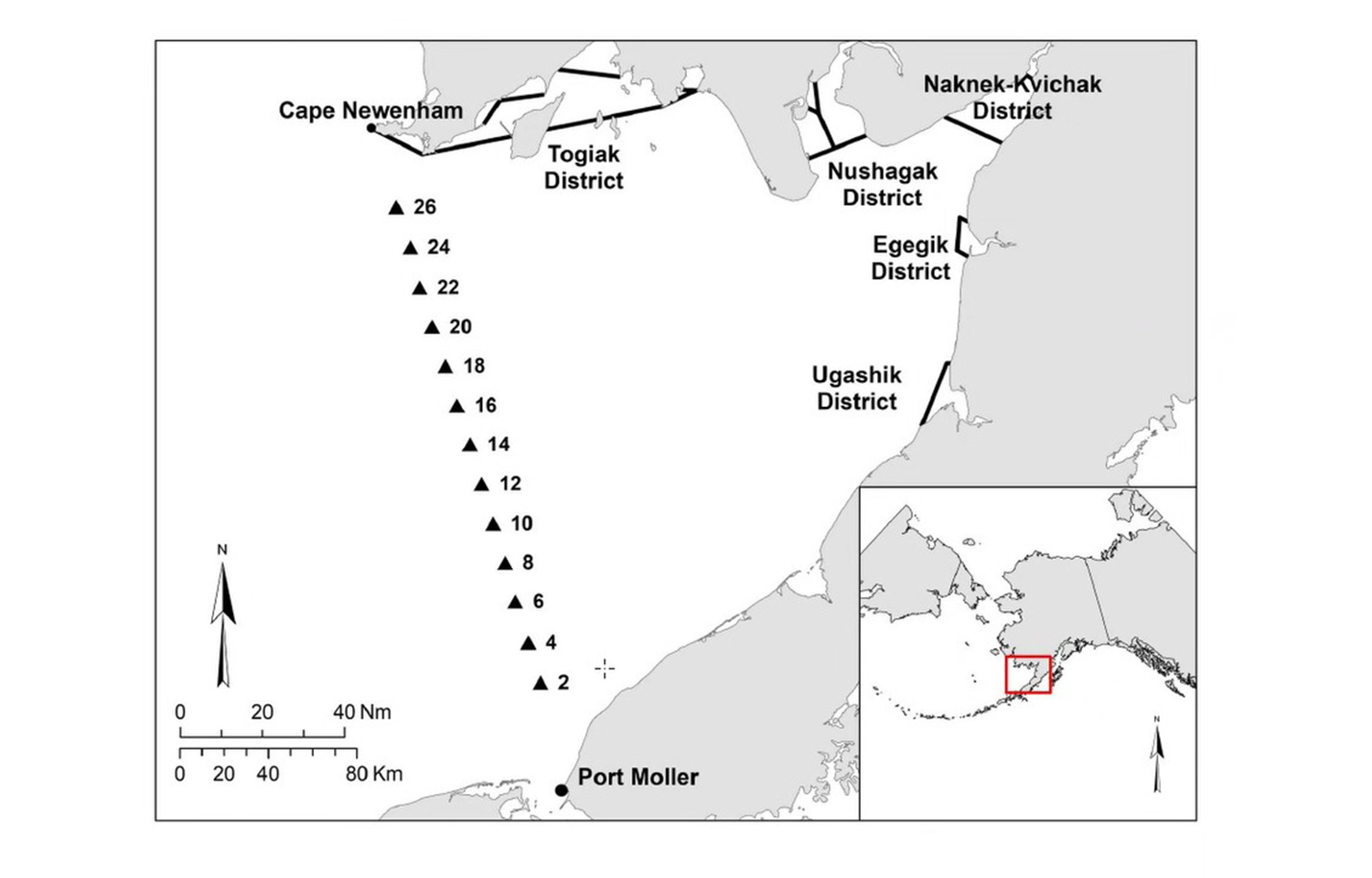
Over the years, the PMTF has evolved its scientific capabilities continuously as it seeks to better understand and predict what is happening in the fishery. Each year, from 10 June to 10 July, vessels in Port Moller conduct once-a-day tests to monitor water temperature, test the age and stock composition of fish, update daily catch, and then interpret the incoming data.
This year BBSRI contracted two vessels – St. Andrew and Miss Leona – for the salmon season. Onboard St. Andrew are two science technicians, a genotype scientist, and two additional staff. Miss Leona’s onboard crew includes a captain, two deckhands, and one additional crew member.
At Port Moller, alongside Project Manager Jeff Regnart, is Science Lead and Data Statistician Scott Raborn, and Pre-Season Logistics and Crew Trainer Sam Harris. This coalition helps Alaska’s busiest commercial salmon fishery understand the stock composition in the water, and send that data statewide to commercial fishermen, ADF&G, and fisheries managers.
Head said the scientists all work full tilt during the salmon season as fish come in and they make predictions to benefit the fishery.
“We’re getting this information and we’re coordinating what the boats are going to do at 6:00 or 7:00 a.m. and we’re getting the last data in and sending out information at 10:00 or 11:00 p.m. and you’re sitting here all day watching the numbers come in, getting excited about each new number,” Head said. “It’s very stressful, but it’s so rewarding at the same time.”
BBSRI has made its own improvements to the research performed by the PMTF. It has expanded the number of test collection sites, added new gear types to encompass more fish sizes, and increased the depth in mesh per net so that fish could not escape under it.
It has also enhanced the equipment and techniques used to determine run composition and origin. Up until 2010, fishermen and researchers only got a rough magnitude of salmon runs and also did not know what rivers fish were traveling to from Bristol Bay. Now, Head said scientists can know how many fish are traveling to which specific rivers.
"We can say, of all the fish we caught on this Tuesday and Wednesday, 60 percent of them were going to the Nushagak, 20 percent of them were going to the Naknik Kwijak, so then the fishermen, managers, and industry can know,” Head said. “If that’s combined with a high catch per unit effort, they know that a lot of fish are going to show up in the Nushagak District 7 days from now. That allows a whole new level of being able to manage these districts.”
That information is the result of investments in equipment. In 2022, BBSRI was the first test fishery to add a genomic sequence scientist on board with custom-built genetics equipment after contracting Nikon to custom build a microscope with photo capability.
Before this, on-vessel scientists would have to extract fish, take samples of scale patterns, apply the samples to slides, bring the slides back into Port Moller to the dock, coordinate an airplane to pick up the samples, and fly them to ADF&G’s lab in Anchorage in a process that took 3-3.5 days. Head said as there is often only a 7-day period where data collected is still valuable, making an already fast-paced month that much harder. Now, with the new microscope, the entire process is done in about a day.
"What we do is we have a t-shirt press, and we have a Nikon microscope where you put the acetate in and it will automatically go and take a high-resolution image of every scale,” Head said. “We can send that now with Starlink right over to ADF&G and they can age it right on their computer, rather than having to physically get the scale. That also allowed us to never have to go into Port Moller, which is a port where vessels go to get weathered in."
Head said the research that the PMTF does is key in ensuring continued strong runs of salmon in Bristol Bay.
“The most rewarding part is working to do my part to ensure that Bristol Bay stays the way it is, and it’s a sustainable world class resource,” Head said. “But, also working and helping an industry that’s built of people who are hardworking, independent vessel owners who are out there to utilize this resource in a responsible way. Knowing that I’m doing my part to preserve that way of life and preserve that natural resource is really the most rewarding part. There’s a lot of parts that aren’t rewarding, and there’s a lot of parts that suck, but knowing you can get through all that knowing you’re working for a great cause.”
BBSRI does almost all of the data collection, and works in collaboration with ADF&G to compose the stock composition reports. King Salmon helps determine the age of fish scales, and conducts the age composition reports. Then, the annual catches and catch per unit reports are sent via email to fleets, the University of Washington, and fisheries managers.
“BBSRI took over in 2002 or 2003, and a lot of these things have been pushed by [them] because a lot of these things were on the verge of just going away at that point,” Head said. “They took it and they said let’s make this the biggest, baddest project because as you’re seeing it now, it’s a very valuable tool. Fishermen are able to use it and say ‘this district doesn’t look like it’s going to get a lot more fish, let’s go over here,’ and managers are able to say ‘I have a lot more fish coming down the pipeline that are coming to my district,’ and they can have confidence in that."
Head credited the people involved in the project before him with its strong focus on science, which has gradually lead to the robust research program it is now.
“From about 1985 to present, you’ve had very intrigued research scientists operating the project and I think that’s what’s made it successful. There’s always been an attitude of how we can make it better, and how we can make it more informative for the managers, fishing fleet, and processors,’” Head said. “If it was still operating the way it was operated in 1967, I don’t think it would have a whole lot of value for industry, but because it’s continually evolved and continually been made better and expanded, it continues to provide more and more value to industry and to the ADF&G managers.”
Funding for PMTF has come from a combination of state and industry funds, including BBEDC (Bristol Bay Economic Development Corporation), BB&A Environmental, BBNC (Bristol Bay Native Corporation), and BBRSDA (Bristol Bay Regional Seafood Development Association).
The state of Alaska started funding a portion of the project through a legislative increment in 2021, and upped to cover half of PMTF operational needs by 2022. On 18 May 2026, the Alaska Legislature met and voted to correct and address the department of fish and game state refuges and critical habitat areas, including Port Moller. According to Head, this means if the proposed bill is not vetoed by Governor Mike Dunleavy, the project will be fully state funded in fiscal year 2027.
“That does a lot because industry and BBSRI people still are going to be contributing money towards fisheries management, but now instead of paying for the tool that ADF&G is using to manage the fishery and industry – what is obviously a well-established tool running for 60 years – we’re going to turn around and put all of that money towards Chinook research with the stocks of concern and everything going on with Chinook in Bristol Bay which needs a lot of effort and research,” Head said. “This project is a good example of what happens when people just roll up their sleeves and make things better instead of just tearing stuff down. That’s why I’m proud of this project, that’s why I’m proud of the work BBSRI does because we’re kind of a unique organization, there’s not a lot of them like us who are a nonprofit that sits department adjacent whose role is to try to fill the gaps and do what agencies can’t do.”
