


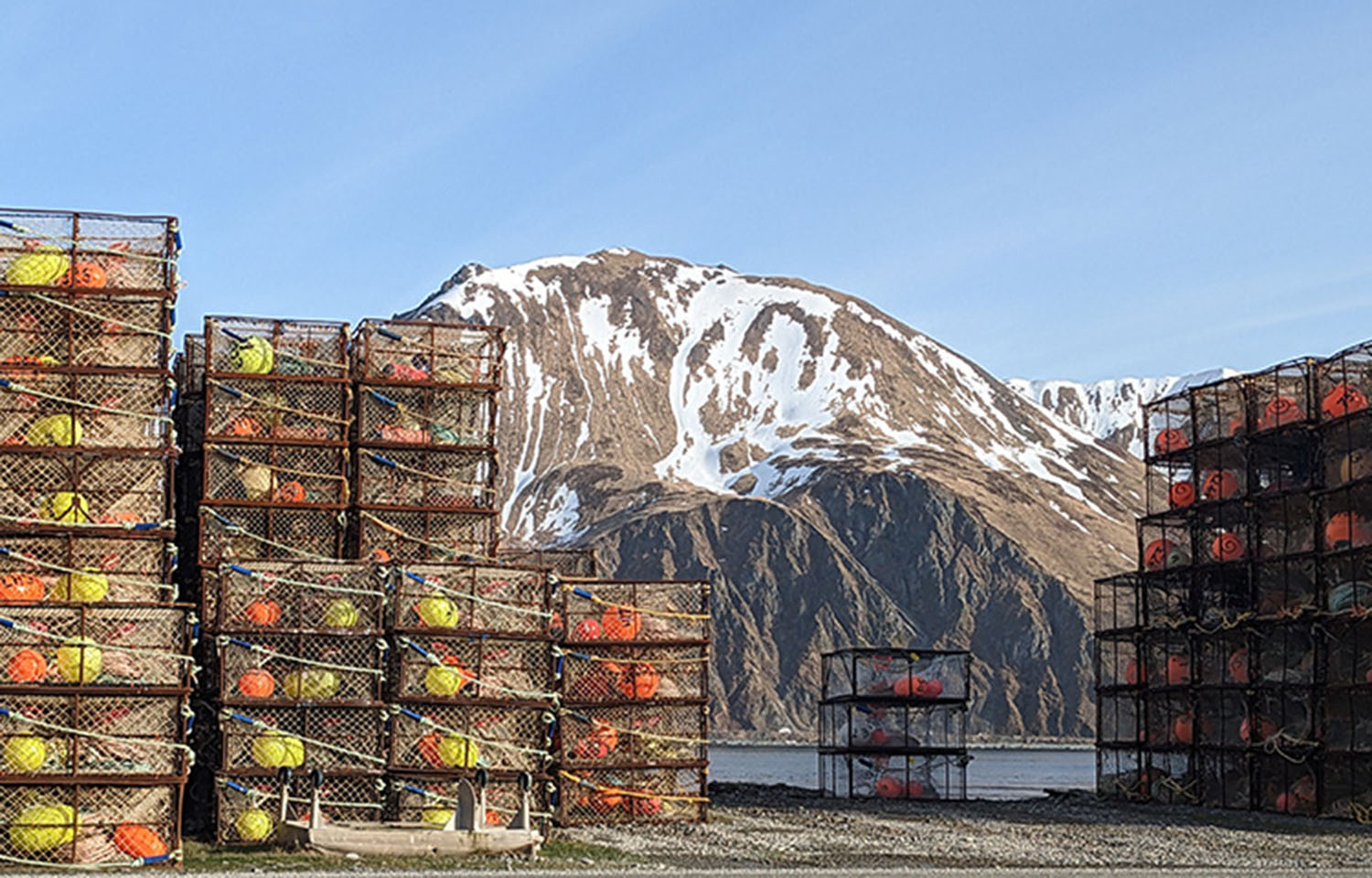
Alaska fishermen are waiting for final word on whether there will be a red king crab season in Bristol Bay this fall.
And with the first 2025 Alaska salmon season forecast showing grim results, fishermen across Alaska, where seafood represents an outsized portion of the state’s economy, are worried about the future of their livelihoods.
In mid-September, the North Pacific Fishery Management Council's (NPFMC) crab plan team recommended an upward revision of the acceptable biological catch of Bristol Bay red king crab for the 2024-2025 season, which is slated to begin in mid-October. The proposed ABC of just over 4,000 metric tons – following a positive assessment issued in September 2024 – will likely result in the council’s approval of the season opening for the second straight year. Last year, there was around a 975-MT total allowable catch set, after two straight years of the fishery being closed due to low biomass.
“The near-future outlook for the Bristol Bay red king crab stock ranges from a steady state to a declining trend,” Alaska Department of Fish and Game Researcher Katie Palof wrote in the assessment. “The closure of the directed fishery for seasons 2021-2022 and 2022-2023 appears to have allowed abundance of male and female crab to hold steady, with survey data observing only small increases in the overall population. Effects of fishery closures on recruitment are unknown due to the 6- to 7-year lag between spawning and crab recruitment into the assessment model. Current crab abundance is still low relative to the late 1970s, and without favorable environmental conditions, recovery to the high levels of the late 1970s is unlikely in the near future.”
That would be a bright spot in an otherwise bleak-looking near-term outlook for Alaska’s fisheries. NOAA scientists are recommending the Bering Sea snow crab fishery remain closed as its stock is still rebuilding after that population crashed in 2021, and Southeast Alaska’s red and blue king crab fisheries have been closed since 2017.
The salmon fishery is also facing foreboding prospects. The University of Washington’s Fisheries Research Institute released its 2025 Preliminary Preseason Forecast for the Bristol Bay sockeye salmon fishery, predicting a run size of 49.6 million fish, down 18 percent from the 10-year average of 60.1 million sockeye. Its projected inshore harvest for 2025 is 32.4 million sockeye salmon, or roughly 185.3 million pounds of fish.
The total is nearly equivalent to the 20-year average, and taking into account a lower-than-average run in 2024, it suggests run sizes may be regressing back to the mean after several years of huge returns.
The UW-FRI forecast a smaller-than-average run in Bristol Bay in 2024 of 38.9 million fish and a harvest of 26.4 million sockeye, but the actual number for the total run was 51.6 million fish, with 31.6 million harvested. The UW-FRI prediction of an average fish weight of 5.5 pounds was off, as the average weight of 4.53 pounds was the smallest on record.
The small average fish size in Bristol Bay was primarily a result of the fact that around 80 percent of the returning sockeye spent two years growing out in the ocean rather than three years, according to Alaska Department of Fish and Game Biologist Tim Sands.
The preliminary UW-FRI forecast is predicting 39 percent of the 2025 Bristol Bay run will be two-ocean-year sockeye, and 61 percent will be three-ocean-year sockeye, implying larger fish sizes are likely next year. UW-FRI will issue its formal preseason forecast in November 2024.
But Sands said there are other factors impacting Bristol Bay sockeye sizes – with climate change likely the biggest factor. The weight of Bristol Bay sockeye has declined 10 percent since the 1960s, according to a University of Washington study, which found similar decreases among Alaska’s Chinook, coho, and chum salmon.
Sands said fishermen who didn’t switch to smaller net-mesh sizes missed out on much of the catch this year.
“In my district they were very small, and the fishermen missed them. They went through their nets,” Sands told the Alaska Beacon.
Illegal fishing was also a problem in Bristol Bay this season, resulting in a three-day closure of fishing in the bay’s Egegik district.
Those issues were addressed by a report recently issued by NOAA's Marine Fisheries Advisory Committee investigating the state of the Gulf of Alaska and Bering Sea fisheries. The report, completed at the behest of U.S. Commerce Secretary Gina Raimondo after a meeting in May with Alaska's congressional delegation, requested NOAA provide solutions to help the state’s seafood industry cope with its ongoing downturn, which some state officials have described as reaching a crisis situation.
The report, completed by NOAA Economist Stephen Kasperski, found Alaska suffered a USD 1.8 billion (EUR 1.6 billion) loss in direct revenue to the Alaska seafood industry between 2022 and 2023, resulting in a loss of 38,000 Alaska and U.S. jobs. Alaska fishermen suffered a 50 percent decline in profitability between 2021 and 2023 as a result of decreasing prices and increased costs, according to Kasperski.
“There were substantial increased costs starting in 2022 and price declines that really started in 2023,” he told the committee at its meeting in Kodiak, Alaska, on 15 September, according to the Kodiak Daily Mirror. “We've seen large increases in the cost of fuel and borrowing and interest rates, labor costs, and wages. They've all increased substantially starting in 2022, leading to increased pressure on both harvesting and processing business operations.”
Prices have been declining due to “the change in the way that retail operations are handling seasonality of seafood products,” according to Kasperski.
“[That] has contributed to large seafood inventories and lower prices received by processors and wholesalers,” he said. “Also, there's a lack of market differentiation between the sustainably harvested and regulated Alaska seafood and products produced outside American certification regimes.”
The profit margins of Alaska’s fishers were essentially flat for the 10 years between 2011 and 2021, according to Kasperski, but then dropped about 50 percent between 2022 and 2023. In 2023, the average wholesale price for Alaska seafood declined 23 percent, and the statewide average ex-vessel price dropped 38 percent. Wholesale revenues declined 26 percent to USD 1.2 billion (EUR 1.1 billion) and ex-vessel revenue declined USD 617 million (EUR 555 million).
“This is with an increase in landings between 2022 and 2023, so the volumes are still there, but prices have really substantially declined,” Kasperski said.
Market forces “have resulted in really high inventories and low seafood prices throughout the global supply chain,” according to Kasperski, and with most of Alaska’s seafood products exported, the state’s industry has high exposure to trade shocks, such as the Sino-U.S. trade war or the Covid pandemic.
“The Covid pandemic really brought unprecedented destabilizing changes to the seafood industry and fishing communities that led to substantial revenue losses, substantially increased costs, and decreased participation among a lot of communities and individual vessels,” Kasperski said.
Those shocks are compounded by a lack of revenue insurance in the U.S. fisheries sector, in contrast to the U.S. agricultural sector, which has federally sponsored insurance that helps mitigate against market collapses or environmental challenges, according to Kasperski. And while federal government has approved USD 340 million (EUR 306 million) in disaster relief funding for Alaska crab, salmon, and cod fisheries since 2019, those funds do not serve as an equal replacement for the steady income provided by healthy fisheries. Additionally, a strong U.S. dollar and tariff asymmetries are harming Alaska seafood exports. U.S. producers face tariffs between 1 and 30 percent in China, the European Union, and Japan.
“Alaska seafood is competing in global markets against countries that have lower operating costs, subsidy support, and less environmental and labor regulations. And tariffs and non-tariff barriers continue to be an impediment to developing new markets as well as expanding current markets,” he said.
In the past, Alaska fishermen and seafood businesses have survived a downturn in the fortunes of one fishery by relying on a second. But in the past few years, practically every fishery has suffered some sort of decline, Kasperski said. That has resulted in company closures, a lack of investments in aging physical plants, and fishermen leaving the business.
“The ultimate impact of these stressors is a severe decline in commercial fishing participation for about the last decade,” he said. “Communities with plant closures faced substantial tax revenue losses, creating uncertainty for community budgets and spending, and community businesses that support the fishing industry and rely on fisherman spending are also struggling to survive.”
Alaska produces about 60 percent of U.S. seafood, and the equivalent of around 2 percent of the world's total supply, including 9 percent of its salmon and crab, but the impact of environmental stressors impacting those catches could potentially be catastrophic, Kasperski reported.
“We are hearing reporting of declining physical and mental health, increasing substance abuse issues, and struggles to make loan payments … There are concerns over large-scale losses in fisheries participation with potential generational implications for fishing communities,” he said. “The Alaska seafood industry is a really important way of life, a sense of place, a community and identity. It's a prominent food security provider for many Alaskans, and these recent changes have caused significant revenue losses in Alaska for state, town, and community. And they've threatened the sustainability of Alaska fishery-dependent communities in that way of life.”
