






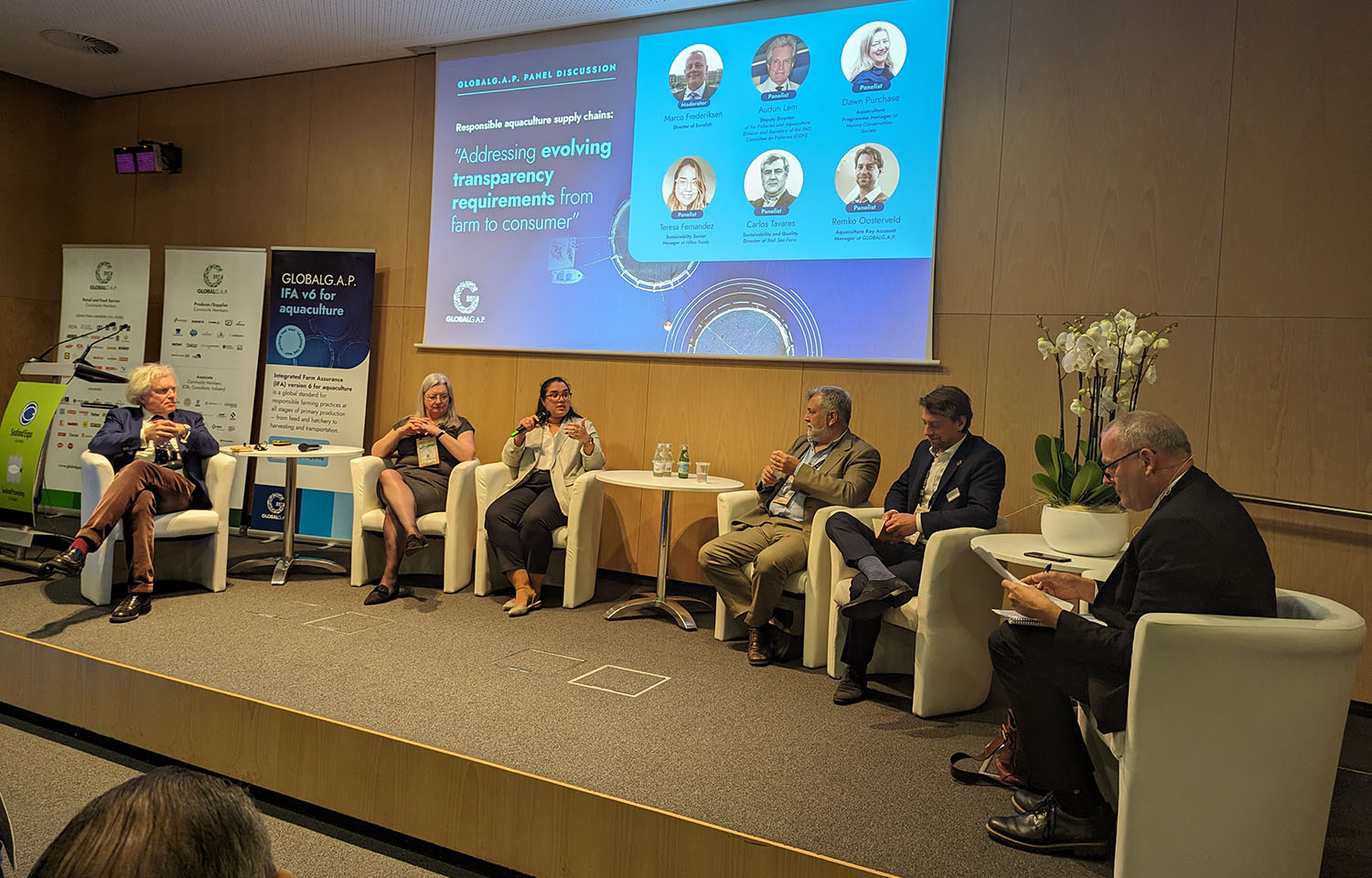
Over the last decade, expectations around sustainability certifications have expanded, and certification schemes need to work harder than ever to meet them, according to industry professionals who participated in a recent panel organized by GlobalGAP.
GlobalGAP first delved into aquaculture production in 2004, and 20 years later, the certification has undergone a number of transformations – including new standards. Those transformations are key to keeping up with global trends in responsible aquaculture production, FAO Deputy Director of Fisheries and Aquaculture Audun Lem said during the panel, which took place during the 2024 Seafood Expo Global in Barcelona, Spain.
“When we talk about sustainability, today, we really have to be holistic. We have to think in all the three dimensions of sustainability, whereas some years ago, the focus was on environmental sustainability,” Lem said. “Now, social dimensions, civil rights, and decent work conditions are all very important components of a sustainability strategy from any company or organization.”
Lem said the FAO has been developing guidance documents on sustainability issues for aquaculture and the seafood industry, and that in July, the FAO’s Committee on Fisheries will be examining how to create standards that various sustainability and certification organizations can use as guideposts.
The FAO standards have long been central to both seafood companies and certification schemes. Particularly, the FAO’s sustainable development goals (SDGs) have been guideposts for companies and nonprofits, with SDG 14 – “Life Under Water” – specifically serving as a key marker. According to Lem, this builds on FAO's collaboration with fisheries organizations in the past.
“Something we have developed on aquaculture in particular – guidance on sustainable aquaculture – includes guidance on all these different dimensions of sustainability,” Lem said. “We are confident that that will go through and be at a later stage adopted at a national level and become part of national legislation.”
Hilton Foods Sustainability Senior Manager Teresa Fernandez said legislation can be important, but the reality is legislative efforts and the realities of global supply chains aren’t always aligned.
“There is a difference between what legislation is asking us to do and perhaps what the U.K. retailers have been asking for a while,” Fernandez said.
From her perspective, the bridge joining industry and legislation is transparency.
“In our supply chains in the U.K., we’ve been a bit more focused on transparency to understand the social and environmental concerns and animal welfare, and now, we need to extrapolate that to the rest of the [industry], which is quite a challenge,” Fernandez said.
She said the challenge mainly comes from the complicated nature of seafood supply chains and the fact that verification adds new layers of complexity.
Because of that, new ideas are necessary to solve sustainability issues, Stolt Sea Farm Sustainability and Quality Director Carlos Tavares Ferreira said. Because Stolt Sea Farm raises turbot and sole in a land-based facility in Spain and uses a specialized aquafeed, ingredient sourcing is a primary challenge it's dealing with.
“How can we formulate healthy diets for fish that can also bring all the healthy characteristics for the final product, or the end consumer, without disrupting the supply chain?” Ferreira said.
Ferreira said he'd like to see the aquafeed sector be less dependent on wild-caught ingredients.
“How can we substitute ingredients and decrease our ... dependency on fish?” Ferreira said. “This is a huge challenge.”
Ferreira suggested moving back toward land-based animal proteins – something that has been off the table since the prevalence of mad cow disease in the 1990s.
“Everyone made kind of a boycott to land-based animal protein. A lot of the retail chains are now reopening the door and realizing the rates are under control, but I think we still have some way to go and reassess,” Ferreira said. “We have to be able to use every responsible ingredient out there.”
Lem said technology must play a bigger role in moving the seafood industry toward meeting the expanded scope the sustainability requirements they face, beginning with traceability.
“Traceability is a fundamental need in production systems – whether it’s capture fisheries or aquaculture,” Lem said. “Traceability and even artificial intelligence and database systems are becoming fundamental in improving efficiency in the management of any production system, whether aquatic or not.”
The aquaculture sector has been leading the way in the development and adoption of technological solutions for decades and will continue to pull the global seafood sector forward, Lem said.
“The situation today is completely different from what it was any time 50 years ago; aquaculture now is driving most of the innovation in our sector of aquatic products,” he said. “Traceability systems within aquaculture is not only important, but it’s also driving development in traceability systems in general within our sector.”
