





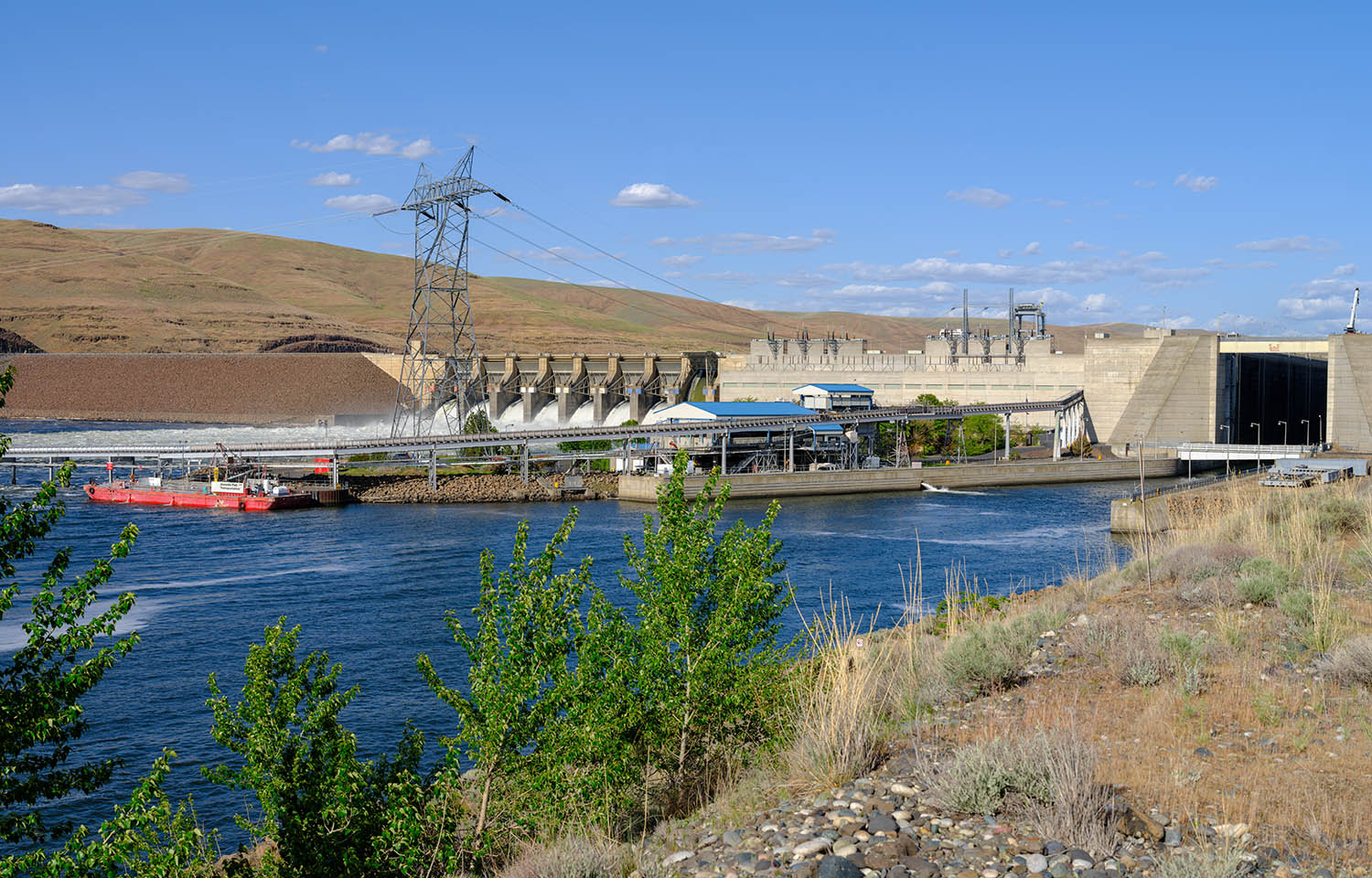
A bill from a Republican U.S. lawmaker that would block the federal government from removing four dams on the Lower Snake River has renewed debate in Congress over the future of salmon recovery in the Pacific Northwest.
"I have been working hard with allies of the Lower Snake River dams to ensure we do everything possible to protect them, and this hearing today marks another success in that effort. This legislation guarantees that federal funds will not be used to breach, or even study breaching, the dams and protects the Army Corps and [the Bonneville Power Administration’s] rights to control spillage operations," U.S. Representative Dan Newhouse (R-Washington) – the sponsor of the bill – said in a release.
Former U.S. President Joe Biden made restoring Columbia River Basin salmon populations a priority during his administration, but U.S. President Donald Trump has reversed course, undoing much of his predecessor’s work to collaborate with state and Tribal governments on the issue.
The U.S. substantially boosted funding for Pacific salmon recovery under Biden’s watch, with his two signature pieces of legislation – the Inflation Reduction Act (IRA) and the Bipartisan Infrastructure Law (BIL) – including vast increases in money for NOAA Fisheries’ Pacific Coastal Salmon Recovery Fund (PCSRF). In 2023, Biden signed a memorandum prioritizing fish restoration in the Columbia River Basin and announced the Resilient Columbia Basin Agreement – a settlement with Pacific Northwest Tribes and state governments on restoring wild salmon populations.
That agreement also called for energy investments to offset the potential removal of four Lower Snake River dams, which Tribal governments and conservationists claim hinder the recovery of salmon in the region. A 2020 federal draft report found that removing the dams would benefit endangered salmon populations but would have negative impacts on the region’s power supply and costs.
The announcement drew immediate opposition from some officials, who argued that the hydroelectric power generated by the dams is critical for the region's power grid. U.S. lawmakers quickly introduced several bills in 2024 to block the removal of the dams, but none were passed before the end of the Congressional office.
In his first year back in office, Trump has moved swiftly to undo Biden’s legacy on Pacific Northwest salmon recovery, proposing to eliminate funding for the PCSRF, rescinding unspent PCSRF funds from the IRA and BIL, and pulling out of the Resilient Columbia Basin Agreement.
Now, Newhouse has introduced the Defend Our Dams Act, legislation that would prohibit the federal funds from being used to breach the four dams on the Lower Snake River. On 3 September, the House Subcommittee on Water, Wildlife, and Fisheries held a hearing on multiple bills, including the Defend Our Dams Act.
“This legislation builds on action that President Trump has taken to withdraw from the flawed settlement agreement and will provide certainty to all of those who benefit from this critical infrastructure across the Pacific Northwest,” U.S. Representative Rob Wittman (R-Virginia) said at the hearing.
Republican lawmakers argued in the hearing that the dams are essential for the region’s power supply while dismissing the usefulness of dam removals to salmon recovery.
“We need to do our best to increase baseload energy, especially as the overall energy demand increases. We need more baseload energy not less,” U.S. Representative Doug LaMalfa (R-California) said. “It keeps occurring in my district and around the West, where, in the name of salmon and salmon runs, we’re removing a lot of baseload power, a lot of hydroelectric power, and so far, we haven’t seen the return on salmon populations because of dam removal.”
Democrats at the hearing, however, pointed out that the federal government has a treaty responsibility with Tribes to protect salmon populations and ensure fishing rights are maintained.
“As a water resources manager who spent my entire life working on water resources and the restoration of ecological systems associated with our rivers and streams, we understand the importance of making sure that the historic and vast rivers of the West are restored, not only for their ecological importance, but their cultural importance,” U.S. Representative Melanie Stansbury (D-New Mexico) said. “At the end of the day, this is not just about the restoration of that vast watershed and the river and ecosystem that it sustains, but it is also compliance with both federal law and Tribal trust and treaty responsibilities. So again, I humbly but emphatically oppose that bill.”
Nez Perce Tribal Executive Committee Chairman Shannon Wheeler was also present at the hearing to give the perspective of Tribal governments, and he unequivocally condemned the Defend Our Dams Act.
“The primary man-caused source of mortality facing Snake River basin fish are the dams and reservoirs that the fish must pass through on their way to the ocean, and we need to do something about that for the fish to survive,” Wheeler said. “Unfortunately, this bill takes a contrary approach that would tie the hands of the federal agencies and force them to ignore the realities on the ground by prohibiting any use to study alternatives and solutions to the largest source of salmon mortality and preventing adaptive and responsive dam operations that would be more beneficial to fish. In doing so, the bill would set the United States on an unambiguous course to destroy wild Snake River salmon runs, which would abrogate our treaty rights to fish in all of our usual and accustomed fishing areas and those of other Columbia River Basin Treaty Tribes.”
U.S. Representative Val Hoyle (D-Oregon) also criticized the legislation for blocking federal funding that would go toward simply studying the dams, noting that prohibition prevents Congress from obtaining research needed to make informed decisions on the dams’ future.
“Unfortunately, I can’t get behind the fact that HR 273 would ban studies into what it would take to replace or modify these dams. Now, these dams provide nearly one-third of the Pacific Northwest’s power. They’re central for regional trade; they help with flood control; and they are the subject of major environmental debate. But, we shouldn’t tie our own hands from being able to research their impacts, even while we acknowledge that right now, there is no other way to replace that power,” Hoyle said during the hearing. “It seems like overreach, and the fact is, if the Lower Snake River dams are truly irreplaceable, as some claim, then we should see the facts to prove it, and we would want the data that would help us effectively manage them.”
U.S. Representative Jared Huffman (D-California) lambasted the Trump administration for “blowing up” the Biden administration’s agreement with Pacific Northwest tribes on restoring salmon populations without preparing an alternative restoration plan. During the hearing, he grilled Department of the Interior Senior Advisor to the Assistant Secretary for Water and Science Dustin Sherer over the administration’s actions.
“The resilient Columbia Basin Agreement took years to create, and the president has thrown all of that away, seemingly, with the stroke of a pen. So I need to ask you, Mr. Sherer, what is this administration’s plan to address Columbia River and Snake River salmon? Do you have something better than this – something that will replace it?” Huffman said.
“We are working to figure out whether or not there is a path forward on a plan,” Sherer replied. “The department understands that it’s a priority to restore habitat and salmon populations in the Pacific Northwest, and we’re going to continue to use existing authorities we can to accomplish that.”
