




Several organizations are playing an important role in designing a more responsible seafood industry.
For instance, organizations like California, U.S.A.-based FishWise, are using data collection, reporting, and learning loops to identify the most efficient and effective ways to implement responsible practices in the sector.
Mark Kaplan, the chief sustainability officer and co-founder of traceability software firm Wholechain; Renee Perry, the vice president of corporate social responsibility and environmental social governance for seafood wholesaler Oddisea SuperFrozen; Michelle Beritzhoff-Law, a senior project director with FishWise; and Lindsay Ceron, another senior project director with FishWise, discussed why it’s essential to analyze supply chains from top to bottom both to reduce risk and ensure responsible practices.
SeafoodSource: Why should a typical seafood company assess its supply chain for risk all the way down to vessel-level due diligence?
Beritzhoff-Law: Irrespective of where you are in the supply chain, fishing vessels carry risk, and as a company that is reliant on wild-caught products, you cannot manage nor mitigate what you don’t know or understand.
Historically, companies only looked "one step back" to their direct supplier. However, because many of the severe risks in wild-caught seafood, such as forced labor and illegal fishing, occur at sea, assessing risks throughout the supply chain, down to the individual vessel, is the only way to truly mitigate these threats.
Put simply, three specific reasons a company should assess its supply chain at the vessel level are:
- Mitigation of high-stakes legal and regulatory risks: For example, for U.S.-based companies, U.S. Customs and Border Protection (CBP) issues withhold release orders (WROs) against fishing vessels. If your product was transshipped from a blacklisted vessel, your entire container can be seized, even if your direct suppliers are seen as “clean.”
- Financial and operational efficiency: Investments in granular data often lead to a more resilient business.
- Brand reputation and consumer trust: Public exposes, investigative reports, and government action have publicly shown that human rights abuses, such as debt bondage or physical abuse, occur on distant-water vessels. Making an effort as a company to mitigate and address human rights risks rather than ignore them builds trust with consumers.
SeafoodSource: What does implementation practically look like for a seafood company?
Beritzhoff-Law: I’d break it into two initial steps:
Step 1: Purposefully collect quality data. Companies should always be collecting data for a clear use. So, the first step for a company is to understand and establish the internal why, what, and how.
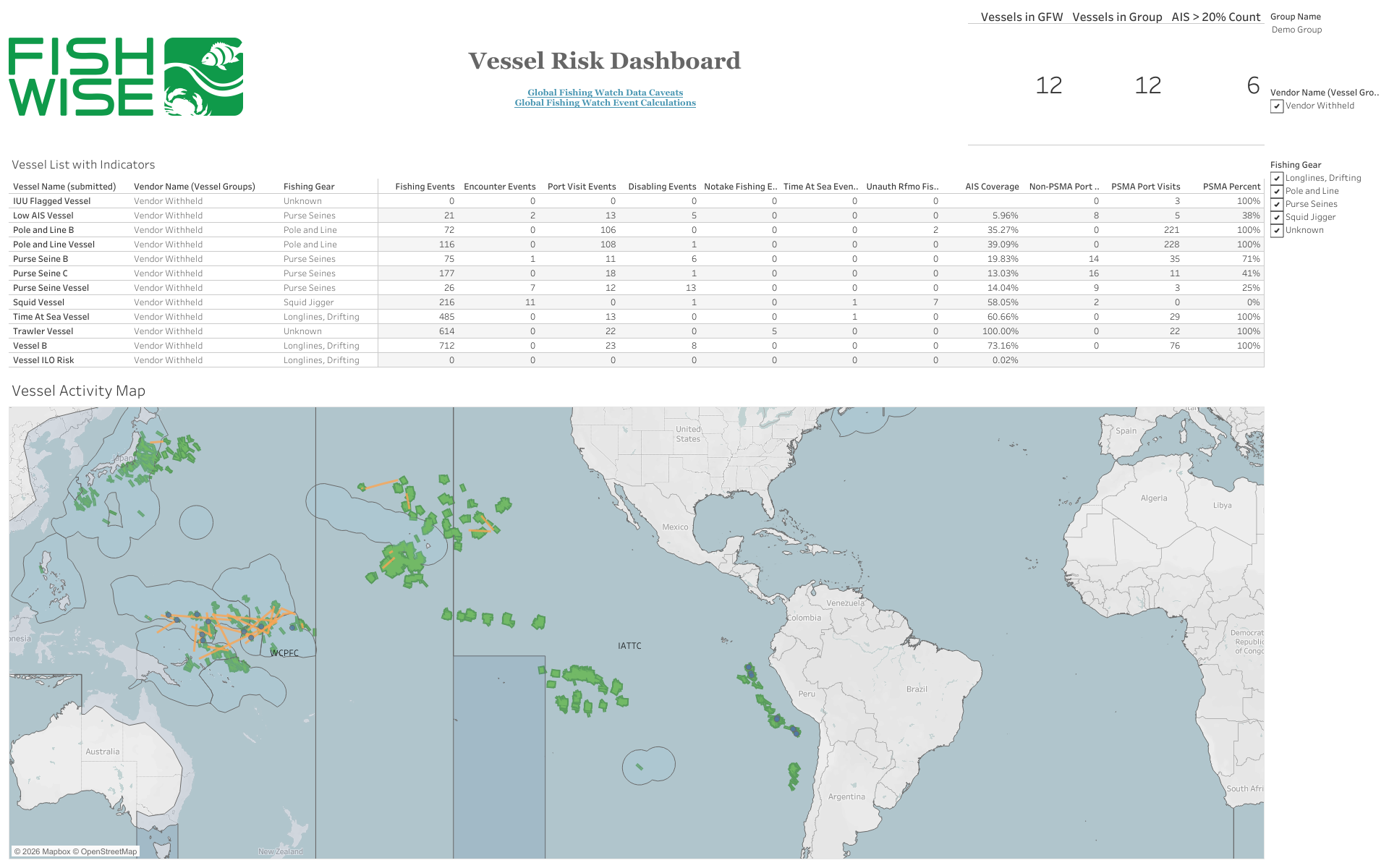
The why needs to be embedded within the company so that senior leaders understand why this data is a critical part of a company's due diligence. Even if the “why” is to run a one-off risk assessment, it's important to understand the activity or tool the company will use (e.g., GFW Vessel Viewer, FishWise’s Vessel Risk Dashboard, or an internal system) and any specific data requirements.
The how relates to the process and tools. How will a company ask for, collect, and securely store data? What tools will they use to assess for risk?
What refers to specific key data elements. It is important to leverage industry standards, such as GDST, to ensure you receive high-quality, usable data that is easy to share. Companies should also consider scope. Which products will you start with, and how will you scale up from there?
The data a company collects (what) and the process (how) should be informed by and enable a company to meet its why. Then, you are ready to start reaching out to suppliers to collect data and assess risks.
Step 2: Act. Don't just archive. Utilize risk assessment tools as part of a broader due diligence approach so the company has a process or framework to follow once it receives the assessment results. Don’t just look at a summary or outputs of vessel-level risk assessment and put it in a file. Use it, engage with your suppliers, and act strategically with it.
Kaplan: Implementing traceability and vessel-level due diligence means moving from static paperwork to digital event-based data at a product level and monitoring. For a seafood company, it starts at the vessel with verified identity and applies key data elements like IMO number, geospatial data, and VMS/AIS monitoring and crew records and then captures each event record at a lot or batch level as a digital event. The result is not more reporting but cleaner, more efficient data collection across the supply chain in a way that can be audited, shared, and trusted.
SeafoodSource: Is there a value to data collection beyond reporting out to external stakeholders?
Perry: For us, data collection is not about checking a box for external reporting. It’s about building real supply chain intelligence. We use it to verify vessels against IUU and sanctions lists, confirm ISSF registry status, pressure-test our supply chain maps, and validate MSC Chain of Custody.
That work gives us early visibility into risk before it becomes a customer issue, a compliance issue, or a reputational issue. It strengthens internal controls, supports better procurement decisions, and protects the trust our retail and foodservice partners place in us.
In today’s environment, transparency isn’t retrospective. It’s both strategic and operational. The companies that lead will be the ones using data every day to make smarter, more responsible decisions, not just to publish reports.
SeafoodSource: Can you give some examples of what companies can learn by conducting vessel-level due diligence in their supply chain?
Beritzhoff-Law:
Example 1 - A spectrum of risk indicators by vessel: From the highest risk, such as the presence of blacklisted vessels, to other risks, such as time at sea, utilizing FishWise’s Vessel Risk Dashboard (VRD) or GFW Vessel Viewer can help you rank vessels within a group by specific risk indicators. You can also triangulate multiple indicators, such as low AIS coverage, a high-risk flag state, and multiple beneficial owners to understand how that vessel may be operating. Ultimately, you can get a prioritized list of high-risk vessels within your supply chain and understand the specific characteristics or reasons why they are deemed high risk.
Example 2 - Transparency and strategic advocacy: A better understanding and characterization of vessels, including the ports they visit and whether they are on ISSF’s PVR or VOSI, can help companies better prioritize which types of advocacy or pre-competitive collaborations they should invest time in. Many of these risks can’t be effectively addressed by a single company, and understanding your supply chain not only helps identify risks but also clarifies where a company strategically needs collaborative support and what it should advocate for.
Example 3 - Supports iterative improvement: Through these exercises, you may find that you have a couple of suppliers doing an amazing job at collecting vessel information and managing vessel-level risk. Conversely, you may also find some companies aren’t able to collect this information at all, and you can identify opportunities to work with certain suppliers to make improvements.
SeafoodSource: Does this approach align with regulatory requirements, such as FSMA 204, and buyer procurement standards, or does it focus on a new set of issues?
Ceron: Yes, this approach is strongly aligned with existing regulations, particularly SIMP, by documenting harvest-level and chain-of-custody data that importers need to demonstrate legal harvest.
While FSMA 204 doesn’t require entry filing like NOAA’s import programs and doesn’t go back to the vessel level, there is still complementarity here. A similar traceability infrastructure, using critical tracking events and key data elements, supports quick record retrieval. FSMA, while it focuses on food safety, has motivated companies to invest in more robust traceability systems and to improve transparency in their supply chains beyond one-up, one-down systems.
For MMPA import bans, there is alignment as the eligibility of products to enter the U.S. hinges on supply chain data, especially a vessel’s flag, name, and number. This regulatory requirement for first-mile information makes it easier and, at times, mandatory for companies to compile and report on their vessel information.
Overall, this approach aligns closely with leading private-sector expectations around responsible sourcing, traceability to the point of harvest, supplier engagement, and risk mitigation. The VRD, for example, helps companies meet today’s regulatory requirements while also positioning them ahead of the curve on emerging due diligence expectations, especially around IUU fishing and human rights.
