



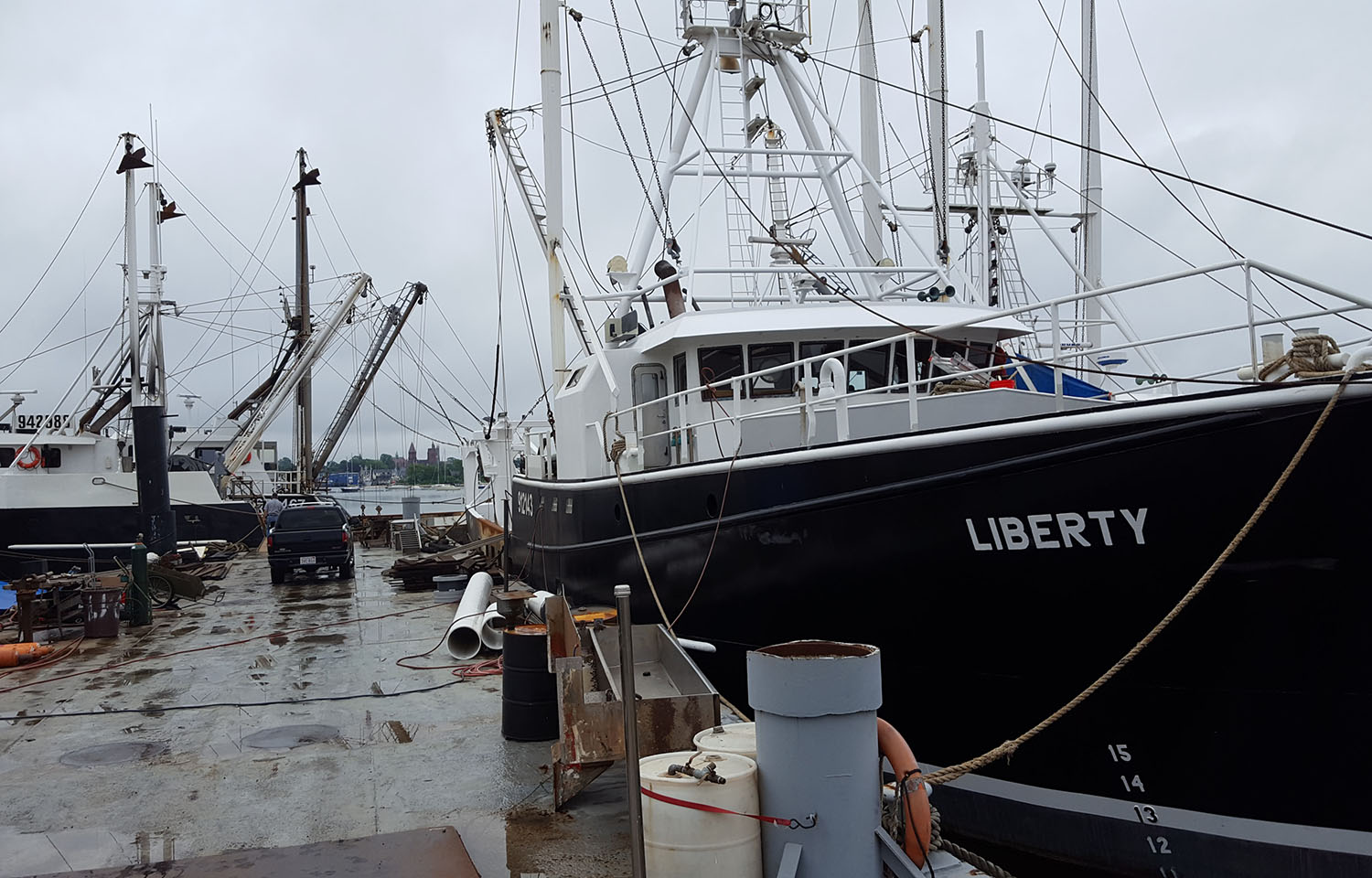
U.S. President Donald Trump recently sent a deregulatory wish list to the country’s regional fishery management councils, and the New England Fishery Management Council (NEFMC) now has to grapple with how to address his proposed changes to the scallop fishery.
In early July, White House Senior Counselor for Trade and Manufacturing Peter Navarro held a press conference touting the move by Trump and Secretary of Commerce Howard Lutnick as a means of “unlocking the fertile fisheries of America.” Included in that list of requests, the Trump administration is asking the NEFMC to open the Northern Edge of Georges Bank to rotational scallop fishing for the first time in 30 years and to implement permit stacking on commercial scallop fishing boats.
Navarro said the push is intended to “make American fishing great again.”
“America has the largest wild scallop fishery in the world. Atlantic scallops are a premium American protein, yet imports now supply roughly 85 percent of what Americans consume by weight,” Navarro said. “The insanity is clearest on Georges Bank. Canada lawfully harvests scallops on its side of the line, while American boats remain locked out of the adjacent U.S. northern edge by regulators.”
Fishing associations welcomed the announcement, and the Sustainable Scalloping Fund said the move will make the New England scallop fishery more competitive and sustainable.
Historically, the NEFMC has either opened or closed areas of the region’s scallop fishery based on survey and fishing data, separating them into either open-access areas where vessels are given a certain number of days at sea or areas where access is limited by weight. For instance, a vessel may get 30 days at sea in an open area and a separate allocation of two 12,000-pound access trips to another area.
The Northern Edge of Georges Bank, meanwhile, was closed for reasons unrelated to the scallop fishery. The region was closed to scallop fishing in 1994, ostensibly to protect important spawning grounds for cod.
Since that closure, the fishery has frequently pushed to regain access to the region, citing a lack of evidence the closure actually benefited the cod industry.
“There are no surveys showing there’s been more cod in there after it was closed than before it was closed,” Erik Orman, a consultant for major scallop company Northern Wind with years of experience in the industry, told SeafoodSource.
Orman said talk has centered around potentially opening the Northern Edge to become a limited access area, which is part of the rotational area program that limits boats to a certain number of pounds. He said if the Northern Edge becomes a limited-access area, it will help add quota to the fishery.
“Hypothetically, if it was 12,000 pounds per boat, it’ll be 5 million pounds added to the fishery,” he said. “Depending on the size of the scallops that are available in there, if they're bigger sizes, 10 to 15 count, it’ll definitely help that segment of the fishery.”
Northern Wind CEO Ken Melanson told SeafoodSource that the scallop fishery is currently on pace for a solid season. Northern Wind has focused on securing supply via a combination of imports and by consolidating the industry, and Melanson said the current catches appear to be on a positive trend.
“I think the supply right now is starting to catch up with the demand,” he said.
Melanson said most boats are catching 2,800 to 3,000 pounds per day for their open-access days, and over the roughly two months of fishing, that has maintained a consistent pace. He also said the industry expects to see higher catch in the 2027-2028 season, which will hopefully bring the fishery closer to the ideal quota.
“Our sweet spot, in my opinion, for a total quota is somewhere around 45 to 50 million pounds,” Melanson said. “That creates good prices for the fishermen, and it’s still reasonably priced for the consumer.”
He said too much quota results in problems for the industry, which popped up when the fishery hit a historically high harvest of over 60 million pounds.
“We were cannibalizing each other,” Melanson said. “It’s a small industry, and when there’s too much quota, there’s nowhere for it to go and we beat each other up over pricing.”
Orman said the increase in quota that opening the Northern Edge of Georges Bank would bring has been widely supported by the industry, but the second part of the Trump administration’s request may be trickier, as permit stacking on scallop boats has a mixed history in the fishery.
“We have a 5 percent ownership cap that exists within the industry, and we also have baseline issues like horsepower and length overall of the boats. It depends on how they approach it,” Orman said. “The devil’s going to be in the details. It’s a contentious issue in the industry.”
Orman said the issue has already been brought up multiple times at the NEFMC, and it has been defeated every time.
“I would say the opening of the Northern Edge is the more universally accepted proposal,” he said. “That was close to unanimously supported from the industry.”
Before any movement can be made on the Trump administration’s priorities, the council has to decide how to approach it. A spokesperson for the NEFMC told SeafoodSource it has largely kept discussions internal on how to address the requests.
“The council received a letter from NOAA Fisheries Assistant Administrator, Eugenio Pineiro-Soler, on 2 July, requesting that the Council consider several priorities in response to Executive Order 14276, Restoring American Seafood Competitiveness, during upcoming prioritization and action planning processes,” NEFMC told SeafoodSource in a prepared statement. “These included consideration of a “controlled, rotational limited-access scallop fishery within the Northern Edge Habitat Area of Particular Concern (HAPC) and consideration of a scallop permit stacking action. The Council will consider NOAA’s requests through their annual priority-setting process. At present, the Northern Edge HAPC remains closed to fishing, and there are no changes to permit regulations in the scallop fishery.”
