

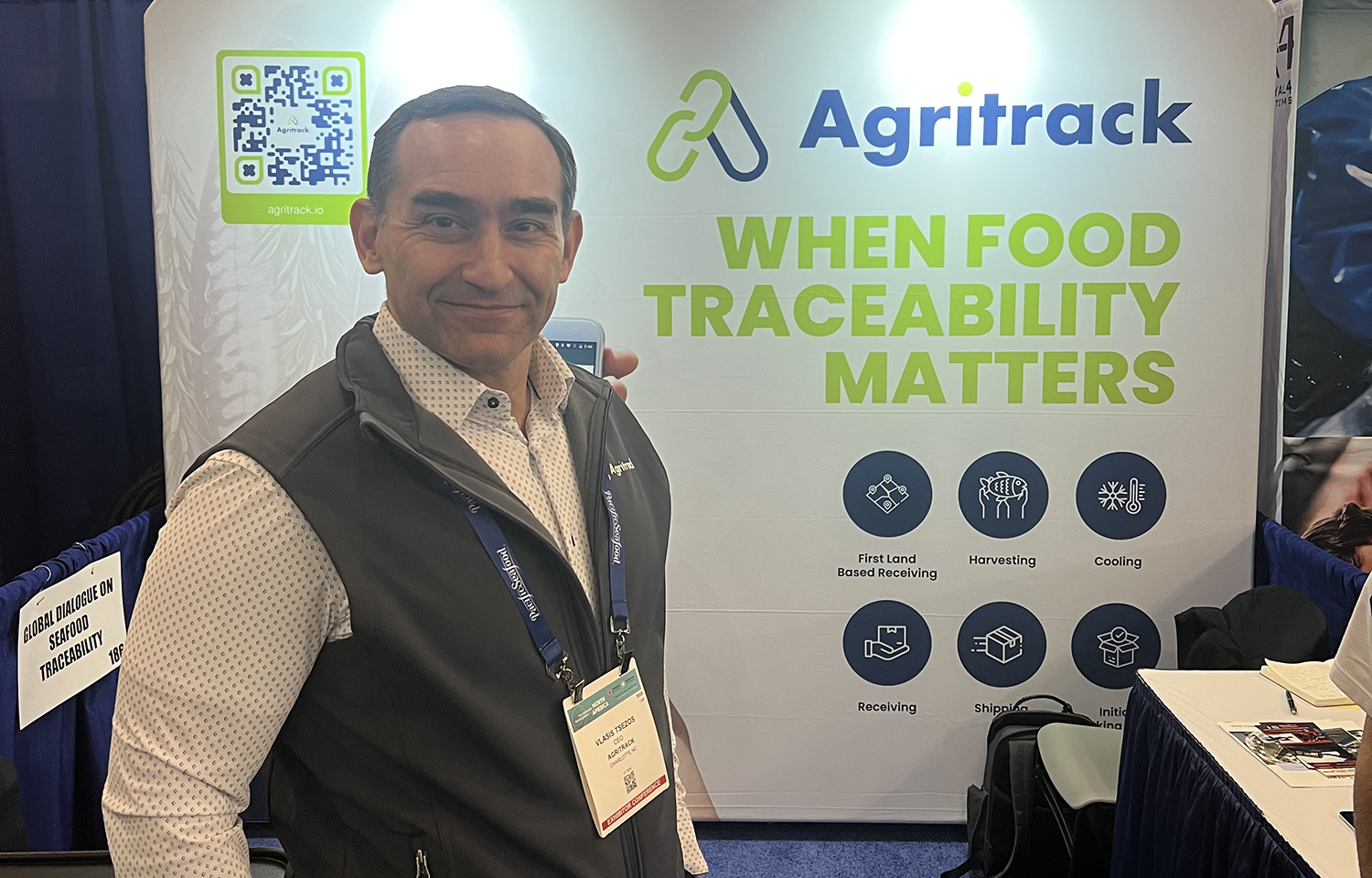
Vlasis Tsezos has held many roles in his 25-year career, including time spent as an electrical engineer, a lieutenant in the Greek Marine Corps, and an Internet of Things (IoT) and cloud data specialist.
But, it was his time spent as a management consultant, where he worked with food companies to optimize their value chains, that sparked the idea to co-found Athens, Greece-headquartered food traceability software firm Agritrack in 2021.
“It was apparent that there was a big gap in traceability and [ensuring] quality in the food industry. That was the trigger,” Tsezos told SeafoodSource at the 2025 Seafood Expo North America.
Agritrack is a customizable post-harvest software solution that integrates food science expertise with AI-enabled tools to assist stakeholders in monitoring quality, reducing perishable food losses and costs, and enhancing consumer trust in products.
In other words, it helps stakeholders up and down the food industry’s value chain, such as harvesters, processors, distributors, and retailers, track products from farm to fork.
“Customers can expect an easy-to-use software. We have spent a lot of time building an intuitive interface. We strive to make the process of transforming real-time information into data as easy and non-invasive as possible,” Tsezos said.
There are many traceability platforms available for global producers to choose from, but Tsezos said among several capabilities that sets his firm apart, Agritrack utilizes machine learning models that reference food science data, allowing the platform to, for example, use predictive microbiology to determine when a product is likely to expire.
“We are the only traceability provider that has the option to provide customers with additional business intelligence through food science,” Tsezos said. “We can predict certain characteristics within seafood products as part of our offering.”
The firm started its work locally, initially collaborating with Greek finfish farms, such as sea bream and sea bass farmers, but has since expanded to global clients both in the aquaculture and wild-caught sectors, including scallop and lobster producers. The firm also serves clients in the dairy industry.
It was also founded as markets around the world began tightening their food traceability regulations.
In the U.S. in particular, trade experts have warned that the nation’s seafood industry is not ready to comply with traceability requirements outlined in the Food Safety Modernization Act (FSMA).
Agritrack’s software automates FSMA and other regulatory reporting, and the demand has been high enough from U.S. clients worried about their traceability infrastructure that the firm recently opened an office in Charlotte, North Carolina, U.S.A., in addition to its Athens headquarters. Agritrack now has 12 employees combined between offices.
“[FSMA] has incentivized companies to go through the process, but regardless, the more you digitize your operations and get away from the pen and paper, the more visibility you have with your data and the better you can optimize your entire operation,” Tsezos said. “In every industry, there is resistance to change. It’s reasonable for stakeholders to be resistant across industries, so it’s important for them to understand why we are doing this and for us to incorporate each client’s idiosyncrasies into the solution – not only to address a request from the government but also to address and simplify the way they do business.”
The U.S. Food and Drug Administration (FDA) recently pushed back the FSMA compliance date by 30 months from its original deadline of 20 January 2026, but Tsezos said that this move should not signal to companies that they can wait around to bolster their traceability infrastructure.
“While the FDA’s recent announcement to delay FSMA 204 enforcement may seem like a reprieve, the urgency for traceability digitization remains high. Leading distributors and retailers are already requesting suppliers to meet traceability records – well ahead of the new deadline,” Agritrack said in response to the pushed deadline. “Proactive traceability digitization is not just about compliance; it’s about maintaining seamless partnerships with key buyers, staying competitive, reducing risks, and improving efficiency in an evolving seafood industry. Companies that delay may struggle to meet customer demands, miss out on market opportunities, or face operational disruptions down the line.”
Agritrack is Global Dialogue on Seafood Traceability (GDST)-compliant, was labeled as a Climate Innovator at the 2023 United Nations Climate Change Conference, and was also listed as a 2023 FoodTech 500 startup.
