


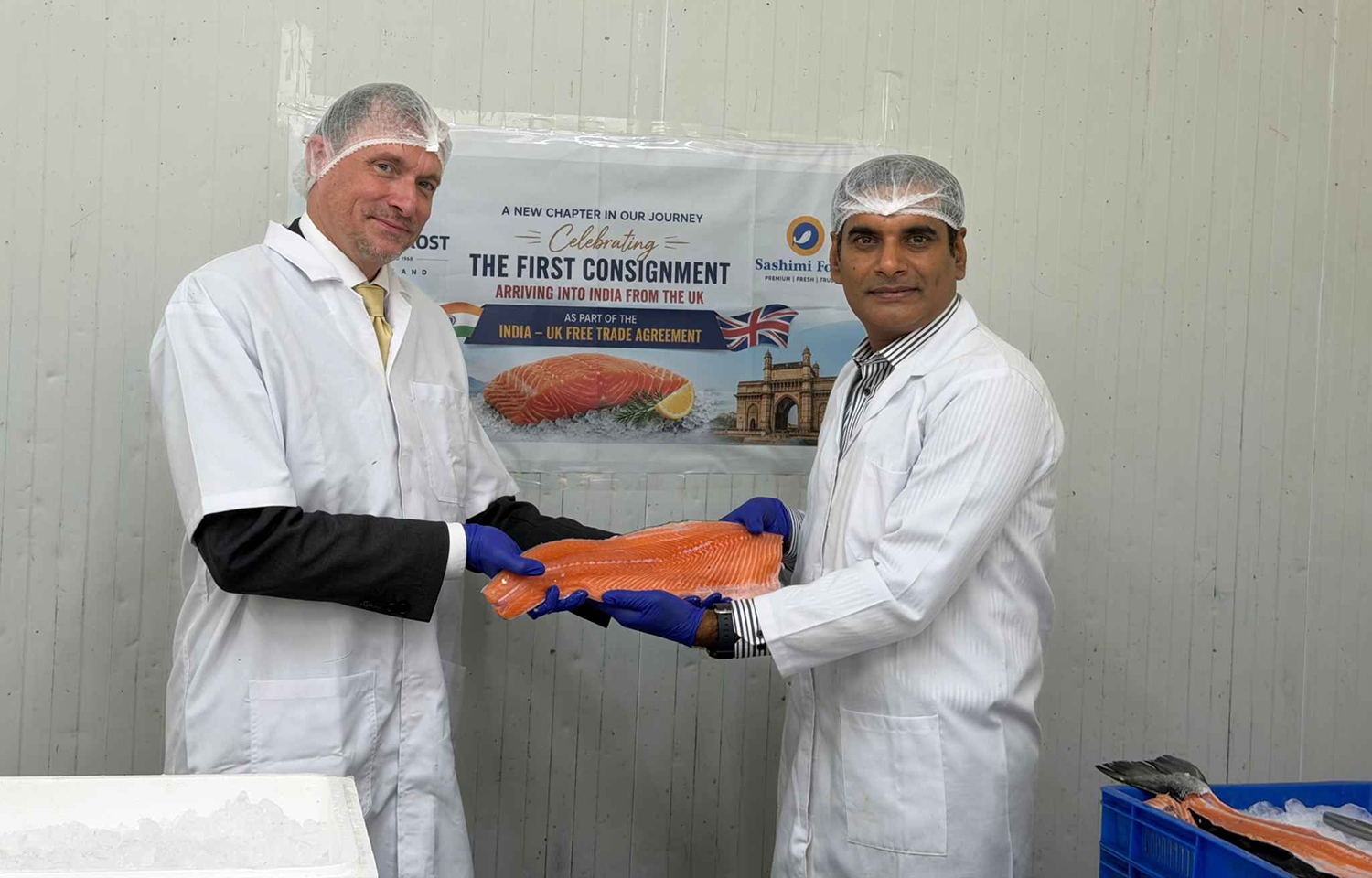
The first commercial shipment of salmon has arrived in India under the new U.K.-India free trade agreement (FTA).
The shipment, produced by Bakkafrost Scotland and delivered to Bengaluru, India-based seafood importer Sashimi Foods, arrived on 31 July – less than two weeks after the trade agreement came into force.
The FTA eliminated the 33 percent import tariff that previously applied to Scottish salmon entering India, and industry estimates suggest the removal of that tariff could generate as much as GBP 130 million (USD 174.9 million, EUR 151.8 million) in additional sales for Scottish salmon producers over the next decade.
"Scottish salmon is a globally renowned U.K. food export, and it has been a great privilege to witness its first duty-free shipment arriving into Bengaluru," British Deputy Trade Commissioner for South Asia Chandru Iyer said. "[The FTA] will increase the competitiveness of the Scottish salmon industry in India's market."
India ranks as the world's third-largest seafood market by volume, consuming almost 12 million metric tons (MT) of fish annually. Most products consumed domestically are locally produced, but imports have carved out opportunities in the premium retail and foodservice sectors in cities including Delhi, Mumbai, Bengaluru, and Chennai.
Bakkafrost Scotland Managing Director Ian Laister said the removal of tariffs fundamentally enhances such commercial opportunities.
"We're delighted to have been the first producer to ship Scottish salmon to India now the free trade deal is in place," he said. "The removal of the tariffs is a huge opportunity for us, and we look forward to continuing to grow our business there."
The shipment was imported by Sashimi Foods, which specializes in supplying premium seafood to India's expanding hospitality and retail sectors. Sashimi CEO Kedarnath Reddy said the agreement would allow the company to expand consumer access to imported Scottish salmon while strengthening long-term partnerships with U.K. suppliers.
"We are delighted to be among the first Indian companies to benefit from the U.K.-India free trade agreement," Reddy said. “We look forward to building a strong, long-term partnership with Bakkafrost Scotland and to making premium Scottish salmon more accessible to consumers across India.”
Salmon Scotland CEO Tavish Scott added that his organization has been working hard with the U.K. government and business partners in India “to make the most” of the agreement.
"India has phenomenal potential as a growing market for premium and sustainable Scottish salmon," Scott said. "With the first shipment having arrived in India, this is the start of a close relationship that could unlock tens of millions of pounds in exports each year, supporting well-paid jobs, investment, and growth here at home."
For Scotland's salmon industry, the agreement offers a timely boost, especially as trade disruptions arise elsewhere, including recently implemented Section 301 U.S. tariffs of 10 percent now applied to a range of U.K. exports such as salmon.
While the U.S. remains one of Scottish salmon's largest overseas markets, the ever-changing tariff landscape was listed as a key driver behind the deal when it was negotiated last year.
Total trade between India and the U.K. was worth GBP 48 billion (USD 64.6 billion, EUR 56.1 billion) in 2025. According to U.K. government estimates, in the long run, the deal is expected to boost bilateral trade by GBP 25.5 billion (USD 34.3 billion, EUR 29.8 billion), Indian GDP by GBP 5.1 billion (USD 6.9 billion, EUR 6 billion), and U.K. GDP by GBP 4.8 billion (USD 6.5 billion, EUR 5.6 billion) every year it is in place.
Scottish salmon is the U.K.’s top food export, generating more than GBP 828 million (USD 1.1 billion, EUR 967 million) in international sales during 2025.
