






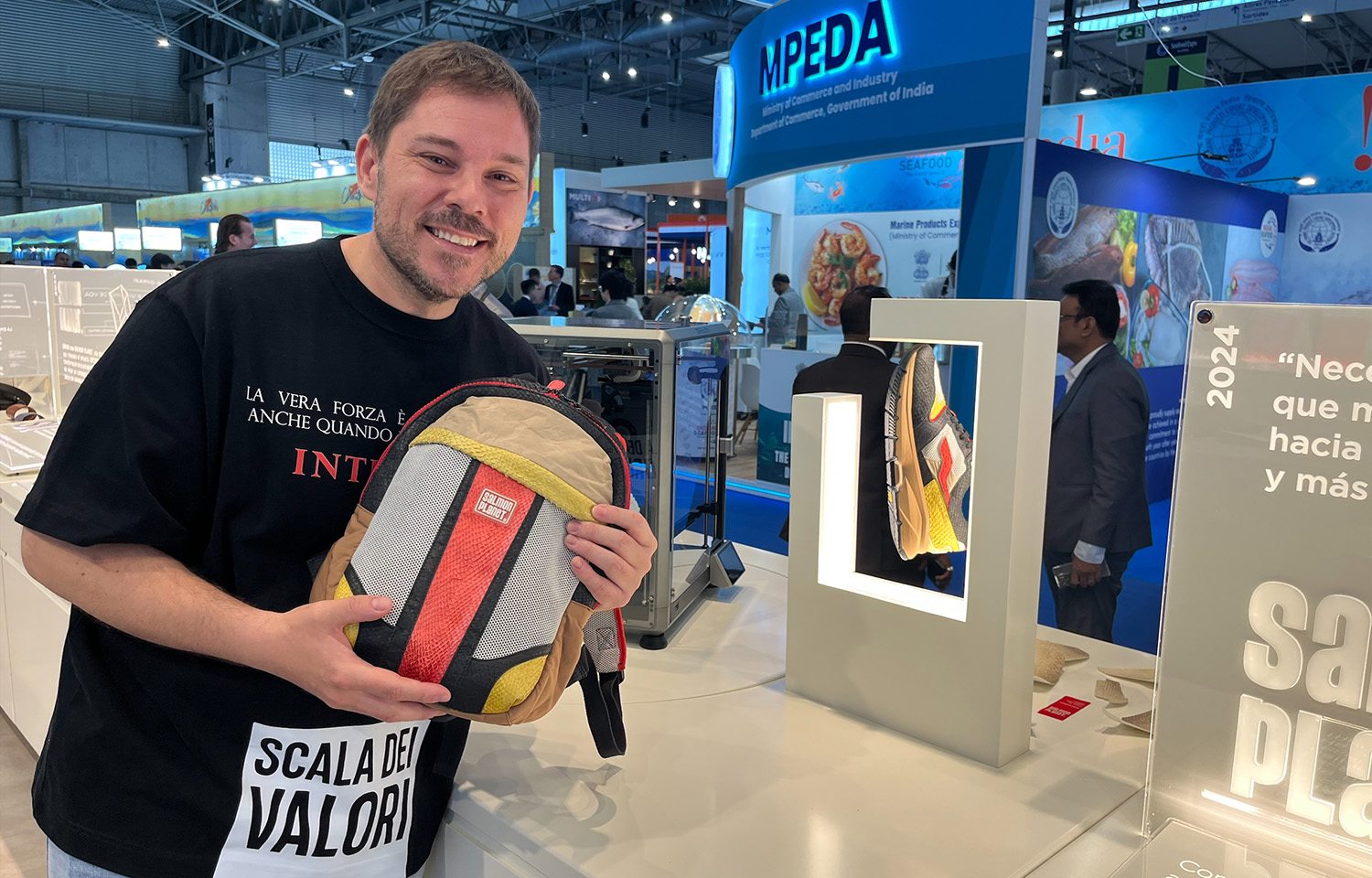
Alicante, Valencia, Spain-based Gimar, and sister brand Salmon Planet, are aiming for total circularity in their value chain, a move driven by both their sustainable ethics and their desire to stand out from the crowd.
“Being in Alicante, Spain, we had trouble grabbing the public’s eye and differentiating from other companies,” said Salmon Planet owner Carlos Jiménez through a translator. “We’re not talking about numbers, but we’re talking about romanticism. [Our] vision, [our] future projects.”
This desire to differentiate inspired Jiménez to start an innovative salmon skin upcycling project, which is in its prototype phase in partnership with local recycled shoe brand Sneep. At Seafood Expo Global, held 6 to 8 May in Barcelona, Spain, the company displayed a range of shoes, handbags, belts, and other fashion items made of salmon leather.
Alicante, Jiménez said, is known for its leather, so the expansion also makes sense from a community perspective. In a local market saturated by fine leather goods, marine leather has a chance to not only offer a sustainable alternative, reducing waste through the the utilization of a byproduct, but also elevate the name recognition of the Salmon Planet brand.
Though he was happy with the prototypes on display, Jiménez said that soon he would be redesigning the marine leather creation process himself.
“Having a great salmon skin [leather], it’s a real challenge to create,” said Jiménez. “This know how, [it] must be [mine].”
This isn’t the first time Jiménez’s passion for disruption has inspired him to rebuild the systems on which his family business is founded. He grew up working at his father’s side at Gimar, learning to perfect his salmon cutting and curing skills.
Carlos’ father Aurelio started the company with a small traditional Spanish rotisserie in 1974. He began working with Norwegian salmon in the 1980s, and established the Gimar Maestro Ahumador brand in 1989. That brand has evolved to become today’s Gimar, known for its sleekly packaged salmon, tuna, and swordfish in smoked, sushi-grade, or partially cooked offerings.
In 2020, Carlos developed his own brand in the Gimar family, Salmon Planet. He told SeafoodSource that he wanted to redesign the traditional salmon cuts for the European market he knew best. Wanting to give his customers the opportunities to make traditional dishes, like the carpaccio which Gimar had long been known for, that required sushi-grade salmon at home, he developed an additional trim he called trim G, moving beyond the standardized traditional salmon trims of A-E.
Salmon is usually cut through five trims, starting with the backbone and bellybone removal, and then moving to the more delicate challenging cuts. Almost all commercial cut salmon will be trimmed through levels A and B; many will then be trimmed through levels C, D, and E, which involve removing pin bones, fin tissue, and finally skin from the fish.
Jiménez believed that this standardized process wasn’t enough. He sought more depuration of his salmon loins, by “completely eliminat[ing] the veins and blood points that appear between the upper loins and the ventrals, obtaining perfectly clean and purged salmon loins," according to Salmon Planet.
Jiménez built his own cutting machine to achieve this process, using Gimar to standardize four curing levels, each with different textures and firmness, to appeal to customer preferences.
To make his product accessible to those who weren’t already conversant in salmon cuts, he created six consumption formats he believed would speak to European consumers: fishteaks, fishburgers, fishbangers, fishballs, fishbits, and fishloin.
Customers who wanted to prepare dinner themselves could purchase a whole fishloins in various thicknesses, which could be cooked or served raw, depending on the level of curing.
Jiménez told SeafoodSource that his work at Salmon Planet had leveraged his parents’ mastery of the business and work ethic to create a new approach to a well-known product. Now, he wants to do the same with marine leather, the commercialization of which could significantly reduce waste in the salmon industry.
“I work by concepts,” Jiménez said. “The product is the result, but the message, the purpose, the intention is the important thing. Salmon Planet’s [marine leather] is an upcycling project.”
“The Gimar formula is based in knowledge, experience, and life values, transmitted by the family, developing a genuine know-how, with our own vision and critical thinking. [In] all of this formula, the family is key,” Jiménez said.
