






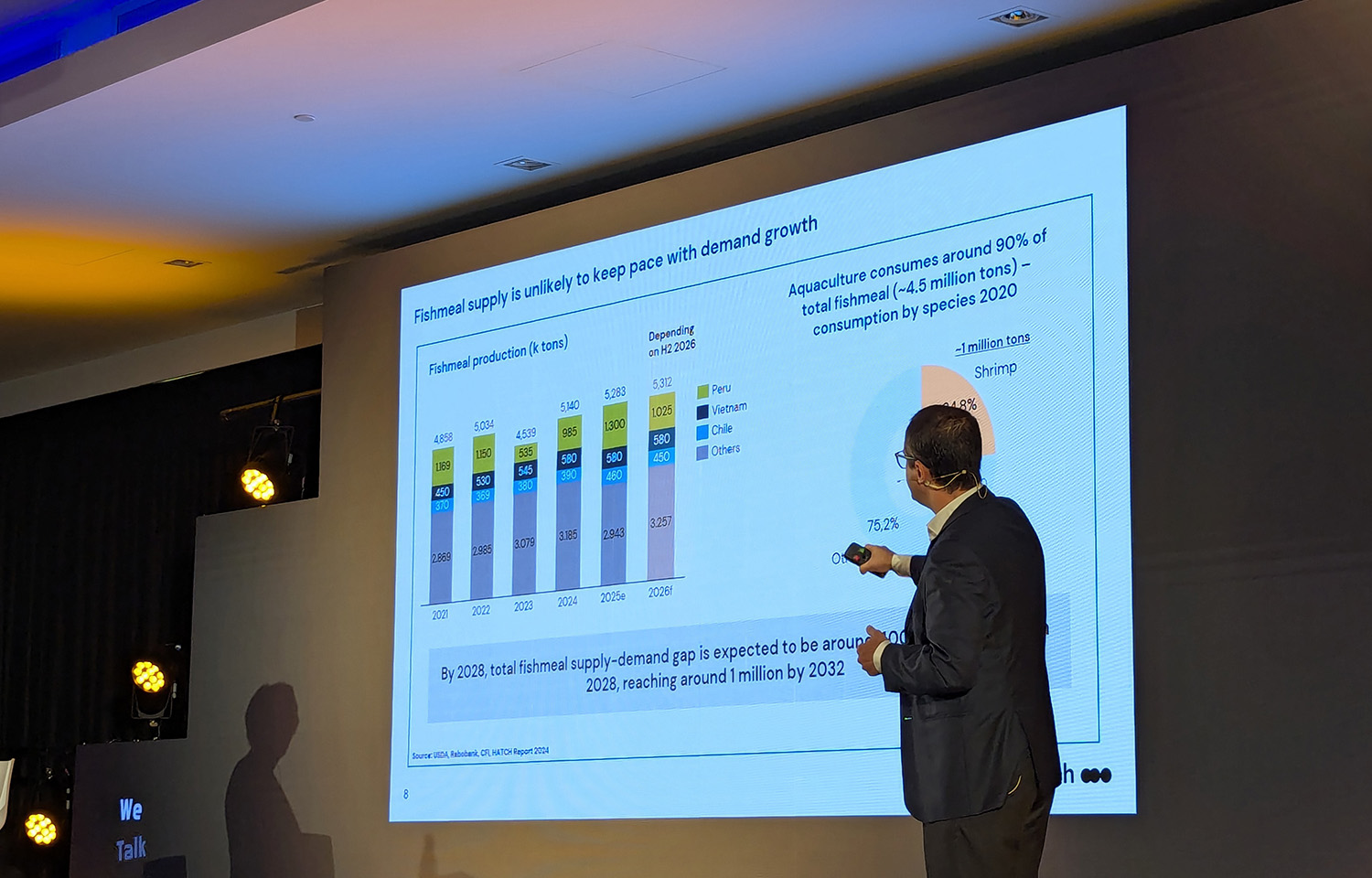
The demand on marine ingredients for fishmeal and fish oil is continuing to grow, and signs already point to a looming tonnage gap that has few solutions available for the shrimp aquaculture industry.
Dsm-firmenich Head of Business Intelligence Adolfo Fontes, speaking during the Global Shrimp forum in Utrecht, the Netherlands, estimated that by 2028, there will be a gap of 400,000 metric tons (MT) between demand on marine ingredients and the supply available to feed producers. In 2026, that gap will start being felt as sources like the Peruvian anchovy fishery are impacted by the strong El Nino.
“This is very important topic for our industry right now,” Fontes said.
The last strong El Nino that the marine ingredient industry faced was in 2023, and the resulting impacts caused a drop in available supply of marine ingredients. During that year, impacts on the anchovy fishery in Peru – which cancelled its season – contributed to a drop in fishmeal production of 23 percent compared to historical levels.
“When we talk about 2026, and this is still very conservative because we still have the second half of the year to see what is going to happen, but [...] if we go to the official projections, we have a decline of around 20 percent,” Fontes said.
Scientific projections also expect El Nino to stick around until early 2027, meaning those impacts will continue, and the reduction in marine ingredients will come too.
Those reductions in available supply are coming as the demand continues to grow. According to Fontes, over the last several years, the annual increase in marine ingredients production has been steadily lagging behind the increase in overall aquafeed production.
“From 2000 to 2025 we had an increase of around 230 percent in production for aquafeed. Over the exact same time, we had an increase in production of 40 percent for marine ingredients in aquafeed, which means the inclusion of marine ingredients in aquafeed declined from around 25 percent to around 10 percent,” Fontes said. “This is the reality that we are facing now.”
The shift is clear in the makeup of shrimp aquaculture feed. Over time, the inclusion of marine protein plus fish oils has reduced to around 10 percent of the volume of feed in shrimp aquaculture.
Throughout that same period, the amount of shrimp production globally has steadily increased, closing in on an estimated 6 million MT of production in 2026. That increase has inevitably required an increase in the amount of feed those shrimp need.
By Fontes’ estimates, the current trajectory amounts to a 400,000 MT supply gap by 2028, and that gap will only grow going forward.
Those gaps are already having an impact on price. Current fishmeal and fish oil prices are far above the norm, and are even above where they were in 2023 despite there technically being more supply on the market.
“We can see the price is well above what happened in the last El Nino,” Fontes said. “This is not only about El Nino.”
That difference in three years is thanks to the big increase in demand on marine ingredients globally, he said.
The problem facing the shrimp aquaculture industry – and other aquaculture industries that rely on marine ingredients in feed – is there isn’t an obvious solution to filling that gap. Single-cell proteins, which could grow in supply, produced roughly 40,000 MT of product in 2025.
“You need to think about the potential, considering the forecast from the current companies would be around 150,000 to 200,000 MT, and then we can expect 35 percent of that goes to aquaculture, which would be about 50,000 MT,” Fontes said.
Insect meal is another proposed solution, and the latest available statistics from 2024 put production at 15,000 MT. However, the potential of that industry is still largely unknown, with some group saying it could scale quickly to 250,000 MT.
“In the meantime, we have seen some players actually leaving the activities and bringing some additional questions on the potential capability that can be realized in the near future,” Fontes said.
Algal oil, a third solution, produced 20,000 MT in 2025, and is estimated to produce around 36,000 MT in 2030.
With all three potential solutions combined, the gap in demand and supply is still there and will only worsen over time, Fontes said.
In the short term, that means the prices for fishmeal and fish oil will be very volatile, with price risks for companies that need them.
Fontes said the shrimp industry needs to examine how it can manage that supply gap, either through finding new sources of ingredients, or through accelerating innovation to reduce its usage of marine ingredients in feed.
“We truly believe that this is not a short-term issue; this is a signal that the industry needs to accelerate toward a more sustainable and efficient feed formulation,” Fontes said. “This is a strong signal that we need to accelerate those changes.”
