





For the first 43 instances of Seafood Expo North America (SENA), the show contained two overarching categories of seafood: wild-caught and farmed.
At the 44th edition – which took place from 15 to 17 March in Boston, Massachusetts, U.S.A. – it added a third category for the first time.
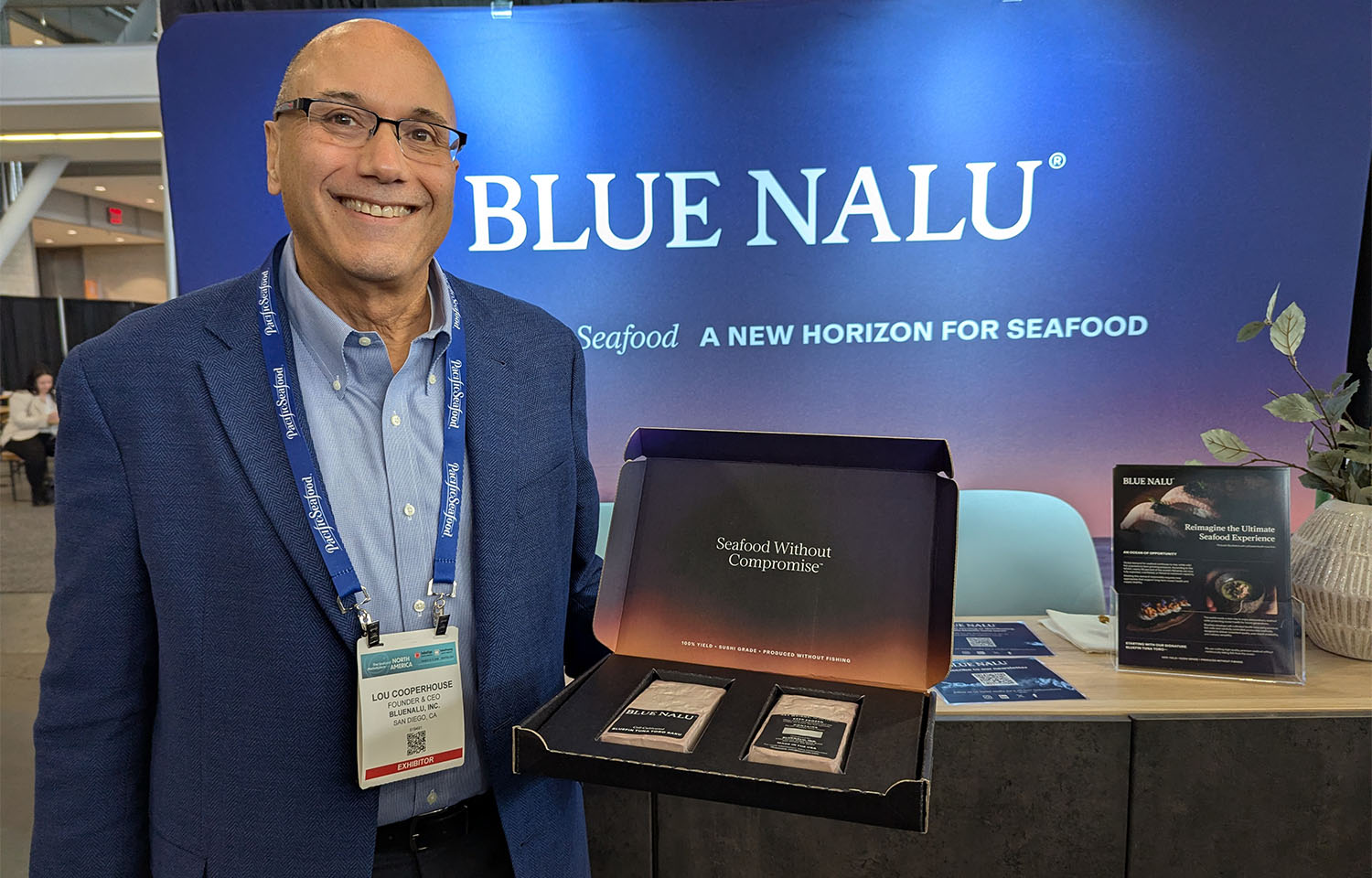
“It’s the third category of seafood – wild, farmed or ranched, and cell-cultivated seafood,” BlueNalu CEO Lou Cooperhouse told SeafoodSource during the event.
BlueNalu, a cell-cultivated seafood company, attended as an exhibitor at the event to show off its plans for its bluefin tuna products. Those products are still awaiting U.S. Food and Drug Administration (FDA) regulatory approval, but Cooperhouse said the company is expecting clearance in the next several weeks.
“It’s quite imminent,” he said.
The FDA has already shown willingness to approve cell-cultivated products.
It made its first approval in 2022, issuing a “No Questions” letter for cell-cultivated meat, poultry, and seafood produced by Berkeley, California-based Upside Foods. In June 2025, it approved Wildtype’s cell-cultivated salmon product, similarly finding it had no questions on whether the food product was safe for human consumption.
Cooperhouse said the company expects a similar finding within several weeks, which will allow it to begin selling its products.
To start, BlueNalu is going to focus on restaurants in San Diego, California.
“We’ve already identified three initial restaurants,” Cooperhouse said. “Those restaurants represent an interesting mix of fine-dining and premium sushi establishments within San Diego.”
He said he can’t share the names of the restaurants that the products will launch in but said bringing the product to menus will allow both those restaurants and BlueNalu to begin dialing in how the company communicates its product.
BlueNalu was founded in 2017 and has grown from a small startup to a multi-million-dollar venture attracting investments and partnerships with major companies. The cell-cultivated process it has been working on grows cells from isolated pieces of fish tissue. In BlueNalu’s case, that has included tissue from bluefin tuna.
Using technology and equipment that at a glance resembles something more likely to be found in a brewery, BlueNalu grows the products from isolated fish tissue, creating a piece of fish that was never a part of an actual living tuna. It also means the company can, with the proper research, grow tissue from any part of the bluefin tuna, and in BlueNalu’s case, it is targeting the most valuable toro portion of the fish that is prized in restaurants.
Cooperhouse said the early days of BlueNalu were all about refining the technology, as no one had propagated fish cells before at a scale necessary for a commercial venture, which meant it had to find the key to unlock scalability.
“Scalable means no genetic engineering, no things that other people use like scaffolds or microcarriers which are an intermediate process, which we found is not appropriate to this technology,” Cooperhouse said. “We’ve taken the really hard route to understand how to unlock scalability, and we’ve done that.”
Cooperhouse said he can’t share details of how it did so but said the company has created a process that will allow it to produce bluefin toro at scale and at a cost that is viable for restaurants.
Cooperhouse said at this year's SENA, it found that there are a fair number of people familiar with the product and the process in the seafood industry and that there was a lot of excitement about the company’s presence at the show.
“We couldn’t be prouder to be here at SENA to announce that we exist,” he said.
There was also excitement in foodservice over what a BlueNalu product could mean for fine dining. Cooperhouse said many restaurants, when looking to source high-quality bluefin, need to source a headed and gutted fish that hasn’t been processed yet. That means the restaurant needs a skilled – and, therefore, highly paid – member of the staff who can process it.
BlueNalu’s future product will be available in a pre-portioned “saku” block that can be immediately used in a range of different applications like poke, ceviche, seared and cooked items, and more.
“We’ve actually trialed our product in all of these different serving applications, and it’s really performed excellent,” Cooperhouse said. “We’ve had continual tastings among local chefs and others who are influential in this whole community, and we’ve had extremely positive responses.”
The product will also be available year-round, with complete consistency in quality and size.
“We’ve even trademarked ‘toro you can trust,’” Cooperhouse said.
He said the reason BlueNalu decided to attend SENA was to get a headstart on its plans to expand rapidly as soon as it gets FDA approval so that it can aim toward widespread distribution in the U.S.
“We’re about to launch, but we’re also about to expand,” Cooperhouse said. “We are all about getting to volume as quickly as possible; from point of launch to widespread distribution, we are trying to minimize that timetable.”
