






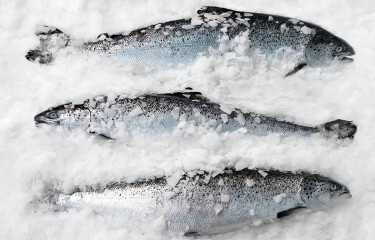
Farmed salmon has been trending downward in terms of its production by volume since 2021, with the total worldwide harvest falling to just over 2.86 million metric tons (MT) whole fish equivalent (WFE) in 2022, and then further still to 2.81 million MT last year as the main producing countries were hit by various biological challenges, according to Filip Szczesny, a senior financial analyst at Norwegian aquaculture and seafood data firm Kontali.
In Kontali’s latest webinar on the farmed salmon industry, Szczesny said that the salmon-farming sector enters 2024 battling some serious headwinds.
“I think it’s going to be challenging, but I am also really excited,” he said.
Specifically, challenges the industry faced last year will bleed into this year, Szczesny said.
Those obstacles in 2023, alongside the biological issues, included important regulatory changes in Norway, composed mainly of the new aquaculture resource rent tax that was approved by Norwegian Parliament on 31 May 2023, and which placed a 25 percent tax on the sea cage grow-out phase of the production cycle. This particularly affected the industry last year by limiting supply, Szczesny said, adding that the supply drop, which the industry experienced through the end of 2023, will also be evident at the start of this year.
Kontali also found that the introduction of the resource tax led companies to change their structures, mainly limiting value creation in the at-sea growth phase of salmon farming. Some businesses started to make changes to adapt in 2022 and continued to do so throughout 2023.
Amid the adjustments and restructuring, which have been largely based on companies’ own assumptions of how the tax might affect their operations, there are still a lot of unknowns surrounding the deferred tax and its scope, and accurately calculating the associated tax burdens and potential deductions will take time. More conversations and decisions on the tax will take place this year, Szczesny said. Despite the added tax, major salmon companies continued to report record profits in 2023.
As for other factors that will affect salmon farming in 2024, there will be a new auction of salmon-farming capacity in Norway, preceded by adjustments made to the industry’s traffic light system, with the hope for more green lights that would allow the sector to expand production in certain areas.
Szczesny highlighted the last time such an auction took place was in 2022. This followed hot on the heels of the original resource tax announcement.
“What we saw was no large or stock-listed companies participating in that auction, and the prices of those licenses dropped – roughly 30 percent across the production areas – which really said a lot about the investment appetite [at that time],” he said. “When things settled a little bit and the tax was passed, the remainder of the unsold capacity was auctioned off again [in 2023], and that gap closed to around 16 percent across the production areas. I believe for [2024], the gap could disappear or really close in … there’s not enough supply, and this is one way to grow.”
When viewing the sector region by region, rather than on a global scale, Szczesny said there are opportunities in 2024 that could bolster the industry. One example is some sub-regions may avoid suffering from biological challenges and can, therefore, profit from such circumstances.
“One thing I expect in 2024 is to see more differences in the earnings,” he said. “If you have large fish, you can earn a premium because there are fewer big fish in the market.”
Though the predictions going into 2024 are inauspicious, Szczesny noted that Kontali issued a largely optimistic forecast for 2023 – one that did not fully come to fruition – providing some hope that the bleak outlook could be proven wrong as the year rolls along.
“At that time, the underlying assumption that we had was quite correct, but that changed quite drastically in the second half of ’23,” he said. “Looking forward to ’24, I think the key word is uncertainty.”
Photo courtesy of Matveev Aleksandr/Shutterstock
