






Governmental antagonism toward salmon farmers in Chile has reached such a point that the sector may soon be forced out of a significant aquaculture region in the country’s south, according to Arturo Clement, the president of industry association SalmonChile.
Chile’s national forest service, Conaf, announced earlier this year it is looking to draw up management plans for national reserves where salmon farming occurs, with some of these plans including phase-outs of important concessions over the next handful of years, Clement told local newspaper El Mercurio.
“We learned about the draft, to which we were never invited to the discussion, and if that document were applied, salmon farming in [the region of] Magallanes would disappear, as simple as that. They propose that none of the concession contracts wrapping up their first phase be renewed. So, if these concessions are not renewed within a period of six to seven years, salmon farming disappears in Magallanes,” he said.
The salmon-farming industry in Magallanes is responsible for over 15 percent of all the salmon produced in Chile and nearly 5 percent of employment in the region, according to data from SalmonChile.
Over the last decade, Chile’s salmon-farming industry has grown at about a 1 percent revenue rate per year, according to Clement; however, due to the current scenario, “it is very likely that this year we will have a decrease for the first time in a long time because everything is being complicated with the permits and obstacles that are limiting us,” he said.
Clement, among other sector players, said he believes while the Chilean government is preparing changes to the country’s controversial national fisheries law, which comes with the promise of an accompanying aquaculture law, the government should collaborate with the industry to develop a short-term agenda that clears up regulatory and permitting problems creating operational complexities and increasing costs.
The executive branch has committed to presenting the aquaculture bill during the first half of 2025, but in the meantime, aquaculture executives have proposed working with the government on such issues as concessions and environmental controls.
“We have proposed this short-term agenda to the undersecretary of fisheries, which we are interested in moving forward with because we have too many administrative obstacles and issues with permits that we need to improve,” Clement said. “Without the need to have a new law, we can perfectly solve many of the problems we have and generate more competitiveness and economic growth. Discussion of the aquaculture law is important, but much more important is to start the discussion of this short-term agenda now. We have to do both things in parallel.”
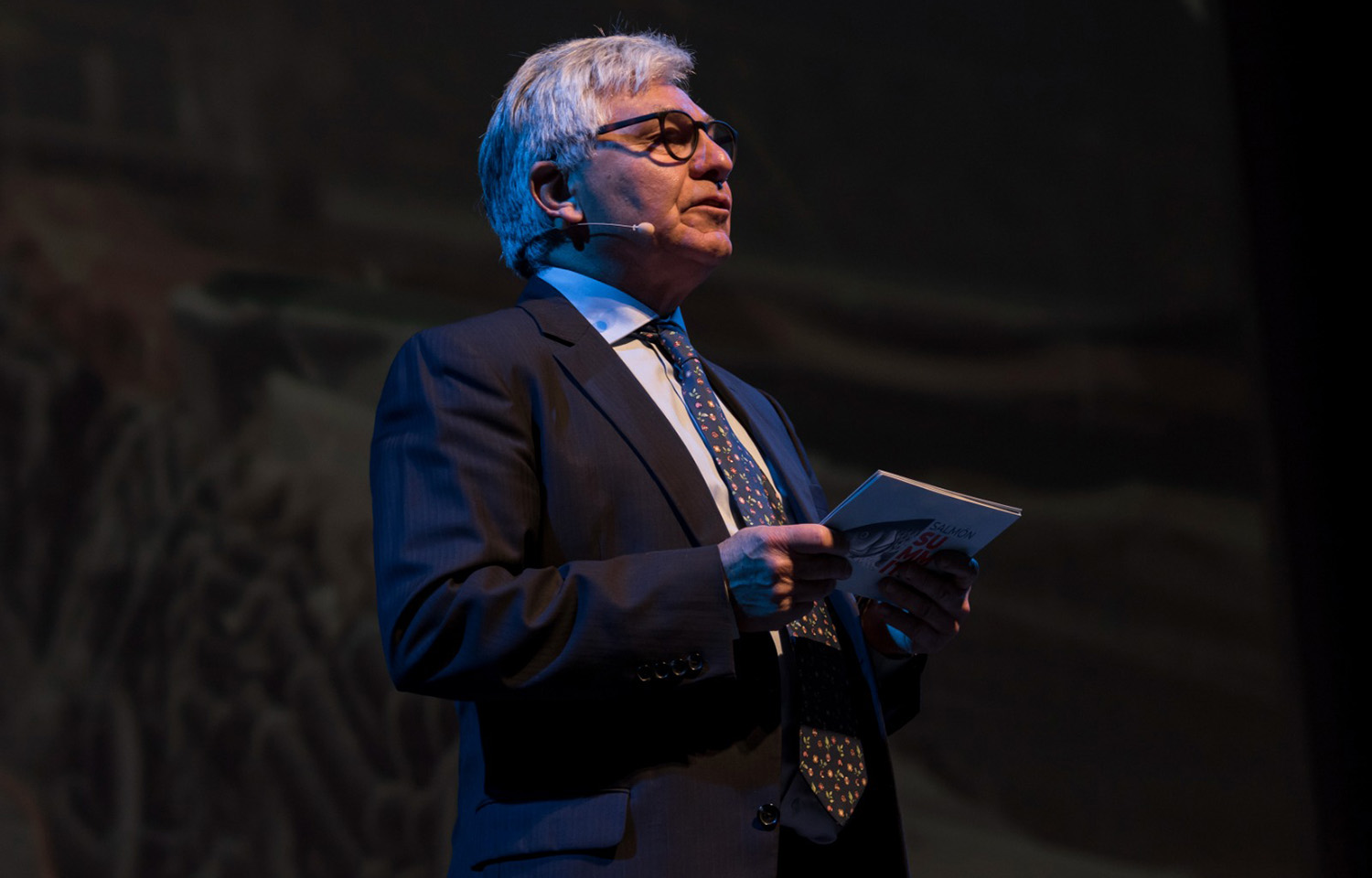
The SalmonChile executive further voiced his concern for these issues during the Salmon Summit 2024 which took place on Wednesday, 10 July, in Frutillar, Chile.
During the event, sponsored by SalmonChile, Clement was critical of the “neglect” the industry is experiencing in the country.
“There is a lack of understanding of the value of our industry; there is neglect of the people in the south, and we are being drowned by our competition. We are committed to our country; we want to continue to be leaders in the development of the south and our aquaculture,” he said. “We don’t want to be made to disappear or to reduce our activity; we want to be listened to, have dialogue, and contribute to the growth of Chile. “[However], there are many negative signs and a lack of trust to understand and know what we do. We need certainties to move forward.”
In a keynote address at the summit, former Chilean President Eduardo Frei said that the salmon industry has been “the engine of growth in southern Chile” for the last 30 years, a feat achieved “without receiving even a subsidy from the state … without a cent,” he said.
“Are we going to stop it; are we going to complicate it?” he asked. “The industry needs to double in the next 30 years. It is trained to do it. It has people to do it. It has the investments to do it. We cannot accept that this be destroyed with a bad aquaculture law.”
Other presenters at the event were not as bullish on the future of aquaculture in Chile.
Oceana Chile Executive Director Liesbeth van der Meer addressed attendees with a presentation entitled “Visions from the Other Side.”
She discussed the use of antibiotics in salmon farming, in addition to escapes, overproduction, and transparency.
“We have a different but, I think, not opposed vision,” she said, highlighting the meeting as a space to raise different points of view in a respectful manner.
Chile President Gabriel Boric has also been critical of the salmon-farming industry, pushing to reform the sector, which has faced increased regulatory pressure after a series of scandals that included the underreporting of environmental damage and salmon mortalities.
Salmones Aysén recently cited this governmental pressure as the main reason why it closed one of its processing plants in the southern city of Puerto Montt.
“Our greatest concern is the institutional or regulatory uncertainty, where we frequently encounter surprises,” Salmones Camanchaca Vice Chairman Ricardo García said.
