






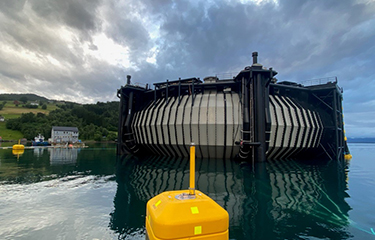
Bluegreen Group, the company that recently launched its first “Marine Donut” enclosed aquaculture system concept, is making progress on bringing the system to Canada.
The company established a subsidiary in Canada in 2022, and selected Mark Lane – the former executive director of the Newfoundland Aquaculture Industry Association – to head up the company’s operations in Canada and the U.S. Now, as the company launches its first full-size Marine Donut in Norway, it has also submitted an environmental registration to begin construction and utilization of the concept in Newfoundland and Labrador, Canada.
The Marine Donut concept creates a massive thermoplastic enclosure – the largest structure of its type in the world – that weighs 600 metric tons. The enclosed structure is meant to minimize salmon escapes; the risks of disease, algae, and sea lice; and reduce the use of antibiotics and other medicines.
The torus-shaped closed unit uses a flow system that can be adjusted to exercise fish, and it can be raised and lowered in the water when needed.
Lane told SeafoodSource that the company submitted its environmental documentation on 19 July, and now the Newfoundland Department of Environment and Climate Change has seven days to post the full document publicly.
The documentation, Lane said, is the result of consultations with salmon farmers, government officials, and those who typically oppose aquaculture projects.
“I sent them my environmental registration on three separate occasions to ask them; is this something that people want? Is this something that people support?” Lane said. “When you’re making the largest thermoplastic structure on earth and using it to farm salmon, there’s naturally a lot of questions.”
The document, Lane said, is asking for permission to construct a Marine Donut in the province of Newfoundland and Labrador. It outlines the potential impacts constructing the project could have, and how the company expects the structure to be used.
“Through all our consultations we’ve had from coast to coast, we’ve implemented all the answers that we had in the document,” he said. “I’ve heard no opposition to it.”
Lane said the documentation is some of the most extensive ever submitted in the province. Newfoundland and Labrador has a three-phase process for submitting environmental requests. A full environmental impact statement (EIS) is not needed for the first phase unless called for by the minister, who can make one of four decisions after receiving an environmental registration: “Release” the project to proceed as indicated in the registration, order an Environmental Preview Report, order an EIS, or reject the project outright.
Lane said the company decided to skip ahead in the process to avoid any delays.
“I feel confident that this is the most competent environmental registration that’s ever been submitted, because we wrote it to the standards of the EIS,” Lane said. “We just said, 'Let’s give all the information that we have, let’s provide it to everybody up front.’”
The Marine Donut, he said, is not intended to be a complete replacement of net-pens.
“Bluegreen and I are full supporters of traditional sea cages. The Marine Donut, what it does, it provides farmers with an additional level of technology in some areas that are exceptionally challenging," Lane said. "Whether the challenges are biological, environmental, or political, that’s for them [farmers] to decide. We’re not here to replace net pens, we’re here to provide experienced farmers in Canada with a new technology that they can use at their disposal to address some of the issues.”
So far, two companies have been interested in testing the concept on the east coast of Canada, Lane said, though the company has also been making inquiries in British Columbia, Canada, and one salmon farmer in B.C. has been interested.
With sea trials underway in Norway, Lane said he’s confident the company will see even more interest after full-scale commercial farming proves possible.
“Once the proof is in the pudding, then you’ll even have more interest,” he said.
Photo courtesy of Bluegreen Canada
