

China is pushing a major expansion of its mariculture sector as a valuable technology export opportunity and a fix for domestic food security issues.
The municipal government of Yantai in the key aquaculture region of Shandong recently announced it will build “50 demonstration zones for deepwater mariculture” over the next five years. Sun Chenglie, a researcher at the Yantai Ocean Development and Fishery Bureau, recently said at a government press conference the 50 zones are a recommendation of the “2022 Blue Book on the Construction of the Marine Ranch in Yantai Sea Area,” which aims to make Yantai a “world-class” city for mariculture production and technology.
China’s government is coming to see economic opportunity in mastering new technology for the expanding global market for offshore aquaculture, in much the way it has taken a dominant position in the markets for railway technology, electric cars, wind turbines, and solar panels.
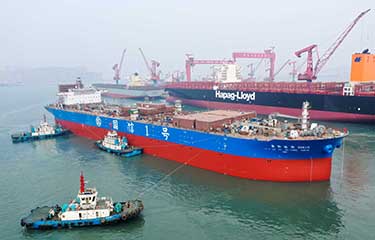
Several prominent mariculture facilities developed by China, including the Genghai 1 platform and the Guoxin 1 vessel, have recently been featured in documentaries on state television, a medium frequently used to highlight Chinese government priorities. Developed by Qingdao-based Guoxin Development Group, the Guoxin 1 “smart-aquaculture” vessel was the focus of a feature on the popular finance program CCTV 2 finance show Jing Ji Feng Yun, with company executives saying the 100,000-ton vessel is the first of five the firm expects to launch in the next five years, allowing Guoxin to rapidly expand its production of premium species including yellow croaker, grouper, and salmon.
Executives from Guoxin told a camera crew aboard the vessel, which recirculates sea water, the firm is targeting CNY 300 million (USD 45 million, EUR 40.5 million) worth of production in 2023.
Aside from the Guoxin 1 and the Lu Lan Yu 61699, China also has three deep-water mariculture platforms in operation – the Hai Xia 1, the Geng Hai 1, and the Sheng Hai 1, as well as the Shen Lan 1, a deep-water cage.
China’s plunge into offshore aquaculture was given major backing in 2022 after Chinese Vice Premier Liu He emphasized deep-water mariculture could help guarantee China’s food security. Heightened geopolitical tension has accelerated the urgency of the issue of food security in China, as it has been the predominant topic of coverage by agricultural policy papers over the past year.
Large state-owned entities, which dominate the country’s shipbuilding and construction industries, appear poised to be the major movers in China’s mariculture sector. Deep-water aquaculture accounted for just 1.37 percent of the country’s total mariculture output in 2022 and only 0.56 percent of its total aquaculture output, according to a report prepared by Lin Ming, an engineer at the China Communications Construction Group, which has sought to expand its business in building deep-water platforms for mariculture projects.
In a recent paper, ”Development of Large-Scale Deep-Sea Aquaculture: Problems, Models and Realization Paths,” Lin pointed to “saturation” in near-shore aquaculture and attendant pollution as a driver of government support for deep-water, offshore mariculture. China’s freshwater aquaculture peaked in 2015 in terms of farming area and will not grow in volume output, according to Lin.
“In recent years, the requirements for the ecological protection of inland rivers and lakes and the prohibition of fishing in watersheds have become more and more stringent,” Lin wrote.
Despite nationalistic calls to improve China’s global status through offshore mariculture development, most companies are first and foremost seeking economic returns. Off the shore of Yantai city, the Genghai platform farms rockfish (Sebastes dalii), red sea bream (Pangrus major), grouper, and yellow croaker.
Speaking on the China Central Television (CCTV) science and innovation show Chuang Xin Jin Xing Shi, Weng Xing You, the project’s chief engineer, said the facility is built to withstand typhoons and can produce 150 tons of fish per year in each of its three grow-out pens.
Zheng Fengtian, head of the Agricultural Research Academy at Renmin University, speaking on the CCTV 2 finance show Jing Ji Feng Yun, trumpeted the speed of China’s development in deep-water aquaculture in the past five years, comparing the country’s offshore aquaculture sector favorably to those in Norway, Japan, and North America. Deep-water offshore mariculture will ensure “high efficiency, good quality, and high prices” for producers, he said, adding that the offshore facilities, some with nets up to 25 meters deep, are “six times more efficient” than the older, near-shore mariculture installations.
Appearing on the same program, economist Liu Ge said by promoting offshore mariculture, China stands to gain a “whole value-chain industry,” including engineering and facilities expertise, drugs, seedlings, and aquafeed. He compared the “industrialization” of the Chinese mariculture sector to China’s dairy industry, which has been expanded and standardized as a government priority.
“This technology is exportable,” Liu said.
Promoters of the technology have emphasized its environmental credentials. Weng, who designed the Geng Hai 1, described the giant platform as a more environmentally friendly alternative to cheaper nearshore facilities strung together with wood and plastic.
However, the lack of debate in China on the potential environmental challenges of a rapid mariculture expansion offshore is in contrast to the skepticism in other quarters about the environmental credentials of mariculture. A paper published in 2020 Marine Communications and Nature stated that USD 1 billion (EUR 909 million) in planned investments in offshore finfish projects for Chinese waters were swayed towards the production of “luxury species” like Japanese sea bass, salmon, and large yellow croaker rather than towards meeting food security needs.
“Projects such as these, if eventually realized, would do little to contribute to global food and nutrition security, ameliorate malnutrition, or support nutritionally vulnerable people,” it said.
Photo courtesy of Guoxin Development Group
