






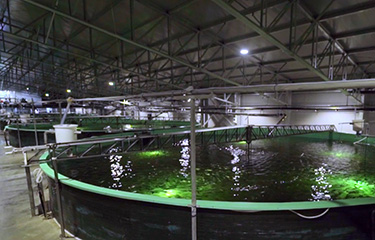
Los Ángeles, Chile-based salmon farmer Salmones Austral has opened a cutting-edge recirculating aquaculture system (RAS) at its Los Arrayanes farming center.
The facility, situated in the Reloncavi estuary in the municipality of Cochamó in southern Chile’s Los Lagos region, cost an estimated USD 35 million (EUR 32.5 million) to build. Salmones Austral said it has a number of innnovations that will change the way it farms salmon, including a 1,250-cubic-meter salinity ponds designed to grow post-smolt to a larger size, shortening their grow-out stage at sea by two months.
“This will allow us to cut down on the time spent at sea, with the benefit of the fish not being exposed to weather inclemency that, unfortunately, climate change is causing these days,” Salmones Austral CEO Gaston Cortez said during the launch. “This center is vital for us to respond to the challenges of the future.”
The process results in more-robust fish, allowing for a reduction in the use of antibiotics and in the fish’s exposure to health risks at sea such as salmon rickettsial septicaemia (SRS), and to environmental risks such as harmful algal blooms, the company said.
The new system recirculates 99.5 percent of the water it uses, allowing the company to spend less money and energy pumping new fresh water, Salmones Austral Chair Pedro Hurtado said. He calling the new system “a technological leap."
“This center puts us in the pole position in the industry,” he said during the event launch. “With this center, we won’t increase production, but we will change the way we are producing.”
Los Arrayanes has a maritime farming concession equipped with a fish-transport duct, berth, and loading platform, allowing the fish to be dispatched from the center to the sea pens by wellboats, reducing handling and lowering the stress levels of the fish. With post-smolt no longer transported by truck, the company's carbon emissions have been reduced, Hurtado said.
In its first stage, Los Arrayanes includes three farming units: winter, summer, and post-smolt, where freshwater from biosecure wells and seawater are combined to raise 30-gram fingerlings into 300- to 500-gram smolts. The company said it adjusts the salinity of the farm's water to optimize it for each state of fish growth.
The water used in the RAS goes through five stages of treatment. First, it is mechanically filtered to remove solids, then it goes through a biological bacteria filter that eliminates nitrogenous compounds that can be harmful to fish, before finally passing through a degasser to remove harmful gases. The water is then disinfected with ultraviolet filters and injected with oxygen at the end of the process. Besides driving a significant reduction in the use of water in production – only 0.5 liters of water are used for each 100 liters used in a traditional fish farm – the RAS also allows for a total control of abiotic parameters, together with minimum controlled-environmental emissions.
“This project forms the fundamental elements of our value chain and our way of producing food in a sustainable, friendly, and respectful way of the environment and community, contributing to the development of the area and the region,” the company said.
Photo courtesy of Salmones Austral
