



Puerto Montt, Chile-based Ventisqueros was recently reported to be for sale, with several parties expressing interest in buying the company.
Ventisqueros has its own Atlantic and coho salmon operations in Southern Chile, employs approximately 1,400 people, and has annual salmonproduction of roughly 45,000 metric tons (MT). As reported by La Tercera, Dutch bank Rabobank led first-round talks with interested bidders that included an unnamed investment fund, unnamed Chinese investors, fellow salmon farmers in Chile, and São Paulo, Brazil-based JBS, the world's largest meat processor, which in 2021 entered the salmon industry with the USD 315 million (EUR 296 million) purchase of Huon Aquaculture, Australia’s second-largest salmon producer.
JBS reportedly came in as the highest bidder for Ventisqueros, and while the amount of the proposed transaction was not reported, market observers estimated the price tag for Ventisqueros was in excess of USD 300 million (EUR 282 million).
However, Ventisqueros then stated that its owner, Munich, Germany-based Schörghuber Group, stopped the sale process.
“As a savvy shareholder, the Schörghuber Group proactively tested the waters to determine whether Ventisqueros' excellent economic performance would meet the group's expectations regarding the company's value," it said in a statement. "Last year, however, the world economy was plunged into one of its biggest crises to-date, and despite considerable market interest, the sale process indicated that these macroeconomic changes have had a massive negative impact on financial markets and, therefore, in the global climate of mergers and acquisitions operations. Therefore, [we have] decided to stay the course and focus on building on the current positive momentum in the salmon farming industry.”
Schörghuber tends to fly under the radar in Chile’s seafood industry compared to other companies. The company was founded in 1954 by the civil engineer Josef Schörghuber as a property-development company. Since then, it has expanded its focus and is now a conglomerate still owned by the Schörghuber family, operating in the real estate (under the holding Bayerische Hausbau), hotel (Arabella Hospitality), seafood (Ventisqueros), and beverage (Paulaner Brewery Group) sectors.
The group has been doing business in Chile for nearly half a century, primarily through what was its majority stake in the Compañía Cervecerías Unidas (CCU) beverage conglomerate. In Chile, CCU is one of the main players in each of the categories in which it participates, including beer, soft drinks, mineral and bottled waters, nectars, wine, and pisco. The conglomerate also has operations in Argentina, Bolivia, Colombia, Paraguay, and Uruguay.
The Schörghuber Group owned its stake in CCU in conjunction with Chile’s wealthiest family, the Luksic group, whose matriarch, Iris Fontbona, is estimated by Forbes to have a net worth of USD 22.8 billion (EUR 21.4 billion) and is considered Latin America’s richest woman. In 2003, Schörghuber sold its stake in CCU to Heineken.
The real estate division of the Schörghuber Group, Bayerische Hausbau, is also recognized for owning two emblematic buildings in Santiago, the Torre Las Condes and Torre las Verbenas.
The seafood business division of the company has its origin in the Schörghuber family's private business ventures in Chile, including Ventisqueros, which was founded in 1989. The Schörghuber family acquired a 51 percent share in the company in 2001, and in 2010, it became the sole owner. Today, the company is one of Chile's top 10 salmon producers.
The group’s seafood asset, while representing “a completely different business direction,” responds to a higher calling to which Schörghuber’s four business divisions each aspire: to improve the standard of living of its customers, according to information on the group’s website.
“With Ventisqueros, the Schörghuber Corporate Group seeks some answers to one of the most-glaring questions of mankind. How can the population of the world be provided with sustainable, affordable food? One way to tackle this problem could be sustainable fish farming,” it said.
According to Ventisqueros CEO José Luis Vial, the decision to stop the sale process is consistent with the Schörghuber Group’s general business approach.
"Since the Schörghuber family took control of the company more than 20 years ago, they have maintained a responsible and pragmatic management style. They evaluate each strategic option in the same way as each of their investments, most of which are decades old," he said.
Over the past decade, Ventisqueros has increased production volume from 20,000 metric tons (MT) to more than 47,000 MT, with the objective of reaching a harvest volume of 55,000 MT in the near future. According to a release from the company, investments of more than USD 100 million (EUR 94 million) in maritime infrastructure, biomass growth, and personnel hiring will help the company reach its production goals. The company also highlighted its pioneering use of artificial intelligence-based remote feeding.
At the end of 2020, Ventisqueros signed a loan with the banks Rabobank and DNB for up to USD 120 million (EUR 113 million) to allow it to increase production to 60,000 MT of salmon per year.
Ventisqueros represents about one-quarter of the Schörghuber Group’s total sales, according to the company's 2021 annual report. In 2021, it brought in EUR 155 million (USD 165 million) against total group sales of EUR 607 million (USD 646 million). The group highlighted Ventisqueros’ positive year-over-year performance, posting 2021 earnings before interest and taxes (EBIT) of EUR 7.2 million (USD 7.7 million) on the back of a 2020 EBIT loss of EUR 6 million (USD 6.4 million), “achieved through an efficient reorganization and helped by the increase in market prices for both salar and coho salmon by more than a dollar per kilogram.” That positive increase in earnings was also despite diminished harvests owing to an algal bloom affecting its farms in Comau Fjord, it said.
Whether or not Ventisqueros is sold, interest in Chile’s salmon market remains high and consolidation will always be a consideration, according to JBS CEO Gilberto Tomazoni.
“Our goal is to become at least one of the world's three largest salmon producers,” he said at the closing of the Huon purchase, pointing to opportunities in Norway, Chile, Canada, and Scotland.
There has been movement in the market in the past few years. In May 2022, the global food and agriculture giant Cargill bought a 24.5 percent stake in Chilean salmon company Multiexport, valuing the company at more than USD 1 billion (EUR 940 million).
Also, in 2019, the Chinese firm Joyvio – a private equity investor which controls the tech giant Lenovo - completed the 100 percent purchase of Chile’s Australis Seafoods for USD 922 million (EUR 867 million).
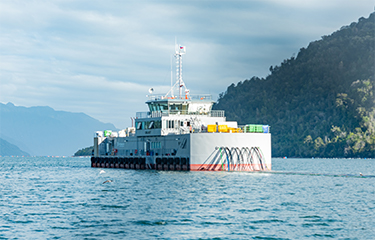
Photo courtesy of Ventisqueros
