


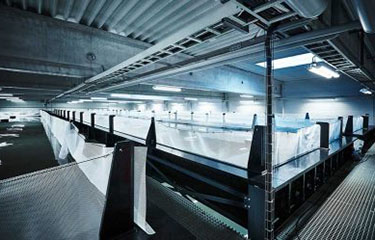
CORRECTION: An earlier version of this article incorrectly stated that Oceanloop uses a biofloc system. The company has developed a custom clearwater system that it plans to use in its large-scale farm under development.
Munich, Germany-based Oceanloop is seeking nothing less than a full-scale remaking of the global shrimp industry.
The company, forged through the combination of Strande, Germany-based land-based shrimp-farming firm Förde Garnelen; Osterberg, Germany-based aquaculture technology company Neomar; and Munich-based recirculating aquaculture system (RAS) technology and shrimp distribution firm Crusta Nova; has the goal of revolutionizing shrimp farming with state-of-the-art recirculating aquaculture technology, according to co-CEO Bert Wecker.
“Oceanloop allows [for] the production of high-quality, antibiotic-free, and sustainable saltwater shrimp farming,” he said.
Wecker, who has been involved in the research and development of RAS for two decades, spent the past eight years perfecting a new clearwater system for shrimp through Neomar and former employer, Sander Holdings. The technology sets new standards in land-based aquaculture, he said.
“This development heralded a significant breakthrough in enabling the scalability of our technology today,” he said.
Previously used for water treatment systems for aquariums, Sander’s development of next-generation protein skimmers and ozone generators, which are highly effective in purifying water, were breakthroughs that brought RAS to the attention of the aquaculture industry, he said.
Unlike most large-scale shrimp farms that rely on biofloc, Oceanloop's clearwater system uses external biofiltration to remove nitrifying bacteria and filters to remove solids.
Plans for the farm include implementing an “urban mangrove” system, in which stacking rack systems developed by Wecker and his team recreate the natural habitat of shrimp within the tanks.
Wecker is confident that the system offers a significant reduction in resource use and negative environmental impact compared to conventional farms, stating that the global warming potential (GWP) of 1 MT of shrimp farmed in an Oceanloop system is as much as 77 percent less than in open-pond farms. It also requires up to 49 percent less land, up to 96 percent less water, and uses 100 percent sustainable energy sources such as solar and wind power.
To prove its feasibility, the Oceanloop model has undergone successful trials using fresh seawater at Förde Garnelen’s land-based farm in Kiel, Germany, which currently produces around 5 MT of shrimp per year, and at the company’s Munich farm, which uses artificial seawater and produces 20 MT per year. Oceanloop technology has also been effective at scale with sea bass, sea bream, and kingfish, Wecker said. Those farms rely on imported, certified, disease-free shrimp larvae (PLs), Oceanloop’s planned expansion includes the construction of a dedicated hatchery that will give the company total control of its means of production.
For Wecker, creating a superior RAS system is not just a matter of ensuring the water quality and the environment is right but also about paying attention to the genetics of the shrimp and breeding animals best suited to the conditions, reducing the mortality rate in the long term.
Oceanloop is also working with a German feed manufacturer to develop a bespoke shrimp feed to help it optimize shrimp growth and reduce production time.
“We sell small quantities of our feed to other shrimp farmers in Europe, but we developed it mostly for our own use. We know exactly what goes into it and where the individual ingredients come from, and our customers appreciate the supply chain transparency,” he said.
Wecker said Oceanloop eventually plans to sell its shrimp across the world, with a a future market potential of around 80,000 metric tons per year in Europe, 40,000 MT in the U.S., 5,000 MT in the U.A.E., and 30,000 MT in Japan, Wecker said.
Oceanloop’s retail sales are now handled by a spinoff firm called Honest Catch. The company is developing an e-commerce platform, which will include business-to-consumer capabilities, and has plans to grow its marketing, media activities, and “digitization of system landscapes,” according to Oceanloop and Honest Catch Co-Founder Fabian Riedel, who also serves as the CEO of Honest Catch.
"Oceanloop is the continuation of our vision of realizing sustainable land-based shrimp farming in all import dependent countries of the world. After years of building up, with Oceanloop we are proud to have developed a technology ‘Made in Germany’ that will revolutionize the shrimp industry. In times of urgent global transformation towards a more climate-neutral food production, Oceanloop is an important contribution,” Riedel said. “Honest Catch, as the exclusive distributor of Oceanloop, will further develop the Seafood category with new impulses. Especially in e-commerce, seafood is a highly interesting growth market, which we want to strategically expand in the coming years. Changing consumer habits such as online grocery as well as healthy, protein-rich diets are trends in the food market that are successfully served by Honest Catch."
Wecker said the potential is enormous, since the world’s shrimp industry is currently fragmented, dominated by pond-farming conglomerates in South America and Southeast Asia. Citing figures from Spheric Research, Wecker said that of the USD 1 billion (EUR 910 million) or more invested in land-based aquaculture projects in 2022, just 16 percent of that figure related to shrimp farming, compared to 50 percent centered on salmon. And presently, the majority of the 50,000 MT of shrimp consumed in Germany is comprised of frozen imports from farms in Asia and Latin America.
“The market for shrimp was worth USD 34 billion [EUR 31 billion] in 2021, which is significantly more than salmon at USD 15 billion [13.6 billion]. Shrimp is also a higher-value species with a greater convenience level and grows to market weight in just three months, compared to 12 months to two years for salmon, depending on market size,” he said.
“I believe that we have the best competencies in technology, plant operations, and commercialization and are on the verge of making sustainable and profitable land-based shrimp farming a reality,” Wecker said.
Photo courtesy of Oceanloop
