


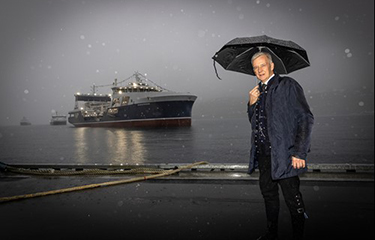
Glyvrar, Faroe Islands-based Bakkafrost Group recorded a strong Q3 2023 in its fishmeal, fish oil, and feed segment, but low fish growth rates at its Faroese farming sites and micro-jellyfish blooms causing high mortality on its Scottish farms have resulted in the company delaying some planned harvests in both regions until Q1 2024.
Delivering Bakkafrost’s Q3 2023 results, CEO Regin Jacobsen explained the aim of the delays is to optimize average fish size and increase price premiums, comparing the strategy to the approach it chose to take within its Scottish segment last year. In addition, since mid-September, biological conditions have significantly improved in Scotland and the Faroe Islands, Jacobsen said.
Jacobsen largely attributed the disappointing growth rates in the Faroes to fish coming from one specific batch of smolt that was subjected to poor water quality in their hatchery in August 2021.
Jacobsen said the smolt had not “lived up to expectations” and that the impact on Q3 growth demonstrated the importance of having consistent high-quality smolt. He said maintaining consistent smolt quality and size is one of the main priorities moving forward as the group increases its smolt production through expansions at its Norðtoftir, Glyvradal, and Viðareiði hatcheries in the Faroes, as well as Applecross in Scotland.
Earlier this month, it also signed a contract for the construction of a large new hatchery in Skálavík in the Faroe Islands. This facility is expected to be completed in late 2026 and will provide 7 million smolt weighing 500 grams on average, thereby increasing the company’s total Faroese capacity to 24 million 500-gram smolt.
Furthermore, having released its first trial batch of large smolt from the Applecross hatchery earlier this year, it is now ramping up Scottish production of large smolt. The Applecross hatchery will deliver close to all the smolt used in the country next year, and an early trial with an initial transfer of 500-gram smolt will take place in Q1 2024.
“From next year, almost all our smolt will be sourced from our own hatcheries,” Jacobsen said. “All smolt stocks are now being vaccinated with the latest anti-viral targeted to marine risk vaccines and timed to reduce the second-summer risk seen this year. We are getting closer to our strategy to produce healthier, larger, robust [smolt] for just one summer in the sea.”
A strong El Niño weather pattern this year had brought higher sea temperatures in Scotland earlier in the year than normal, and this significantly increased jellyfish blooms, which have become a larger problem for Scottish producers in recent years.
“The biological challenges arrived earlier than in recent years but have also eased off earlier as well,” Jacobsen said.
Bakkafrost posted total Q3 2023 operating earnings before interest and taxes (EBIT) of DKK 269 million (USD 38.4 million, EUR 36 million), down 17 percent from the DKK 325 million (USD 46.4 million, EUR 43.5 million) it posted in Q3 2022. Bakkafrost’s operating revenue remained steady at DKK 1.86 billion (USD 265.3 million, EUR 249.2 million), while its profit after tax for the period slipped DKK 30 million (USD 4.3 million, EUR 4 million) to DKK 219 million (USD 31.2 million, EUR 29.3 million).
The group harvested 20,840 metric tons (MT) of gutted weight salmon in the quarter, which was 4,110 MT less than a year previously. Its Faroe Islands farming segment (Farming FO) accounted for 16,740 MT, while the Scottish farming segment (Farming SCT) harvested 4,100 MT.
For the first nine months of this year, both farming segments harvested a total 55,939 MT gutted weight compared to 66,129 MT in the corresponding period of 2022. Farming FO has harvested 36,403 MT, while Farming SCT’s contribution was 19,536 MT.
For the full-year 2023, Bakkafrost expects to harvest around 53,000 MT in the Faroe Islands and 20,000 MT in Scotland. The projection is for a 2024 harvest of around 66,000 MT in the Faroes and 25,000 MT in Scotland.
As a result of changes to the Faroese revenue tax structure, effective from 1 August 2023 onward, Bakkafrost has adjusted its strategy for contracted value-added products (VAP) to reduce contract exposure. For next year, it has signed contracts only covering around 9 percent of the expected harvest volumes in the Faroes and Scotland combined, compared to 22 percent at the same time last year.
Jacobsen said the fishmeal, fish oil, and feed segment had delivered another strong quarter, including record sales and raw material sourcing, but that the group “is not satisfied” with the results from the farming segments in the quarter.
“The journey continues, and I am sure that despite some hits as first movers of large smolts, we have the knowledge, expertise, and strength to fulfill and reach our goal. I am especially confident about the potential of using large smolt produced in freshwater RAS [recirculating aquaculture systems] to reach good growth and low mortality in the marine phase,” he said.
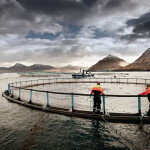
Photo courtesy of Bakkafrost
