






The banking crisis that ignited with the failure of Silicon Valley Bank on 10 March, 2023, was not among the top threats to the seafood industry listed by Megan Greene, a senior fellow at the Mossavar-Rahmani Center for Business at the Harvard Kennedy School, during her keynote address at Seafood Expo North America/Seafood Processing North America on 12 March.
But with the subsequent failure of Signature Bank the same day, and the federal takeovers of both institutions representing the second- and third-largest bank failures in U.S. history, turmoil embroiled on the U.S. financial system as customers hurried to withdraw their deposits and investors rushed to devest from the banking sector.
Greene said Silicon Valley Bank’s business model was “fairly unique” and that while she expected the short-term market reaction to its failure to be “pretty ugly” as the market exposure of other banks comes to light, an expected government intervention that would make affected depositors at the failed banks whole was likely an effective solution to prevent more-significant fallout.
On Monday, 13 March, U.S. President Joe Biden said that the government would respond decisively to the crisis with a government rescue plan.
“Americans can rest assured that our banking system is safe – your deposits are safe,” Biden said. “Let me also assure you we will not stop at this; we’ll do whatever is needed.”
Greene said Silicon Valley Bank’s implosion was the result of developed countries’ central banks shrinking their balance sheets and hiking rates.
“So as borrowing costs are going up, liquidity is waning, and we're getting blowups in pockets of the markets. Silicon Valley Bank is another example of this,” she said.
With a clientele of tech start-ups, the bank used its deposits to invest in government bonds. Due to a pullback in the tech sector, clients began to withdraw funds, forcing the bank to sell off its bonds at a significant loss.
“When central banks expand their balance sheets, it changes bank behavior. So commercial banks end up extending a lot of credit lines in order to make a fee, which makes sense, but just because the central bank decides to shrink its balance sheet, commercial banks don't decide to unwind their behavior. So there's kind of an endless ratchet effect upwards of liquidity needs for banks,” Greene said. “Then every time when the central bank steps in with more quantitative easing, it increases the liquidity needs of a commercial banks. It just makes the problem worse. So I think ultimately, quantitative easing is kind of like Hotel California, and central banks aren't going to be able to get out of it, because if they try, they’ll see more market blow-ups. So I think central bank balance sheets will be pretty big for a while.”
Greene named ongoing inflation as another primary concern for the seafood industry.
“Inflation is top of mind for many, many businesses. I think there's a real risk that inflation remains element elevated and persistent. I think the probability of that is really high and I think that the impact of that would be pretty high,” she said.
In 2021, inflation was driven mostly by the cost of goods rising in the U.S., but in 2022, that shifted as the economy opened up fully so that inflation is now being driven by an increase in prices for services.
“That's a worrisome development just because the biggest component of services inflation is wages, and wage inflation tends to be sticky,” Greene said. “It's relatively easy to hike wages, it's really hard to cut them. And so that's the kind of inflation that will probably be lasting.”
Greene said she believed peak inflation is over but that the U.S. will still end 2023 with the inflation rate at 4 percent, twice the U.S. Federal Reserve’s target rate.
“There's a question about, if inflation is around 3 percent, whether the Fed will crush the economy with higher interest rates just to get it down one more percentage point. I think probably not,” Greene said.
The Fed will likely bring its benchmark funds rate to 5.5 percent and keep them there until 2024, Greene said. The aggressive rate-tightening has worked in bringing inflation down in many aspects of the economy, but labor markets have remained “incredibly tight,” according to Greene.
“It has been a real puzzle for economists, because central bank policy is supposed to work through financial markets and also through the real economy. Really aggressive tightening by the Fed and other central banks is working as you would expect through financial markets, with credit spreads widening and credit demand coming off. It's not working at all through the real economy, though. It's not totally clear why the labor market isn't deteriorating.”
Greene postulated lingering Covid-related issues are keeping some Americans from rejoining the workforce, and said many older workers have elected not to take post-retirement jobs. She also speculated some companies are “hoarding labor” so they’re not forced to rehire and retrain employees as they did in 2021 and 2022 as the economy reopened post-Covid.
"This is just anecdotal, as we don't have any data for this because we don't know how to measure whether companies are hanging on to workers because it makes business sense, or whether they're hanging on to them because they're hoping they can just get through this rough patch and then everything will be fine and they won't have to go out and rehire people,” Greene said.
Wage growth, at 6 percent, is off its previous record-highs, but remains elevated, a situation Greene called “every central bankers worst nightmare” because of the concern it could result in a wage-price spiral, whereby workers ask for more money and end up passing on the extra cost to the end-user in the form of inflation. Greene’s concerns about a wage-price spiral occurring in Europe is even higher than its potential of happening in the U.S., as the most-recent economic data from France, Germany, Spain, and Belgium show inflation increased across the Eurozone. Between higher labor costs and more spending on defense and sustainability investments, Greene forecasts structurally higher inflation globally as a medium-term trend.
China is also struggling with a difficult economic situation, according to Greene. China’s economy should grow by 5.7 to 5.8 percent in 2023, up from 3 percent in 2022, but that growth figure is lower than its pre-pandemic norm.
“After the global financial crisis, China's put the pedal to the metal and stimulus measures and pretty much pulled the rest of the world out of the recession. I don't think we can actually rely on that this time around,” Greene said. “I think that the expansion will be more measured and more targeted this time.”
China is getting diminishing returns on infrastructure investments and is struggling with a sour property market. In response, the Chinese Communist Party is aiming to steer the nation’s economy toward a consumption-driven model, according to Greene.
“There's a risk that the Chinese government can't pull this off because there's very little social safety net in China, and so people tend to hoard away their savings because they might need it for retirement or to pay for their kids to get into good schools, things like that. But I do think that there are a number of policy measures that the Chinese Communist Party has announced, particularly around the property market, to suggest that they'll allow it to stabilize, which should improve confidence and should unlock a bunch of spending,” Greene said.
As the world’s biggest bilateral creditor, China will also play an outsized role in the global response to the emerging market sovereign debt crisis, Greene said. According to the IMF and the World Bank, over 60 percent of low- and middle-income countries are in currently some form of debt distress. It’s unclear if China will abide by the so-called “common framework” commitment among the G7 countries to take the same terms on a debt write-down for any smaller-economy country that defaults.
“But what we've seen is China has dragged its feet quite a lot on these creditor committees – only one country has successfully restructured its debt three years under the common framework, which is a pretty damning statistic,” Greene said. “The longer it takes to restructure a country's debt, the bigger the debt restructuring ends up having to be. And emerging markets were overleveraged before the pandemic hit, then borrowed more to pay for their pandemic response, and now they're facing a stronger dollar and higher borrowing costs. It's kind of a perfect storm for an emerging market sovereign debt crisis But … those countries account for a pretty small percentage of global GDP, so the blowback for the developed world would probably be very small.”
Concern that China might invade Taiwan is also driving global market uncertainty, according to Greene.
“The U.S. has been struggling with its own policy around Taiwan. It's not clear what would the US would do if China invaded. I like to think that the U.S. and China wouldn't get into a huge military conflict. But … the probability is greater than zero,” she said.
The U.S. is attempting to wean itself off economic dependence on China, a process dubbed “deglobalization,” but it’s not clear how serious that effort will be or whether it will have a significant economic impact, according to Greene. Of much larger concern, from a political perspective, is the risk the U.S. defaults on a debt payment or a debt obligation – an outcome to which Greene assigned a probability of higher than 50 percent. The U.S. has already hit its debt ceiling and the clock is running down for how long its cash reserves will last. If Republicans serving in the U.S. Congress don’t agree to lift the debt ceiling, Biden will be forced to make a difficult decision of what federal bills to pay. It could be that he decides not to pay federal employees. Worse, in terms of the global economic impact, would be if Biden decides not to pay global lenders, according to Greene.
“They might also say, ‘Gosh, the U.S. can pay but just won't. It's so incredibly dysfunctional. We should build some kind of dysfunction premium into borrowing costs and push them up,’” she said. “We've never been here before, so it's hard to guess what will happen, but it’s going to be really politically toxic for President Biden to go out and say we're paying off really rich Chinese and Indian investors but we're not going to pay our teachers and your Grandma's not going to get her Social Security check. Especially going into an election year.”
Greene warned the impact of a U.S. default would be “catastrophic,” forcing the imposition of a “moron premium” on U.S. borrowing costs.
“If that were to happen, that would ultimately increase start-up costs on the margins,” she said. “I don't think it will bring the death knell for the dollar as the global reserve currency, but it's just another thing that could push investors into other currencies.”
Listed by Greene as a threat now locked into certain reality, climate change is a global risk nearly impossible to calculate.
“For years, I as an economist would say, ‘Yes, climate change is a huge risk coming down the pike.’ I don't see that anymore – I think is already a risk that we live with. It's just really hard to forecast what exactly a [climate-related] event will happen and what the implications will be.”
The U.S., Europe, and China have all signaled they are getting more serious about making a green transition, but “it’s going to take a long time and [no one[ is going to hit their net-zero goals,” Greene acknowledged.
“But at least we're more serious about it now than we were a year ago,” she said.
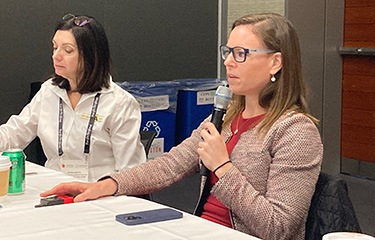
Photo courtesy of Cliff White/SeafoodSource
