






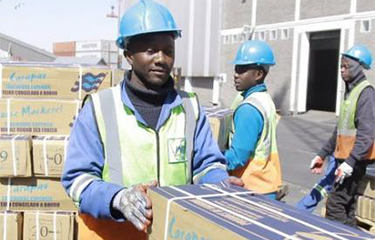
Cape Town, South Africa-based Oceana Group reported a significantly improved performance for the six months ending 31 March 2023, with a 48 percent increase in revenue from its businesses in South Africa, Namibia, and the U.S.
A few years removed from troubling financial reports, and only a year removed from ousting its CFO over allegations of gross misconduct, the beginning of 2023 has seen significant improvements in Oceana’s performance.
A mix of factors – including dependable stock availability, growing demand for affordable protein, and improved pricing particularly for fish oil – pushed the company’s revenues to ZAR 4.5 billion (USD 245 million, EUR 224 million) compared to ZAR 3 billion (USD 163 million, EUR 149 million) for the same period a year prior.
Oceana, a company that specializes in the catching, processing, marketing, and distribution of canned fish, fishmeal, fish oil, lobster, horse mackerel, squid, and hake, increased its operating profit by 87.7 percent for the period under review. This increase brought in ZAR 648 million (USD 35 million, EUR 32 million), up from ZAR 345 million (USD 19 million, EUR 17 million) in 2022.
The positive performance resulted in a 60.5 percent jump in cash generated from its operations to ZAR 563 million (USD 31 million, EUR 28 million), up from ZAR 350 million (USD 19 million, EUR 17 million) in 2022.
One of the only data points that remained stagnant in the unaudited interim results for the six months was Oceana’s flat gross margin from its continuing operations, which at 27.1 percent was just 0.1 percent more than what it posted for the previous year. The company attributes this to “strong fishmeal and fish oil pricing in U.S.-dollar terms offset by the effect of the weaker currency on the cost of imported frozen fish for Lucky Star,” the organization’s canned fish entity.
Lucky Star, a market leader in South Africa’s canned food business, increased its sales volumes by 20.9 percent after selling 5 million cartons of canned products, rising from the 4.2 million it sold the previous year. The results attribute the increase to “improved opening inventory levels.”.
Improved opening stock levels, higher landings, and increased pilchard offcut volumes also pushed up Oceana’s Africa-based fishmeal and fish oil sales volumes by 39 percent to 5,944 metric tons (MT), compared to 4,277 MT for the same period in 2022.
Oceana’s U.S. fishmeal and fish oil segment posted the highest performance of the company operations, with a 78.4 percent increase in sales volumes to 21,895 MT – up from 12,274 tons in the 2022 season – while fish oil sales volumes increased to 4,852 MT, up from 1,933 MT.
The company also benefited from U.S.-dollar fishmeal and fish oil prices jumping as global supply and demand dynamics shaped the pricing of the two commodities.
“Subdued second-season anchovy landings and fish oil yields in Peru, together with stable demand, resulted in U.S.-dollar fishmeal prices increasing by 10.6 percent and fish oil U.S.-dollar prices increasing by 59.5 percent compared to the prior period,” Oceana said.
Oceana’s redeye and anchovy landings increased by 75.7 percent to 24,766 MT, up from the 14,092 MT landed in 2022, due to “good early season catches.”
The company reported a 30.3 percent dip in its South Africa horse mackerel catch compared to the previous year “due to La Niña climatic conditions and the associated higher sea temperatures extending into 2023.” The South Africa segment also experienced constraints from Oceana’s ongoing engine overhaul of the Desert Diamond, which is the company’s horse mackerel midwater trawl vessel.
A more positive story played out in the company’s Namibian horse mackerel sector, as Oceana’s catch was up 40 percent due to an increase in both the number of sea days and catch rates.
Oceana also posted a 35 percent decline in hake catch in South Africa due to both fewer fishing days and poorer catch rates, triggered by planned and unplanned vessel maintenance.
Despite the fluctuating catch, total sales volumes for both horse mackerel and hake remained flat at 29,920 MT. However, prices increased by 17.7 percent and 20.6 percent, respectively, thanks to “strong demand for affordable protein together with the weaker rand effect on export revenue.”
Oceana said that despite operating in a tough business environment – punctuated by increasing bank interest rates, reduced earnings for fish consumers, high inflation, and frequent electricity shortages in South Africa – Oceana injected ZAR 205 million (USD 11 million, EUR 10 million) as capital expenditure into its U.S. and South Africa operations.
The expenditure included, among other projects, ZAR 37 million (USD 2 million, EUR 1.8 million) for its U.S. fishmeal and fish oil business to ramp up plant throughput and vessel utilization. Oceana’s U.S. ventures includeDaybrook Fisheries, located in Empire, Louisiana, U.S.A., just south of New Orleans, which processes, sells, and administers the group’s fishmeal and fish oil products. Furthermore, Oceana holds a 25 percent stake in U.S.-based Westbank Fishing LLC, which manages harvesting through an exclusive fish catch agreement with Daybrook Fisheries.
In South Africa, the company invested ZAR 40 million (USD 2.1 million, EUR 1.9 million) toward the upgrade and expansion of its canned fish and fishmeal production facilities located on the west coast.
Oceana predicts tough operating conditions for all its entities as South Africa navigates a challenging economic period that is exerting pressure on seafood consumers. The company plans to counter the tough business climate through intensifying its marketing activities and increasing its investments in Lucky Star. This, Oceana hopes, will drive up sales volumes and enable the company to maintain affordable consumer prices.
Oceana also expects to leverage the 30 percent increase in the pilchard total allowable catch (TAC) to expand its mix of fresh fish. The increase in TAC to 39,000 MT is based on scientific data received from a 2021 small pelagic survey by Cape Town-based marine monitoring consultancy Capricorn Marine Environmental Ltd.
“Increased volumes, improved yields, and increased fresh fish landings at our local production facilities will contribute to improved profitability,” Oceana said.
The company says fishmeal and fish oil demand and pricing is likely to remain firm for the remainder of the year given the current market dynamics and Peru’s canceled anchovy season.
Oceana also announced that South Africa’s Financial Sector Conduct Authority concluded an investigation it launched in February 2022 – soon after the resignation of its previous CEO, Imraan Soomra – into whether Oceana published possibly misleading information concerning the company’s performance on the Johannesburg Stock Exchange (JSE).
Oceana, in a statement to the JSE on 22 June 2023, said the company has been formally notified that “the FSCA had closed its investigation on the basis that the evidence did not disclose any contravention of section 81 of the Financial Markets Act 19 of 2012, and therefore, no enforcement steps are contemplated against any person arising from the investigation.”
Photo courtesy of Oceana Group
