


The Norwegian government’s proposed new aquaculture resource tax, which if passed will levy an additional 35 percent tax on the seawater grow-out stage of farmed salmon production, will weaken the industry’s development and could cause ripple effects throughout the country, according to Lerøy Seafood Group CFO Sjur Malm.
Speaking at a presentation of the Bergen, Norway, seafood corporation’s first-quarter 2023 results in Oslo, Malm said contrary to what Norwegian politicians have been saying, the new tax wouldn’t be “investment-neutral,” but rather, would limit capital investment.
Malm said the company is disappointed the government didn’t consider the more than 400 consultation responses it received that emphasized the tax’s potentially harmful effects and operational challenges its current draft (as of 28 March 2023) would elicit.
“That view is strengthened the more we look and work on this topic,” he said.
With LSG paying around NOK 2 billion (USD 189.4 million, EUR 172.8 million) in taxes and fees in 2022 and also buying NOK 19 billion (USD 1.8 billion, EUR 1.6 billion) worth of goods and services from 5,100 Norwegian suppliers, Malm also warned the proposed tax could have serious repercussions the government may not be considering heavily enough.
“In our view, it’s obvious this tax will not be good for Norway because the risk of these ripple effects is probably larger than the income from taxes,” he said. “That is why we strongly oppose it.”
The current indication is that final voting on the proposal would occur in Norwegian Storting before the end of May, Malm said.
According to LSG’s first-quarter 2023 results, its revenues increased 26 percent year-over-year to a record NOK 6.97 billion (USD 660.2 million, EUR 602.1 million), while its operating profit before fair value adjustments climbed NOK 100 million (USD 9.5 million, EUR 8.6 million) to NOK 989 million (USD 93.7 million, EUR 85.4 million).
Despite the positive report, price inflation on seafood products impacted the company, while a challenging situation in its Farming segment in the second half of 2022 resulted in a low average first quarter harvest weight and a “less than optimal harvest profile with respect to prices,” the report said.
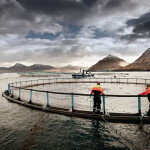
Farming (comprising the three Norwegian farming regions of Lerøy Aurora in Troms and Finnmark, Lerøy Midt in Nordmøre and Trøndelag, and Lerøy Sjøtroll located in Vestland) reported operating earnings before interest and taxes (EBIT) of NOK 742 million (USD 70.3 million, EUR 64.1 million) in the last quarter, compared with NOK 633 million (USD 60 million, EUR 54.7 million) a year previously.
Its Q1 slaughter volumes of salmon and trout decreased 11 percent gutted-weight tonnage (GWT) from Q1 2022 to 28,602 GWT, while its EBIT per kilogram increased from NOK 19.70 (USD 1.87, EUR 1.70) to NOK 26 (USD 2.46, EUR 2.25).
The average price for salmon in the three months was NOK 103.70 (USD 9.82, EUR 8.96) per kilo, compared with NOK 72.10 (USD 6.83, EUR 6.23) in Q4 2022 and NOK 79.70 (USD 7.55, EUR 6.89) in Q1 2022.
For the full year of 2023 and including joint ventures, LSG estimates a total salmonid harvest of 193,500 MT, which is on par with 2022’s volume.
“We expect this to be 2,000 MT more for 2024 to 195,000 MT and a further increase in 2025 to 205,000 MT,” Lerøy CEO Henning Beltestad said.
For LSG’s Wild Catch segment, he highlighted a “strong catch efficiency” and a “positive development in prices,” except haddock.
Lerøy Havfisk's total catch volume in the last quarter was 25,269 metric tons (MT), compared with 25,116 MT in Q1 2022. The main catch species were cod (7,951 MT), haddock (7,318 MT), and saithe (5,671 MT). Compared with Q1 2022, the average price for cod increased by 22 percent, and largely because of lower quotas, saithe was up 11 percent, while haddock prices fell 22 percent.
Along with its LNWS whitefish processing operations, the segment reported an EBIT of NOK 229 million (USD 21.7 million, EUR 19.8 million) for the opening three months, compared with NOK 236 million (USD 22.4 million, EUR 20.4 million) in the same period of 2022.
LNWS's primary business is processing wild-caught whitefish. The company uses 12 processing plants and purchasing stations in Norway, five of which it leases from Lerøy Havfisk.
“The higher prices are a challenge for the land-based industry, but there are signs of operational improvements in the [sector],” Beltestad said. “We see a lot of improvement in the different facilities.”
In the last quarter, LSG’s VAP, Sales, and Distribution (VAPS&D) division, which spans 14 countries, posted larger revenues of NOK 6.4 billion (USD 606.2 million, EUR 552.9 million) due to higher prices and a weakening Norwegian kroner.
“We see a significant improvement in [the segment’s] profitability year-on-year, with an operational EBIT of NOK 96 million [USD 9.1 million, EUR 8.3 million], compared with NOK 26 million [USD 2.5 million, EUR 2.2 million] in the same period of last year. And we expect a significant improvement in earnings in 2023 compared to 2022,” Beltestad said. “Demand has decreased in some markets but the overall demand for seafood remains very strong.”
Photo courtesy of Lerøy Seafood
