






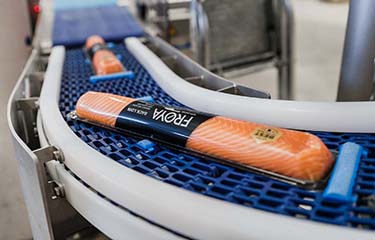
A limited supply of Atlantic salmon coupled with robust demand resulted in another quarter of high salmon prices and, in turn, strong Q2 2023 results overall for Frøya, Norway-headquartered salmon-farming firm SalMar.
The company recently reported quarterly operational earnings before interest and taxes (EBIT) of NOK 1.745 billion (USD 165 million, EUR 151.9 million), a jump from the NOK 1.048 billion (USD 108.9 million, EUR 108.2 million) it posted in the corresponding period of 2022.
SalMar’s Q2 harvest amounted to 44,300 metric tons (MT), up from 32,400 MT a year prior. Its operational EBIT per kilogram rose from NOK 27.30 (USD 2.57, EUR 2.37) to NOK 39.40 (USD 3.71, EUR 3.42) year over year. The company’s operational EBIT for its Norwegian operations alone totaled NOK 1.79 billion (USD 168.8 million, EUR 155.4 million), and the segment’s operational EBIT per kilogram was NOK 40.50 (USD 3.82, EUR 3.52).
“The second quarter was another strong quarter for SalMar,” SalMar CEO Frode Arntsen said. “In fact, [these were] the best results in the history of the Norwegian part of our business.”
SalMar’s Icelandic salmon business, meanwhile, harvested low volumes in Q2 to optimize biological performance, only generating an operating income of NOK 26 million (USD 2.5 million, EUR 2.3 million) in the period. The segment hauled in NOK 349 million (USD 32.9 million, EUR 30.3 million) in Q2 2022.
SalMar’s U.K. joint venture Norskott Havbruk (Scottish Sea Farms) generated operating revenue of NOK 692 million (USD 65.2 million, EUR 60.1 million), compared with NOK 884 million (USD 83.3 million, EUR 76.7 million) in Q2 2022, primarily due to lower harvest volumes. SalMar’s share of Norskott Havbruk’s net profit losses totaled NOK 78 million (USD 7.4 million, EUR 6.8 million) in Q2 2023. Tit said the harvesting of “biologically challenged sites,” which affected the average harvest weight, cost base, and price achievement, led to the weak results.
SalMar’s sales and industry segment, which sells all the fish that the group harvests in Norway, generated a significantly higher Q2 operating income of just over NOK 6 billion (USD 565.7 million, EUR 520.8 million). The unit posted a negative operational EBIT of NOK -67 million (USD -6.3 million, EUR -5.8 million), compared with NOK -781 million (USD -73.6 million, EUR -67.8 million) in Q2 2022. The large improvement was mainly due to the “efficient management of harvesting and processing facilities and good disposal of volume to the market,” the company said.
The group’s newest segment, SalMar Aker Ocean, posted an operational Q2 2023 EBIT of NOK -10 million (USD -942,846, EUR -868,018) in the quarter, an improvement from the NOK -39 million (USD -3.7 million, EUR -3.4 million) the segment posted a year ago.
For the first six months of this year, SalMar generated a gross operating income of almost NOK 12.7 billion (USD 1.2 billion, EUR 1.1 billion), up from NOK 8.9 billion (USD 839.1 million, EUR 772.5 million) in the first half of 2022. The group harvested 92,900 MT in the period, an increase of 20 percent year over year.
The price of salmon throughout H1 2023 averaged NOK 106 (USD 9.99, EUR 9.20) per kilo, compared with NOK 92.90 (USD 8.76, EUR 8.06) in the same period last year.
Photo courtesy of SalMar
