






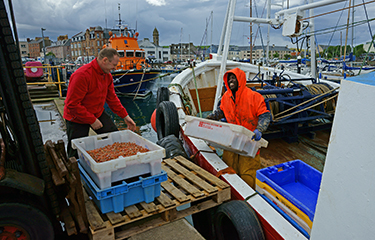
The U.K. government’s decision to add fishing jobs to the country’s official Shortage Occupation List (SOL) signified that many commercial operations in the seafood industry have struggled to plug gaps in the workforce and attract new talent.
Inclusion on the SOL, which came after a recommendation from the U.K. Migration Advisory Committee, means U.K. fishing companies will pay lower fees and face lower salary requirements in recruiting foreign workers.
The move adds to an existing package of governmental support that to aid non-national workers navigate the visa and sponsor application process, as well as the broader immigration system, and expediting visa and sponsor applications to quicken decision-making at no extra charge.
The designation also makes the program part of the ongoing GBP 100 million (USD 124.2 million, EUR 115.9 million) U.K. Seafood Fund, which is aimed at helping modernize facilities, training and upskilling fishermen, and investing in better scientific research on fish stocks.
According to U.K. public body Seafish, the SOL designation will reduce the cost burden for both employers (businesses looking to recruit non-U.K. crew) and prospective employees (overseas workers applying for a visa).
“This change should hopefully make it easier for employers to recruit workers from overseas via the skilled worker visa route,” a Seafish representative told SeafoodSource.
However, it remains difficult to find suitably skilled crew who are able to satisfy English language requirements, particularly written English, the representative said.
“Industry organizations are exploring how to deliver appropriate English language training in overseas jurisdictions, but there is still much work to be done,” the spokesperson said.
The new support measures, however, only address one challenge in what is a very complex situation facing the U.K. seafood supply chain.
The Scottish Seafood Association (SSA), the trade body representing Scotland’s processing and trading sectors, among other groups, said it would like to see the implementation of broader pro-industry actions, particularly projects that seek to overcome on-the-ground issues and can provide the means to capitalize on subsequent opportunities.
SSA CEO Jimmy Buchan said he feels the U.K. government has been “disingenuous” in that it has, without consultation, rewarded just one sector – fishing – with an opportunity to recruit “badly needed” migrant workers, rather than supporting the whole supply chain.
“If we get a situation where boats are returning to sea fully crewed and harvesting plenty of seafood, it’s equally important to have people onshore to make the best of that increased landings opportunity and having that money benefit the local workforce, businesses, and communities,” Buchan said. “I think this is another missed opportunity … [The] government has been talking the talk for a number of years, but our industry has moved far beyond talking – we need actions.”
Alongside lobbying decision-makers, SSA has led several recruitment-focused campaigns within local communities.
Though, with unemployment levels in many coastal areas below the national average and northeast Scotland in particular having a buoyant renewals sector that can offer much higher incomes than the seafood industry, the tendency is for the latter to miss out on talented individuals.
“We always struggle to fill vacancies when they become available,” Buchan said. “It really is a challenge, but we continue to work with our elected politicians, and I do believe that those [members of parliament] that are closest to the industry fully understand the struggles that we have and what the industry needs. Unfortunately, that message seems to become diluted when those MPs or lobbyists go to put our case to government. That’s because government policies are not aligned with what industry needs.”
Despite the current obstacles, Buchan said he hopes that common sense will eventually prevail.
“To feed people, we need people,” he said.
Seafood companies will now be starting to think about how best to start scaling up production to meet the year-end holiday demand, with processors needing to increase operations at the back end of summer to supply both domestic and export markets.
“Generally, we are struggling to get people to do the primary processing work. I know government is fixated on automation solving the problem … But when you try to take a fillet of some fish, shuck a scallop, or cut the tail and skin a monkfish, there’s not a machine that’s been invented that will do it as well as the human hand,” Buchan said. “I’m afraid the government needs to accept that and realize that while there is a place for automation and robotics, there’s also places where we need the human eye and the skill of a human hand.”
Photo courtesy of PJ photography/Shutterstock
