






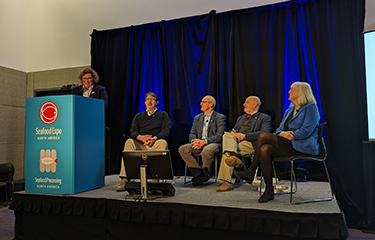
As NOAA Fisheries continues to grapple with shifting fish populations due to warming waters, its leaders have committed to making sure regulatory solutions don’t leave coastal communities out to dry.
Speaking at a panel at Seafood Expo North America – running from 12 to 14 March in Boston, Massachusetts – NOAA Fisheries Northeast Fisheries Science Center Science and Research Director Jon Hare said the last several decades have seen numerous species expand or shift their ranges.
“You can’t not catch black sea bass in Massachusetts,” Hare said during the panel. “I think that’s the example that I like to give. Black sea bass was historically mid-Atlantic – sort of New Jersey to North Carolina species – in recent years the stock population has expanded northward.”
The language he used to describe the changes in the stock is important, Hare said. Species aren’t so much as shifting their location, but are expanding their range. Black sea bass can still be caught in its historical grounds in similar numbers, but now it is being found in places it never was before.
“So now black sea bass is available in Massachusetts, you can catch them up inti the Gulf of Maine, but you still have them in the mid-Atlantic,” he said. “So how do you allow access to a new species in these more northern states, while the availability in the southern states are the same?”
That question is one the current regulatory structure for U.S. fisheries management, NOAA Greater Atlantic Regional Fisheries Office Regional Administrator Michael Pentony said, doesn’t have an answer to.
“John talks about the science and the science is obviously critical. It’s the root of everything we do. But you look at some of the management structures that we have in place that constrain our ability to be responsive and adapt, and black sea bass is a great example,” Pentony said.
The fishery management councils moved to a moratorium permit system 30 years ago, and those permits were based on the fisheries data that existed at the time – which itself is based on even older information.
“So we have permits that are effectively locked in place to a fishery as it existed decades ago, and as the stock expands," Pentony said. "One of the challenges we have is how do we provide access to the fishing industry, the fishing communities, that now have an abundance of resources available to them, without detriment to the fishing communities and the fishing vessels?”
Some of those challenges include being equitable to the fishermen who have invested their time and energy into a permit system. Long Island Commercial Fishing Association Executive Director Bonnie Brady, addressing the NOAA panel’s comments, said many fishermen have invested their livelihoods into their permits.
“New York fishermen, because our stock for fluke and for black sea bass was small, many of them have had to go purchase quota permits from other states, go out and catch the fish where they’ve always caught them, and then steam down to Virginia or to North Carolina where they land those fish,” Brady said. “So if we’re suddenly going to open up to our neighbors and say, ‘Hey, you want to fish too?’ you’re literally destroying the value of those permits and the money that those small businesses put out to obtain and hold on to those permits.”
That issue is on the administration’s radar, NOAA Assistant Administrator Janet Coit said.
“I think one of the things I just mentioned was that we’ve been concerned that we maybe don’t have enough social scientists who are taking a look at the interaction between the decisions that we’re confronted with and impact on coastal communities,” Coit said.
Part of the solution is more industry involvement in decisions, which is why NOAA is working to give advanced notice of any rulemaking and look at standard guidelines.
Another part of the solution, Hare said, is social science – something the Northeast Fisheries Science Center is well-prepared to tackle, according to Hare.
“I’m proud to say that the Northeast Fisheries Science Center has one of the greatest concentrations of social scientists in the country,” Hare said.
U.S. Under Secretary of Commerce for Oceans and Atmosphere and NOAA Administrator Rick Spinrad said that the upcoming climate action plan coming out soon will in some ways address those equity issues. That plan, he said, will get to some of the strategic issues that NOAA is focusing on, and contain the requirements and needs.
“One of the things we’re trying to do, which we’ve not done before as effectively as I think we could, is predicate everything on requirements – show me where the requirements are for doing these things,” Spinrad said. “Having an ocean climate action plan, in my opinion, is an expression of what those requirements are.”
As NOAA continues to work on its climate action plans, Hare and Pentony said the industry needs to contribute to the discussion via the surveys sent to permit holders.
Economic data, Pentony said, is a great example – the councils have the value of landings, but they can’t know what costs fishermen face without participation on their part.
“The only way we’re going to know that, the only way we’re going to get the data to support and understand how those decisions have implications, is for the industry to come forward,” Pentony said.
Photo by Chris Chase/SeafoodSource
