




A study recently published in Science Advances providing before and after assessment of the impacts of Mexico’s Revillagigedo National Park claims there have been no negative consequences for the fishing industry.
The study, performed by a team of U.S. and Mexican researchers, found evidence that Mexico’s industrial fishing sector had no economic losses five years after the creation of the national park. Revillagigedo National Park was created in 2017 and protects 148,087 square kilometers of ocean south of the Baja California peninsula in the Pacific Ocean.
The park consists of a marine protected area (MPA), with a complete ban on all commercial activity inside its boundaries. Dubbed the “Galápagos of Mexico” the area is home to more than 300 species of fish, 36 of which are found nowhere else.
Prior to the establishment of the MPA, the Mexican fishing industry argued it would cause a potential loss of 20 percent of their tuna and pelagic catch, according to a press release by the Scripps Institution of Oceanography, a department of University of California, San Diego – which performed the study alongside the Mexican Center for Marine Biodiversity, the Institute of Americas’ Gulf of California Marine Program, and the National Geographic Society. However, the study found almost no impact on commercial fishing at all.
Scripps Institution of Oceanography Post-Doctoral Researcher Fabio Favoretto, one of the paper's co-authors, told SeafoodSource the goal of the study was to examine how MPAs actually impact commercial fishing.
“We wanted to debunk some assumptions made before the MPA implementation,” Favoretto said.
Researchers used satellite tracking, fish catches, and new AI tools from the Allen Institute for AI’s Skylight platform, as well as machine-learning techniques to help identify patterns associated with fishing vessels that frequented the region. They used government-mandated GPS devices installed on 2,000 fishing vessels in Mexico to collect tracking data, which Favoretto said was critical to determining whether the industry was complying with the new MPA.
According to Favoretto, fishing effort in the MPA decreased by 80 percent on average in the first year after implementation, and then finally dropped to zero and has remained there since, despite being significant fishing activity taking place in the area before the ban.
“It was an important fishing area, averaging 18.85 hours of fishing per vessel, the average of the years after implementation was 3.37 hours per vessel,” Favoretto said. “Then, after 2021, a satellite monitoring platform was implemented and all effort dropped to zero.”
Despite the closure of an area that previously saw significant amounts of fishing, the study found that there was no difference in catch, Favoretto said, and overall catch per unit of effort was not affected.
“Before they were averaging 13.18 tons per hour, and after they were averaging 13.62 tons per hour,” he said.
Scripps Institution of Oceanography Professor of Marine Biology Octavio Alburto, another of the study's co-authors, said the study helps prove MPAs can be effective tools in reducing fishing in sensitive areas.
“The findings of this study are consistent with what experts have recorded in other Pacific marine protected areas,” he said. “Any argument to the contrary were just assumptions – this study provides the data to show that negative impacts to fishing do not exist. We hope the results can open a discussion to work together with the fishing industry to protect biodiversity and improve fish stocks.”
MPAs that prohibit fishing can be an effective regulatory tool when enacted in conjunction with other measures to prevent overexploitation of the ocean and overfishing, Favoretto said.
“It depends case by case and by the objective to be achieved,” he said. “Evidence suggests that well placed fully protected MPAs are a tool that works well in recovering marine communities, but we also need management outside the MPAs. It is not one excluding the other. We need a collaborative and interdisciplinary effort to truly being able to curb overexploitation.”
Looking forward, Favoretto said the next step taken by the researchers will be a study analyzing the fish populations within Revillagigedo National Park to determine what impacts the MPA had on biodiversity. Current evidence indicates fish in the area are “thriving,” based on research from other projects, he said.
Study co-author Enric Sala, who is the founder of Pristine Seas and an explorer in residence at National Geographic Society, said the new study shows that fishing industry concerns are “unfounded,” and that MPAs should be a new tool to preserve ocean biodiversity.
“MPAs are the most-effective tool we have for protecting the health and diversity of our oceans," Sala said in a release. “We need to expand and strengthen protected areas to ensure that our oceans can continue to provide food, jobs and other vital benefits for future generations.”
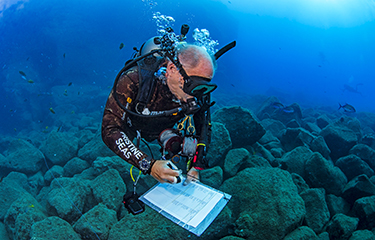
Photo courtesy of Octavio Alburto
