





Though around 88 percent of American restaurants are dishing out some sort of seafood, US Foods Vice President of Product Development and Innovation Stacey Kinkaid said that could be the floor – not the ceiling – of seafood’s prevalence on U.S. menus.
Data recently released by research firm Technomic confirms seafood remains very popular on restaurant menus across the U.S., but favorable trends could make it ubiquitous.
“Pricing and supply availability has improved quite a bit, so there is certainly upward growth potential,” Kinkaid said.
Seafood-focused restaurant operators have seen a broad recovery coming out of the Covid pandemic and inflationary cycle, including Orlando, Florida, U.S.A.-based Darden, which recently reported positive fiscal year-end earnings, and Nashville, Tennessee, U.S.A.-based Captain D’s, which said it aims to expand its footprint to more than 1,000 units in the near future.
“During the height of the Covid-19 pandemic, consumers told us that seafood was one of the foods they missed from restaurants most,” Datassential Associate Director Mike Kostyo wrote in the company’s Midyear Trends report. “Now, it seems like they [consumers] may be indulging in their favorite seafood options [again], as the number of seafood chains that broke into the Top 500 [list of restaurant chains by size] grew 37.5 percent this year.”
US Foods, one of the country’s largest foodservice distributors, has seen an uptick in menu penetration for certain seafood dishes, Kinkaid said. Breaded shrimp is on 12 percent more menus in 2023 compared to 2022, according to food and beverage firm Datassential, surpassing pre-Covid-19 levels. Over the past four years, salmon sashimi’s presence on menus is up 31 percent, and aguachile, a Mexican dish containing marinated shrimp, hot peppers, lime juice, and other ingredients, has appeared on 48 percent more menus.
In late September, US Foods announced the release of 24 new products “that reflect the latest menu trends, diner demands, and operator needs.” Among those were two new items released under its Harbor Banks brand.
The first, four-star Best Aquaculture Practices (BAP)-certified seared Atlantic salmon, aims to give restaurants a raw salmon option.
“The operator only needs to thaw and serve for a sushi-grade salmon offering on their menu,” Kinkaid said.
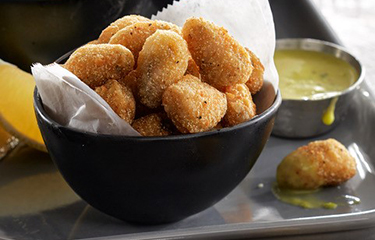
The second, Aquaculture Stewardship Council (ASC)-certified breaded popcorn mussels, have a crunchy cracker breading, making them versatile enough to be eaten on their own or as a complementary ingredient on dishes such as a po’ boy sandwich, according to Kinkaid.
“It’s a unique product that appeals to foodservice customers who are looking to improve profitability on seafood platters or with seafood appetizers, since mussels are a more affordable option,” Kinkaid said.
“These items are a perfect fit with our innovation priorities,” Kinkaid said. “The items are designed to be on-trend and provide back-of-house ease via menu versatility.”
The offerings align with diner demands for sustainable offerings, Kinkaid said. Besides being good for the environment, it’s increasingly good business practice; according to Technomic, 72 percent of Gen Z’ers say sustainability influences their food choices when dining away from home.
In 2022, the entire Harbor Banks seafood portfolio met either US Foods’ Serve Good program sustainability standards or the company’s Progress Check standards at the time of their sourcing, Kinkaid confirmed. All Serve Good farmed species carry BAP four-star recognition, while wild-caught species carry Marine Stewardship Council (MSC) Chain of Custody certification. US Foods’ Progress Check program recognizes seafood products and vendors that have made sufficient progress toward meeting its Serve Good standards, with the eventual goal of fully meeting the program’s criteria.
“The Progress Check program helps to create a market to grow the pipeline of fisheries, farms, and processors that offer responsibly sourced seafood and are working toward our standards of certification,” Kinkaid said.
Moving forward, US Foods plans to delve deeper into frozen seafood, which Kinkaid said has seen drastic improvements in quality.
“Innovation in the harvesting and freezing process often results in a frozen product that tastes as fresh as seafood that has not been frozen – offering a great value for the operator,” Kinkaid said.
Photo courtesy of U.S. Foods
