






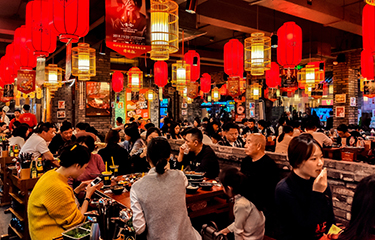
Seafood purchases in China’s restaurant market are drying up as consumer demand dwindles.
Prices for staple mass market species including pangasius and snakehead are down an average of 20 percent year over year, as suppliers push to revive both consumer and restaurant demand.
China’s restaurant scene has seen an influx of new players in recent years, and heavier competition is also resulting in lower prices, according to Shanghai-based agrifood research agency Sitonia Consulting. This crowded market has led to price wars, and consumption data is showing the discounts have been successful in drawing in more customers. China’s restaurant spending has been one of a few high points in its Q4 economic data, with spending on catering rising 13.8 percent in October. However, the figures have shown Chinese consumers remain tightfisted when they do go out to eat.
Weaker consumer spending overall is heavily affecting suppliers of lower-value fish like pangasius, which has become a key, but increasingly lower-priced, ingredient for hotpot chains and convenience food stores. Lower-value species also face competition from slightly higher-priced species like snakehead, which have also fallen in price.
A surge in snakehead production and subsequent supply glut appears to have led to mass discounts on the fish earlier this year, according to the Guangdong-focused Hai Chan Zi Xun WeChat group. Major producers of snakehead in China include Guangdong Evergreen, which in 2021 announced a joint venture with the Nansha Modern Agriculture Industry Group to farm sea bass, snakehead, and catfish.
The Hai Chan Zi Xun article also highlighted the relatively poor performance of pangasius – a largely commodified product shipped in filets – on China’s online platforms. In the first eight months of 2023, China and Hong Kong imported USD 378 million (EUR 355.32 million) worth of Vietnamese pangasius, down 30 percent compared to the same period last year.
“Pangasius is already an old product … Chinese online platforms seek new products to drive sales,” it said.
Across China, pangasius remains far more competitive pricewise compared to snakehead. Snakehead prices in mid-November 2023 averaged CNY 8.60 (USD 1.20, EUR 1.11) per 500 grams for 1,000-gram fish, while smaller fish averaged CNY 5.90 (USD 0.82, EUR 0.76) per 500 grams. These rates are down sharply year over year – in November 2022, snakehead prices ranged from CNY 10.10 (USD 1.41, EUR 1.31) per 500 grams for larger-sized snakehead to CNY 7.50 (USD 1.05, EUR 0.97) per 500 grams for smaller fish.
By contrast, pangasius filets are currently averaging CNY 3.70 (USD 0.51, EUR 0.48) per 500 grams this November, down from an average CNY 4.50 (USD 0.63, EUR 0.58) per 500 grams a year ago, according to data published by the Chinese Agriculture Ministry.
“Consumers are cutting back spending as China’s economy is not doing well,” Siam Canadian Guangzhou Office Head Landy Chow said.
However, he said, snakehead’s emergence as a new staple for restaurants is more down to consumer curiosity and marketing than to price competitiveness.
“As people have eaten pangasius for quite some years, they might now change to a new fish,” Chow told SeafoodSource. “Snakehead is a much more expensive fish than pangasius. In China, the trends change fast. Every three to five years you might see a new fish.”
A tilapia producer-processor in southern China told SeafoodSource that China’s domestic seafood market has seen “cutthroat price competition” since early 2023. “Demand for most popular fish products such as carp, pangasius, and snakehead has fallen as consumption drops,” said the executive, who asked for anonymity to speak candidly.
Inexpensive restaurants that have become more popular in recent years are high-volume purchasers of low-cost species like pangasius, the executive said, frying or sauteing the fish in fillets or portions. By contrast, there is limited scope for replacement of pangasius with snakehead across the eat-in and higher-priced restaurant category, as diners prefer to eat the whole fish.
“These are two different fish cuisines,” the executive said.
Both Chow and the tilapia executive see little scope for tilapia emerging as an alternative species in an ever-competitive Chinese seafood market.
“A lot of Chinese don't like eating tilapia given its muddy flavor,” the tilapia producer said. “Chinese people like hotpot. Pangasius fillets do a better job in standing up to high temperature cooking in hotpots. Tilapia fillets will be mushy after being cooked in less than five minutes in a hotpot.”
The long-term outlook looks uncertain for pangasius given China’s economic slowdown, but there also appears to be plenty of room for growth for more innovative restaurant concepts. Ivan Su, an equity analyst at Morningstar in Hong Kong, pointed to the “immense popularity” of the Tai Er chain of pickled fish restaurants in the past five years across China. That has led him to favor the stock of Tai Er owner Jiumaojiu International Holdings over Haidilao, another Hong Kong-listed catering firm. Haidilao faces increasing competition in the crowded hotpot segment at a time when “Chinese consumers are feeling uncertain and spending less,” Su said.
Photo courtesy of Adam Yee/Shutterstock
