






Bentonville, Arkansas, U.S.A.-based Walmart’s e-commerce and grocery sales soared in its fiscal Q3 2024.
Walmart’s e-commerce sales jumped up 24 percent compared to Q3 2023, and comparable store sales grew 4.9 percent at Walmart stores and 3.8 percent at Sam’s Club stores.
Walmart, which operates more than 4,600 stores and nearly 600 Sam’s Club stores in the U.S., said its strong quarter was led by sales of grocery and health and wellness products.
Insider Intelligence Principal Analyst Suzy Davidkhanian said Walmart continued to have a strong foothold in grocery and the retailer “crushed its near-end competitors in Q3 by mastering a high-low household income branding and merchandising strategy.”
Walmart is well-positioned for continued strong sales growth, particularly in grocery, due to “expected continued consumer anxiety heading into an election year,” Davidkhanian told SeafoodSource.
Walmart CEO Doug McMillon said on an earnings call that he expects further deflation on seafood and other products, which should help ease consumers’ economic concerns. McMillon predicted deflation on key grocery items, such as eggs, chicken, and seafood, and higher-priced pantry staples should also start to decline in the coming weeks and months, CNBC reported.
“In the U.S., we may be managing through a period of deflation in the months to come. And while that would put more unit pressure on us, we welcome it, because it’s better for our customers,” McMillon said.
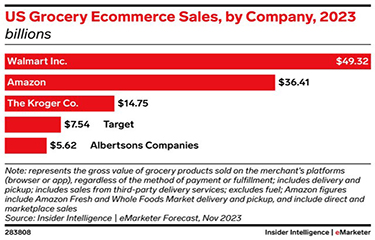
Walmart has realized such significant growth in e-commerce this year that Insider Intelligence predicts it will overtake Amazon in online grocery sales by the end of this year. The research firm predicted Walmart’s sales will reach USD 58.9 billion (EUR 54 billion) in 2024, compared to Amazon’s USD 40.5 billion (EUR 37 billion). That will give Walmart a nearly 27 percent share of the online grocery market versus Amazon’s declining 18.5 percent share.
“Increasing inflation has led to more deal-seeking and trade-down behaviors from consumers, which favor Walmart over its competitors such as Target and grocery-delivery platforms,” Insider Intelligence Forecasting Analyst Brian Lau said. “Of course, having a store within 10 miles of 90 percent of U.S. households has also helped fuel Walmart’s grocery sales, both offline and online, because it means the company has more curbside and in-store pickup locations available.”
By next year, the gap will have widened by such a large margin it will be difficult for Amazon to reverse the trend, Insider Intelligence said.
While Walmart’s sales soared, Quincy, Massachusetts, U.S.A.-based supermarket chain Ahold Delhaize reported a Q3 2023 sales gain of only 0.9 percent in the U.S. Additionally, the company, which operates around 2,050 stores under banners such as Food Lion and Stop & Shop, is selling its FreshDirect business, which it purchased in 2020, to ultrafast grocery delivery service Getir, in order to focus investments in its omnichannel businesses.
“This was a difficult decision, especially given FreshDirect’s rich history in the New York City area,” Ahold Delhaize USA CEO JJ Fleeman said.
A reduction in emergency federal Supplemental Nutrition Assistance Program (SNAP) benefits, higher interest rates, and the resumption of student loan repayments in October “continue to weigh on customer sentiment,” Ahold Delhaize President and CEO Frans Muller said.
The SNAP benefit reductions accounted for a four-percentage-point impediment to sales growth, Muller said.
“While we were able to offset a large portion of this headwind through our strong value propositions and ongoing momentum in online sales, the dilutive impact of a changing sales mix and increasing shrink contributed to slightly lower-than-expected U.S. margins,” Muller said.
However, the company is being aided by its Accelerate program efficiency initiatives, in-store actions to reduce food waste, and volume support incentives from vendors.
“We expect this modest margin pressure to be transitory and pass in a couple of quarters,” Muller said.
Chart courtesy of Insider Intelligence
