






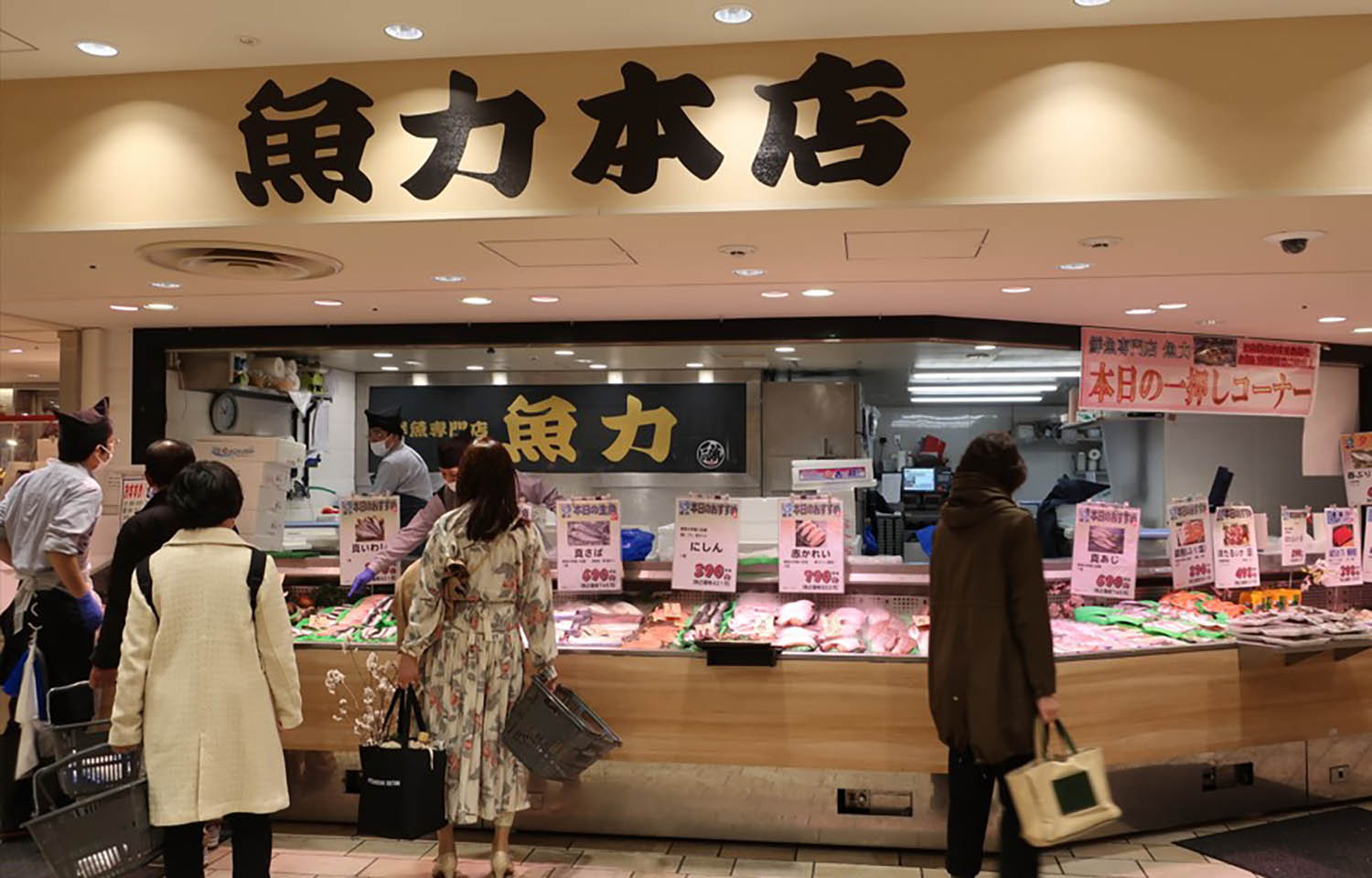
Tokyo, Japan-based seafood retail and foodservice company Uoriki recently posted large spikes in year-over-year revenue and profits for fiscal year 2023, announcing that this growth will allow it to turn its focus abroad where there are more opportunities for expansion.
As of the end of FY2023, the company operated 14 restaurants, 78 stores that sell fresh seafood – largely in greater Tokyo – and seafood supplier operations that serve both the domestic foodservice and U.S. grocery sectors. The latter collaboration is mainly through a partnership with Rochester, New York, U.S.A.-based supermarket chain Wegmans.
“Before the Covid-19 pandemic, we had other business partners, but now it is only Wegmans,” Uoriki Corporate Planner Natsuki Oshiyama told SeafoodSource. “At the moment, we are focusing on the [U.S.] East Coast, and although we have plans for the West Coast, we are not yet in the execution stage.”
Besides the U.S., Uoriki has established a collaboration with CP Food Global Solutions (CPFGS), a subsidiary of Charoen Pokphand Foods. The cooperation includes a memorandum of understanding to import more premium fish products from Japan to Thailand, and the opening of seven retail outlets in Thailand in Makro and Lotus stores selling fresh fish and sushi. Uoriki is aiming to have 25 stores in Thailand by the end of 2024, expanding from the Bangkok area to Chonburi province and Chiang Mai.
The plans for U.S. West Coast expansion and its Thai partnerships are part of Uoriki’s larger strategic shift toward international markets, aiming to make wholesaling a new pillar of the group's business – a plan aided by its FY2023 growth.
“We consider Japan to be a mature industry, while overseas is still a growing industry. Seafood is attracting attention worldwide as a source of protein, and Japanese seafood is particularly high-quality and in high demand,” Oshiyama said. “In such a business environment, we believe that we can utilize our strength, which is our in-store sales know-how. Meanwhile, in Japan, due to the prolonged depreciation of the yen, it is more difficult than before to secure imported goods. For this reason, we do not expect to grow as much as we have in our overseas business.”
For the fiscal year ended 31 March 2024, the company reported sales of JPY 36.3 billion (USD 230.6 million, EUR 215.4 million), up 7.7 percent from the previous year. Its ordinary profit rose about 44 percent year over year to JPY 2 billion (USD 12.7 million, EUR 11.8 million), while profit attributable to the owners of the parent company reached JPY 1.3 billion (USD 8.2 million, EUR 7.7 million), marking a rise of nearly 70 percent year over year.
Uoriki’s Retail Business sales rose 10.2 percent year over year to JPY 30.7 billion (USD 195 million, EUR 182.2 million), while the segment’s profit nearly doubled to JPY 1.7 billion (USD 10.8 million, EUR 10 million). In the category, it increased value-added processing and strengthened its sales of raw fish for sushi.
In the company’s Foodservice Business, sales shot up 15.1 percent, reaching JPY 1.4 billion (USD 8.8 million, EUR 8.3 million), but the segment suffered a JPY 12 million (USD 76,000, EUR 71,000) operating loss, though that was still an improvement from its JPY 56 million (USD 356,000, EUR 327,000) loss posted the previous year.
Though Uoriki's sales increased, its profits were squeezed by increased labor costs and store operating costs, including higher utility costs. Like many companies in Japan, Uoriki is facing a tight Japanese labor market that has created higher wages and increased logistics costs. It's also facing a shortage of trucking capacity due to new safety laws in Japan that cap overtime hours for drivers. In response, Uoriki has reduced delivery costs by reorganizing delivery routes and improving loading efficiency.
“There was a period when there was a global shortage of cargo containers due to the Covid-19 pandemic,” Oshiyama said. “At that time, we increased our local inventory at the request of our overseas business partners. As a result, sales increased significantly in fiscal 2022 but decreased in fiscal 2023.”
In the company’s Wholesale Business, sales fell 9.2 percent to JPY 4.1 billion (USD 26 million, EUR 24.3 million). Profits fell 27.7 percent year over year to JPY 120 million (USD 762,000, EUR 712,000).
In FY2023, retail operations accounted for 84.5 percent of Uoriki’s business, wholesaling accounted for 11.4 percent, and foodservice – including restaurants and bars – accounted for 3.8 percent.
The company expects to double overseas sales in wholesaling by 2026, hoping for the category to account for about 11 percent of total company sales.
