

Mathew Scaletta, the owner of Klawock, Alaska, U.S.A.-based Wildfish Cannery, believes tinned seafood is having its rightful moment in the spotlight but that U.S. brands – at least when it comes to premium products – have still not found their foothold in the burgeoning market.
That’s something he’s looking to change.
“We’ve been executing on the premise of the tinned fish fad for eight years now. My goal all along has been to position our canned fish as premium – an alternative to the fancy imports that feature really high-quality premium – not commodity – fish from Alaska,” Scaletta told SeafoodSource. “We’ve had great success being an Alaska cannery that is achieving the same position as some of the very fine imported brands on shelves, and I think that's unique for a historic Alaska cannery to accomplish. It's been a big win.”
In 2015, Scaletta purchased Wildfish Cannery from his grandmother, Phylis Scaletta, who started the company in 1987. He said his goal in taking over was to normalize high-quality canned fish and show the world how it can be a satisfying and delicious meal.
Since the purchase, the company has expanded its product portfolio, canning and distributing a variety of smoked conservas products such as smoked rockfish, coho salmon, king salmon, sockeye salmon, pink salmon, octopus, herring, geoduck, and more.
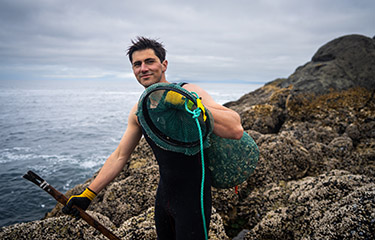
Its latest offering is canned gooseneck barnacles in brine that the company is selling for USD 49 (EUR 46) per can. The gooseneck barnacles, also referred to as “dinosaur toes,” are hand-harvested by professional diver Evan O’Brien and remain fully intact throughout the procurement process with the shell still attached to the barnacles, following the European tradition of harvesting barnacles.
“Thanks to our collaborative efforts with O'Brien, gooseneck barnacles in brine is here,” Wildfish Cannery said in a release. “Snatching a tin means you’re ready to be transported to our rainforest coast home, and with only 300 tins made, this is a rare treat for a select few to enjoy.”
The barnacles are harvested from the shoreline along Baranof Island near Sitka, then packed on ice and sent by seaplane to the company’s cannery facilities in Klawock.
"This product is really the epitome of what we stand for at Wildfish Cannery,” Scaletta said. “Here, it’s about finding uncommon, underutilized, and uniquely Alaskan species that introduce consumers to the variety of our bounty. We want to create new markets and new opportunities for our local fishermen and harvesters, particularly in new fisheries with lower cost barriers to entry.”
Scaletta said unique product has the potential for sustained commercial success.
"There’s something about the canning process that makes a tinned gooseneck even better. The texture is softer, and the tenderness and the briny flavor is similar to an olive,” O’Brien said in a release.
Tinned seafood sales increased rapidly during the Covid-19 pandemic and have continued to grow in its aftermath, jumping 5 percent in 2022, according to analytics firm IRI Worldwide. Scaletta, who worked as a chef in Portland, Oregon, and Chicago, Illinois, prior to purchasing Wildfish Cannery, where he is the director of facilities and operations, said he's always seen great value in canned seafood.
“It’s never been a fad for me. Premium canned salmon has always been my way of life,” Scaletta said. "The whole goal of the company … was to make tinned fish cool but not in a lame way. I wanted everyone to think of canned seafood the way I did: that it can be a super premium delicious [product] that can be stored without refrigeration but can make a really delicious and satisfying meal. We’ve put in a lot of work to make tinned fish a thing before it really hit, and I do think we have been a big part of the movement.”
Photo courtesy of Wildfish Cannery/Bethany Goodrich
