






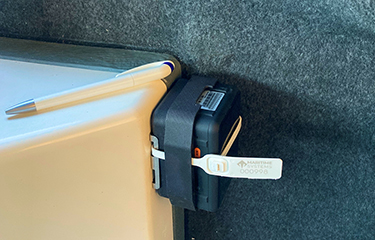
The United Kingdom Marine Management Organisation (MMO) is restarting the rollout of its planned inshore vessel monitoring system (I-VMS) after re-verifying the devices it has selected for the system are up to the task.
The MMO planned to make carrying an I-VMS device mandatory for all vessels under 12 meters – both domestic and foreign – fishing in English waters, with each vessel required to install one of four devices that the organization said were “type-approved” in 2021. The four devices approved were the Fulcrum Nemo, Succorfish SC2, Maritime Systems MS44, and Satlink Nano.
That rollout, however, hit a snag after feedback from users claimed two of the type-approved devices – the Satlink Nano and the Maritime Systems MS44 – didn’t actually meet the standards that the MMO called for.
Now, after the MMO commissioned more independent testing, the organization said it has verified that both the Fulcrum Nemo and Succorfish SC2 are up to the standards, excluding the two problematic devices for now. The government is planning a second rollout of mandatory I-VMS based on an installation schedule of port visits running from 4 September to 30 November 2023.
The organization said it will be contacting fishers directly with details of when engineers will be available for their port, and anyone fitted with one of the devices that are not MMO-approved “should not attempt to remove it themselves.”
MMO Chief Executive Tom McCormack said the organization remains committed to rolling out I-VMS to acquire data that will better allow fisheries to negotiate quotas and help the government with marine planning.
“That is why we are committed to delivering on our promise to support industry to be ready for I-VMS and ensure fishers are fully prepared before the Statutory Instrument is implemented in 2024,” McCormack said. “We are working with I-VMS device suppliers and installation engineers and are collectively focused on the roll-out plan from September through to November. Beginning with the targeting of ports with the highest numbers of vessels, we are aiming to make the installation process more convenient and efficient for fishers, helping to reduce disruption to fishing activity, and best supporting industry.”
The MMO added that it will cover costs of up to GBP 1,050 (USD 1,333, EUR 1,217) to support fishers in acquiring a suitable I-VMS device.
Maritime Systems, meanwhile, has alleged that having its device excluded, and viewed as no longer adequate, amounts to the MMO wasting GBP 650,000 (USD 825,000, EUR 754,000) in grant funding due to a “witch hunt by a public body.”
Maritime Systems’ MS44 device, the company said, accounted for 95 percent of all devices sold to meet the program’s requirements prior to the MMO’s sudden backpedal. It added that the MMO tested all four devices, and all four were found to have issues.
“However, only Maritime Systems has been singled out with revocation of the type approval for their I-VMS device. Two others have been allowed to fix their issues, and one has declined from continuing in the project due to lack of sales,” the company said.
According to Maritime Systems, the only failed feature on its devices – a fault shared by other devices – was that if it was submerged 1 meter underwater for 30 minutes, a “small amount of water” worked its way through the outer casing. The company said that the fault would be easy to rectify and that the independent tester hired by the MMO – GMV – reported that its device “excelled in all other areas.”
Maritime Systems Managing Director James Glover also said the company has concerns with the testing reports.
“One of GMV’s tests states that we need to send a message from the device when we lose mobile phone reception, but this is not possible as there is no mobile phone reception to send the message on,” Glover said. “Also, in the voided GPS reception test that the MMO are holding us accountable for, it was not clear if the issue was within our system or the MMO THEMIS computer system.”
THEMIS, the company said, is the software used by the MMO to display the data collected by the I-VMS devices – software that Fulcrum Maritime, the manufacturer of the Fulcrum Nemo, which is a competing I-VMS device, developed. Fulcrum Maritime, therefore, was able to interface directly with MMO servers.
In the meantime, the MMO never told Maritime Systems about issues with the receipt of status codes regarding the number or GPS satellites after a year of using its devices.
“Suppliers were originally made aware of the issues in March and asked to provide a proposal on how to rectify their issues. Since submitting its proposal to the MMO in March, Maritime Systems had regularly asked the MMO if they required any more information but never received a reply,” Maritime Systems said. “On Thursday 18 May, without consultation, the MMO revoked Maritime Systems Type Approval due to lack of detail in the proposal and was provided 20 hours to submit a new response, stating that it would be a ‘high bar for us to reconsider the revocation.’”
After revoking the type approval, the MMO then only cited two reasons, one of which was that the company’s solutions were not “evidenced,” despite the fact the systems Maritime Systems proposed had already been in use by military vessels for over eight years.
“This is a clear witch hunt by senior management at the MMO,” Glover said. “Other suppliers are allowed to fix their devices, yet the MMO won’t even have a fair discussion with me.”
Complicating the matter, the MMO will be spending thousands to replace devices that, according to Glover, function perfectly fine.
“They will be wasting money to replace functioning equipment with devices from alternative suppliers. Their claims for the removal are farcical, and we could have easily answered their concerns,” he said. “I am not exaggerating when I say that a 5 minute conversation on Friday would have saved [GBP] 650,000 [USD 825,029, EUR 753,740] of public money and hundreds of hours of civil servant work.”
Photo courtesy of Maritime Systems
