



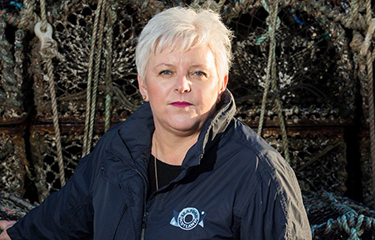
The recent launch of a U.K.-wide Food and Drink Export Council by the Department for International Trade heralds a new era for British exports, according to Seafood Scotland Chief Executive Donna Fordyce, who will be serving on the council representing the seafood industry.
The initiative, set up in response to one of 22 recommendations from a 2021 Trade and Agricultural Commission report, aims to boost U.K. food and drink exports in the post-Brexit and post-Covid trading environment.
“Our task was to advise the U.K. government on how best to advance the interests of farmers, food producers, and consumers in future trade agreements,” Trade and Agricultural Commission Chair Tim J. Smith said in the report.
The need to identify a better trading environment and boost the country’s exports has taken on urgency as poor productivity, a weak business investment, inadequate public services, the damage to trade done by Brexit, compounded by a slow recovery from the Covid-19 pandemic and the global energy crisis, have taken a toll on the U.K. economy. The nation will face one of the worst recessions and weakest recoveries in the G7 this year, according to the Financial Times.
The new council brings together representatives of the food and drink industry, with government export leads for the four devolved administrations (England, Northern Ireland, Scotland, and Wales), in a collaborative approach.
Fordyce told SeafoodSource she is “honored to be able to contribute to the council, which is very much focused on actions.”
“Premium Scottish seafood is highly prized in many key markets around the world, and we work hard to maintain our presence as an individual nation. However, by collaborating and sharing expertise across the rest of the U.K., we can support all food and drink producers to increase exports to existing markets, identify new opportunities for their products, and be part of the economic growth agenda,” Fordyce said.
Fordyce said she plans to tout Scotland’s success in promoting its seafood to the council, and its collaborative approach in working with Scotland Food and Drink’s partnership between industry and Scottish government.
“I am keen to see that this work is not duplicated through future U.K. efforts, which could cause confusion, but that new initiatives amplify and enhance our own efforts,” she said.
Fordyce said the council has much work to do over the next 18 months, which is the initial term for the council. But she said the council already has a forward meeting plan set, has created a workflow process, and has begun identifying key industry players to consult on specific issues.
The U.K.’s 2021 seafood exports totaled 445,000 metric tons (MT), worth more than GBP 1.6 billion (USD 1.9 billion, EUR 1.8 billion), according to data from U.K. government agency Seafish. Though U.K. seafood products were exported to 118 countries, more than two thirds of its total exports by value and volume went to just five countries: France accounted for 181,000 MT, Netherlands took 30,000 MT, Spain received 24,000 MT, the U.S. received 33,000 MT, and the Republic of Ireland imported 18,000 MT. The top five species exported were salmon, mackerel, nephrops, scallops, and herring.
According to Fordyce, around 80 percent of all seafood from Scotland is already exported, and seafood is the country’s second-largest export by value after whisky. However, it is difficult to quantify the value of Scottish seafood exports due to the way in which the U.K. government currently amalgamates all seafood exports in its statistics.
This anomaly is something that Scotland Cabinet Secretary for Rural Affairs and Islands Mairi Gougeon is keen to address. Scotland’s “Strategy for Seafood” report, released in October 2022, calls for better data collection to ensure more-accurate figures on the domestic consumption of landed, farmed, or processed seafood, including its origin, can be independently gathered.
The report also recommends more of Scotland’s fish be landed in the U.K. rather than overseas. Gougeon said a new landing obligation that came into force in January 2023 will support “the wider supply chain and, in particular, our domestic fish-processing sector.”
“Each year, Scottish vessels land around GBP 100 million [USD 120 million, EUR 116 million] worth of fish outside Scotland, often for species for which we have ready processing capacity (herring and mackerel). These changes are an important step in ensuring the people of Scotland benefit first and foremost from our fantastic natural assets and resources,” she said.
The new regulations are not universally popular, and Scottish fishermen’s groups filed a legal challenge in September 2022 to force the government to amend the conditions under which fishing licences operate from January 2023, and remove the landing obligation. The fishermen wish to retain the right to land in Norway during their short fishing seasons, when processing capacity is stretched in Scotland.
But the court intervention was denied, which means that Scottish vessels must now land at least 30 percent of their pelagic quota into a home port this year. This percentage will rise to 45 percent in 2024 and 55 percent in 2025 if further legal challenges are unsuccessful.
Photo courtesy of Seafood Scotland
