



Geopolitical and global economic shifts are driving trade between Saudi Arabia and China, while simultaneously helping the former country achieve its ambitions of dramatically increasing its aquaculture output by 2030.
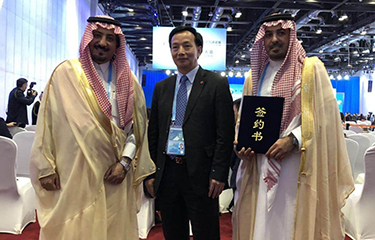
Chinese aquaculture and feed firm Guangdong Evergreen Group inked a memorandum of understanding with the Saudi firm Falcon Vision this past spring, and in June 2023, Zhanjiang Guolian Aquatic Products and Saudi sovereign Public Investment Fund (PIF) signed a USD 560 million (EUR 535 million) deal, which entails the Chinese company receiving various credit lines for business in Saudi Arabia.
Saudi Arabia’s goal of achieving self-sufficiency in its seafood supply – the country’s ambitious Vision 2030, among many other goals, outlines how Saudi Arabia aims to produce 600,000 metric tons (MT) of seafood domestically by 2030 – requires foreign direct investment but also scale, said Gorjan Nikolik, the head of aquaculture research at Rabobank.
“China can assist in achieving both,” Nikolik told SeafoodSource.
That’s a view echoed by Kevin Fitzsimmons, an aquaculture expert and professor of environmental science at the University of Arizona.
“With only one aquaculture venture in Saudi Arabia, smaller operations will need partnerships with bigger international companies in order to gain the technology and operational experience they will need to compete successfully,” Fitzsimmons said.
Fitzimmons said Chinese companies are a good fit to supply Saudi Arabia with labor and technology, as several are “vertically integrated – from manufacturing feed mill equipment and making liners and netting through [to] broodstock, hatcheries, farms, and processing plants.”
From the Chinese point of view, signing deals with Saudi Arabia helps diversify the country’s sources of food supply, according to Oliver D. Nikolovski, the general director of China-based seafood sourcing and trading company Ocean Treasure, which trades shrimp in and out of China.
“Guolian already buys from India, Iran, Mexico, and Venezuela,” he said. “Buying more [seafood] from Saudi Arabia would make sense.”
Ensuring multiple lines of food supply may be even more important for China following its recent imposition of a ban on all Japanese seafood after the release of treated cooling water from the damaged Fukushima Daiichi nuclear plant.
Additionally, partnering with deep-pocketed Saudi Arabia may help the Chinese firms avoid running out of cash and falling short on their ambitious objectives – a problem that has burned Chinese investments abroad in the past. And China is also looking to Saudi Arabia as a source of cash to bail out heavily indebted provincial governments, which often have close financial ties to local seafood firms. The Saudi PIF has established a USD 1 billion (EUR 910 million) investment fund with the municipal government of Shenzhen, a province where much of China’s high-tech manufacturing occurs. Municipal government representatives from Chengdu and Guangzhou have been seeking investments from Saudi Arabia and other petroleum-rich Middle Eastern countries in 2023.
However, Tim Van Vleit, the founder and former director of Singapore-based aquaculture feed startup INSEACT, does not believe Sino-Saudi aquaculture partnerships are necessarily a good move for both sides. Saudi cash would be attractive, he said, but a lack of proven feedstock there would cap production volume.
“If you’re true about running a social impact company, Saudi Arabia probably isn’t the best place [to do so],” he said.
A surge in supply from Saudi Arabia may also affect seafood-supplying nations like Ecuador, which has built its shrimp industry largely on Chinese demand. Quantities of Saudi Arabian shrimp arriving in China remain “very small,” however, so the impact of volumes on local supply and pricing are “limited,” said Pablo Resnik, head of business development at shrimp trading firm Roda International. Any increase in Saudi Arabian volumes would create legitimate competition with Ecuador, though, Resnik said.
Another factor being taken into account in analysis of the budding aquaculture relationship between Saudi Arabia and China is the latter country’s dependence on imported oil, which it’s now getting from Russia at reduced prices due to global sanctions stemming from Russia’s invasion of Ukraine.
“China buys a lot of oil from Saudi Arabia,” Nikolik said. “In the context of the [overall] partnership, the Chinese offer technical assistance, foreign direct investment for aquaculture, a key Chinese global advantage for tropical species, and even an export market.”
An overall partnership between the two nations may also face challenges related to China’s opaque system of government, which in addition to scaring off Western investors, has caused problems for PIF. The USD 778 billion (EUR 708 million) fund’s USD 11 billion (EUR 10 billion) loss in 2022 was partly due to the poor performance of one of its key investments – Chinese e-commerce conglomerate Alibaba – which became the focus of a poorly communicated government crackdown on the Chinese internet economy.
Photo courtesy of Falcon Vision
