






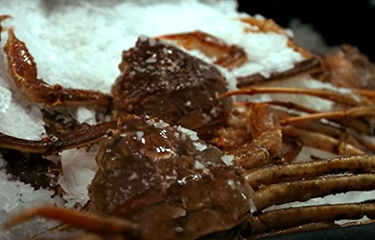
Significant U.S. demand has rescued the Canadian snow crab sector from a potentially disastrous situation.
The United States has imported 44,027 metric tons (MT) of snow crab from Canada year to date through July 2023, up from 39,090 MT in all of 2022, 40,137 MT in 2021, and 36,063 MT in 2020, according to NOAA data. The all-time annual record for U.S. imports of Canadian snow crab is 46,295 MT, set in 2009.
Canada’s leading province for snow crab production is Newfoundland and Labrador, which had a 54,727 MT quota in 2023. In the southern Gulf of Saint Lawrence, the snow crab quota is 35,106 MT, and there is a 7,345 MT quota in Nova Scotia this year.
The season was initially complicated by a a six-week standoff over pricing in Newfoundland that led harvesters to stay tied at the dock until 19 May. Subsequently, Canada’s Department of Fisheries and Oceans (DFO) issued several season extensions for critical fishing zones in Newfoundland, allowing fishermen there to catch 95 percent of the quota, or 51,632 MT, by the season’s end on 31 August. And fishermen in the Gulf of Saint Lawrence and in Nova Scotia caught their entire quotas this season.
With tepid demand going into the season due to inflation and 10 million pounds of Canadian snow crab remaining stockpiled from the 2022 catch, there was deep concern from both processors and fishermen that their earnings would not outpace expenses this year. But demand – and prices – rebounded somewhat as the season progressed, and the stockpiles had been sold through by June 2023, according to Tradex. Along with strong U.S. sales, demand from China and Japan was also better than expected, with sales to China up 133 year over year.
Urner Barry reported pricing moving to USD 5.00 (EUR 4.65) per pound for 5- to 8-ounce clusters by June and USD 6.00 (EUR 5.58) and even above that by the end of the season. Fishermen in Newfoundland were earning CAD 2.60 (USD 1.92, EUR 1.78) per pound by the end of the year, up from CAD 2.20 (USD 1.63, EUR 1.51) at the season’s start.
By value, 2023 U.S. imports of Canadian snow crab were at USD 563.5 million (EUR 524.9 million) through July, down from USD 925.9 million (EUR 862.4 million) in 2022, USD 1.17 billion (EUR 1.1 billion) in 2021 (the all-time high), and USD 610.8 million (EUR 568.9 million) in 2020. While not as lucrative as previous years, Canadian processors were happy to have the work, according to Louise Power, a floor supervisor at the Quinlan Brothers plant in Bay de Verde, Newfoundland, Canada.
"This season has been one of the hardest seasons that we have worked here, because we had to do a lot of crab in a short period of time. We all got through it, and made the season work," Power told the CBC. "Right now, [I'm] happy as a lark.”
Quinlan Brothers President Robin Quinlan said snow crab processors in Newfoundland were moving through 10 million pounds of product weekly.
"We operated 12 weeks straight this year, round the clock. We had no shutdown of the plant whatsoever," Quinlan said. "You had to live through it to be able to convince yourself that it became reality."
The Association of Seafood Producers, which represents the region’s processors, thanked workers for a job well done in an advertisement that ran in local newspapers in early September,
“Thank you to those who work in seafood processing facilities Newfoundland and Labrador,” the ad said. “We're grateful for your hard work and commitment. Your voice should never be ignored, and your strength is a lesson to us all.”
ASP Executive Director Jeff Loder told the CBC he was relieved the instability that plagued the early part of this year’s snow crab season was likely over, and called for change so this year’s crisis is not repeated.
"I think we can all agree that this should never happen again," he said.
Similarly, FFAW-Unifor President Greg Pretty, representing fishermen, met with DFO Deputy Minister Annette Gibbons in July to call for reform.
Loder said he would like to see pricing negotiations begin in September, much earlier than has been done previously.
“It’s my understanding that this perspective is shared by both the province and the FFAW. We will have to see what happens,” Loder told Saltwire. “We cannot have a situation where one party can make a decision to tie up the largest fishery in this province, with all the implications that come with that. “We are the largest, singular, private sector employer in Newfoundland and Labrador. Our labor force deserves to work when there is product to catch. That is the heart of our collective bargaining agreement and it didn’t happen right this year.”
Photo courtesy of the Government of Canada
