




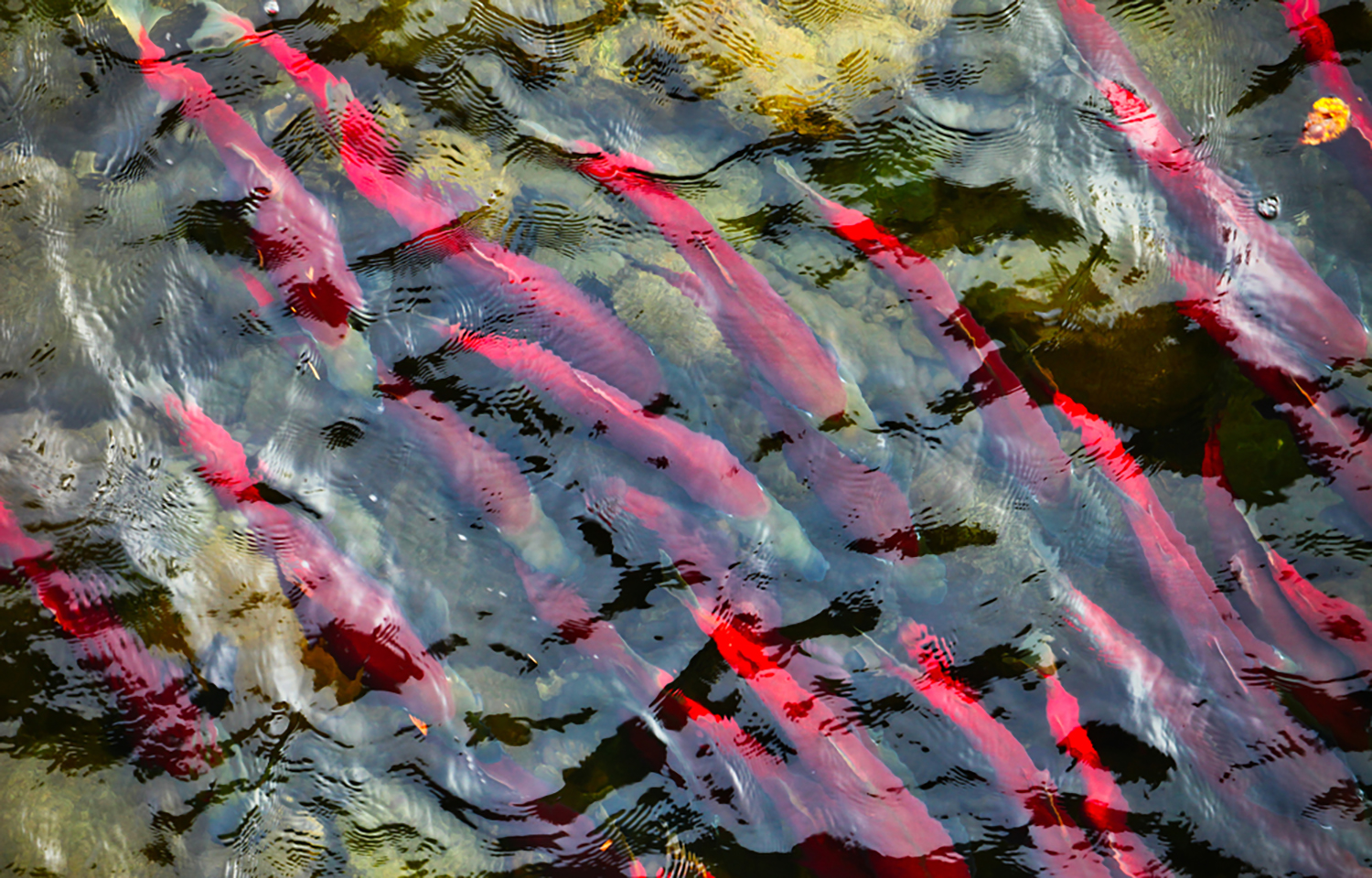
An unexpected bountiful sockeye salmon run on the Fraser River in British Columbia, Canada, has revived hopes for the future of the province’s beleaguered wild salmon fishery, but in the near term, commercial fishers are voicing frustrations at the small numbers they are allowed to catch.
Around 10 million sockeye salmon have returned to the Fraser River this year, marking a nearly three-decade high; however, Fisheries and Oceans Canada (DFO) has allowed commercial fishers to catch only about 2 percent of that total.
Christina Burridge, executive director of the British Columbia Seafood Alliance, said that even though the DFO decision marked the first time in seven years commercial harvesting was permitted for Fraser sockeye, the stringent catch limits prevented fishers from taking advantage of a meaningful business opportunity.
“There's a lot of frustration,” Burridge told SeafoodSource. “Yes, people were glad to be able to go out and get a few fish, but they probably didn't make very much money doing that.”
Burridge said the preseason forecast was for a return of just 2.3 million fish, which was based on a model developed after years of poor returns and scarcity in the fishery. As this year’s season progressed and the run became much better than expected, the DFO never revised its catch limits, Burridge said.
“I think it came as a total shock, and the decision-making structure has not been able to respond quickly,” she said.
The DFO’s nonaction prompted Michael Griswold, a former commercial fisher who had served for 40 years on the Pacific Salmon Commission, to resign his seat on the commission in protest.
In a social media post announcing his resignation letter, Griswold described the DFO management plan for this year’s harvest as “unnecessarily restrictive.”
“DFO no longer manages to optimize production,” Griswold wrote. “In fact, its refusal to allow warranted harvests could negatively affect potential production in some specific systems in the Fraser where strategic population control is absolutely necessary to optimize production.”
Watershed Watch Consultant and Fisheries Advisor Greg Taylor agreed that the DFO’s decision-making should have been more flexible, saying that if escapement goals are met or exceeded, the DFO should have loosened restrictions on commercial harvesting.
“That's what sustainable fisheries management is all about,” Taylor said. “Is there a declining trend in some populations across this province? Absolutely. But, does that mean you cannot fish at all when you do have sudden abundances of different species and stocks? No, not if you believe in sustainable harvest.”
While significant, Taylor said the 2025 Fraser sockeye run puts the fishery in line with historical averages.
“Let's put it in context,” Taylor said. “It really takes us back to where we were in the 1980s and ‘90s. So, yes, it's great compared to the last couple of decades, but is it from a historical point of view? No, it's average.”
Taylor and other Fraser River observers and stakeholders have speculated whether the Canadian government’s decision to remove fish farms from the Broughton Archipelago and Discovery Islands – areas in close proximity to juvenile salmon migratory routes – played a role in this year’s rebound.
Taylor said while “correlation is not causation,” the closure of the fish farms should put a focus on the aquaculture industry to prove operations aren’t adversely affecting wild species.
“For years, the onus has been on the opponents of fish farms to prove they aren't deleterious to salmon,” he said. “When we see these kinds of returns right after the fish farms are removed, it changes the onus for those proponents of fish farms to prove they don't impact wild salmon.”
Recent studies have pushed back against these types of claims.
A May study showed that wild salmon populations in the Discovery Islands continue to have high levels of sea lice, despite the closure of all salmon farming in the region.
More recently, a study found evidence that the removal of salmon farms in British Columbia has had no impact on the number of sea lice found on wild salmon in the Broughton Archipelago.
“In British Columbia, the proximity of juvenile salmon migratory routes to open net-pen salmon aquaculture sites led to an assumption that most, if not all, sea lice infesting the juvenile salmon originated from infestations on farmed salmon,” the paper stated.
Based on the study, sea lice concentrations on wild salmon in 2024 were higher than sea lice concentrations on wild salmon in 2019, when salmon farming was at its highest production in the last decade in the area.
Nevertheless, another explanation for the 2025 run, according to Taylor, could be cooler ocean temperatures that came about as the result of an 18-month period of La Nina weather patterns.
“If there is one trend I would point to is that we are seeing the benefit of better ocean conditions for those populations that tend to go to sea quite quickly after hatching or don't delay in streams,” he said.
Looking ahead, Burridge said despite the current limits placed on the commercial fishery, the 2025 Fraser sockeye run is an encouraging sign.
“I think it's been very disappointing for us, both on the harvesting side and the processing side, but it does give us grounds for optimism for next year,” she said. “We will have to work with the DFO and the Pacific Salmon Commission to find something that's more flexible to respond to actual conditions on the water, rather than what a model says.”
