






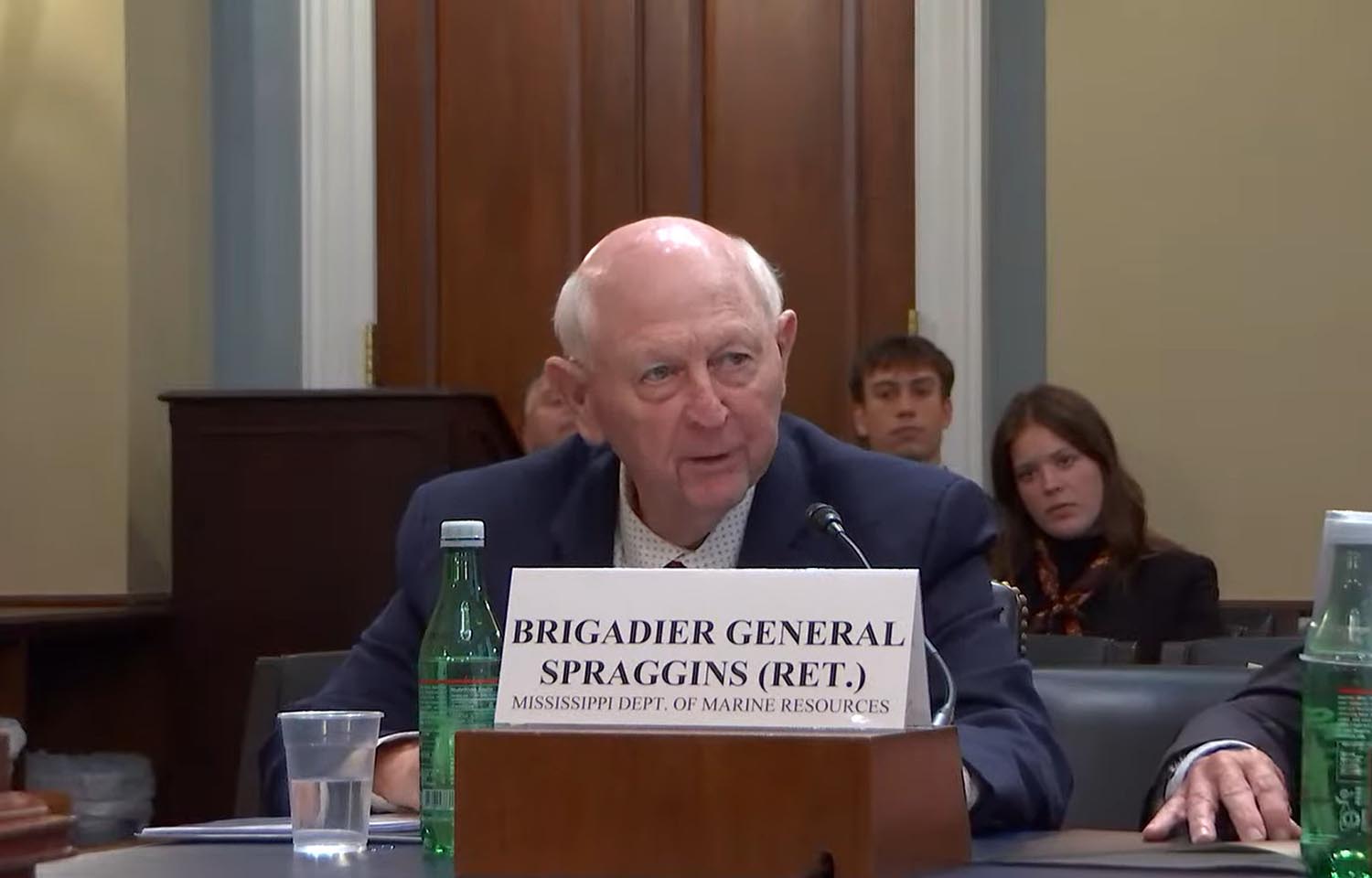
A Mississippi state official testified in favor of expanding state fisheries control from three to nine nautical miles off the coasts of Louisiana, Mississippi, and Alabama, a change proposed in the recently introduced Offshore Parity Act.
Advocates of the legislation claim it’s unfair that Texas and Florida are able to control fishing up to nine nautical miles off their coast, while the three other Gulf states only control three nautical miles due to the Submerged Lands Act of 1953. During a 3 June hearing held by the U.S. House Subcommittee on Water, Wildlife and Fisheries, Mississippi Department of Marine Resources Executive Director Joe Spraggins told lawmakers it was critical to his state’s fishers to expand state control.
“It would help us to equalize ourselves with the other two states, with Mississippi, Alabama, and Louisiana all being able to go to nine miles” Spraggins said.
Spriggins also testified that the Offshore Parity Act would support state shrimpers, giving them more area to harvest from. Current law restricts state shrimpers to harvesting within three miles of the shore, meaning they are unable to trawl fishing grounds that shrimp go to after they head south of the coastal islands, Spraggins said. Those areas are also seeing less fishing pressure due to the declining number of federally permitted shrimp vessels.
“Our local shrimpers need to be able to go out nine miles so they can be able to shrimp and not have a federal permit to do that,” Spraggins said during his testimony. “This would allow us to be able to have shrimp and fish on our docks with us almost year-round.”
“By passing the Offshore Parity Act, you will increase access to the productive shrimping grounds of the north-central Gulf of America and not only bolster the availability of shrimp to the market but expand the state-licensed vessels ability to participate in this fishery year-round,” Spriggins added in his written testimony.
Equalizing state control would also reduce confusion for fishers over who controls fishing for what species in the Gulf of Mexico, where invisible boundaries can see fishers moving between neighboring state jurisdictions and federal jurisdiction.
“The disparity in jurisdiction can cause confusion for anglers that cross jurisdictional waters, or even transit over to other states for vacations centered around enjoying the coastal waters of those states. This confusion often leads to uncertainty in harvest regulations which require clarification directly from state fisheries agencies and at worst, fisheries violations due to assumed consistency when fishing amongst neighboring states,” Spraggins said in his submitted testimony.
Confusion is also caused by the fact that reef fish are governed differently than other species, with all five Gulf states controlling fishing up to nine nautical miles out for those species. When other fish are encountered by those primarily seeking reef fish, it can become complicated what regulations apply, Spraggins said.
Similar legislation was introduced in the last Congress, but was not acted upon by lawmakers.
