




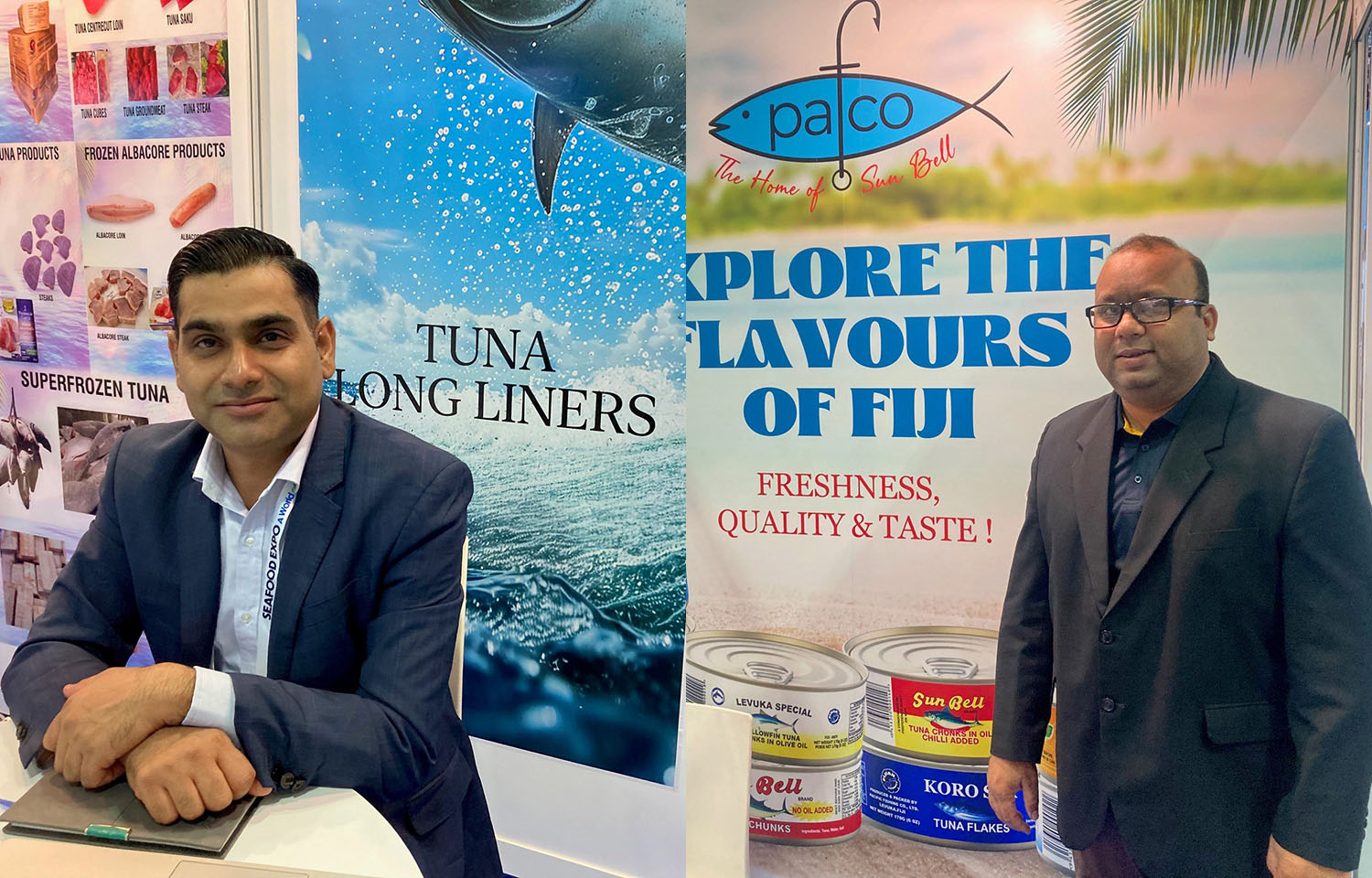
Fiji’s seafood industry is back on its feet after the Covid-19 pandemic and is seeking to expand its international exports, according to representatives of two of the country’s largest firms.
Pacific Fishing Company, or Pafco, is running double shifts at its tuna-canning facility in Levuka, Fiji, according to CEO Saiyad Raiyum.
“Supply of fish has been really good. So far this year, we've been doing really well,” Raiyum told SeafoodSource at the 2024 Seafood Expo Asia in Singapore, where the company was exhibiting.
Unlike most other seafood products, demand for canned seafood remained steady throughout the global inflationary crisis of the past two years. Pafco has concentrated on locking down the Pacific regional market with flavors geared toward local tastes such as its Sun Bell Curry Tuna Flakes and its Tuna Flakes in Coconut Cream.
“We keep improving our products and adding new flavors,” Raiyum said. “We want to be the favorite brand of the South Pacific.”
Pafco sells its canned products in Australia, New Zealand, Papua New Guinea, Samoa, Tonga, and the United States. It also sells fishmeal to Saudi Arabia and Japan and has a large business selling frozen loins to major customers in the U.S. Raiyum said the company has targeted North America and Europe as key growth markets, but he said expansion may take longer than expected.
“Demand for canned food products, while there is stability in the U.S., is not as great as it used to be,” he said. “In the Covid period, we saw a much bigger hike than anyone anticipated. However, as people have returned more to work and things have opened up – restaurants and everything – there's been a bit of a hit on the products that are on the shelf in supermarkets; people are more inclined to go and eat out again, as opposed to cooking at home, and canned food is definitely taking a bit of a hit because of that.”
As for conditions in Fiji, Raiyum said there are “no issues.”
“The Western and Central Pacific Ocean has a healthy and sustainable fish supply,” he said. “There is a shortage of labor, but that is a global problem, and in Fiji, it is variable. For us, labor supply is not an issue except in one or two technical areas.”
Raiyum said Pafco will continue to explore avenues to grow its global presence, with continued assistance from the Forum Fisheries Agency (FFA), an organization helping to manage, control, and develop Pacific Islands tuna fisheries.
“I can clearly say FFA is doing a wonderful job. They have been stalwarts behind us through Covid and being here [at Seafood Expo Asia] and helping us go to [Seafood Expo Global in] Barcelona and [Seafood Expo North America in Boston] to showcase our products is only because of their support.”
Raiyum said he wants the global seafood industry to know that Fiji and Pafco are “open for business.”
“All of us from Fiji, we want the world to experience our products and know that we are happy to discuss new ventures,” he said.
Suva, Fiji-based Hangton Pacific is also looking to grow its overseas business, according to the company’s finance manager, Ashneel Chand. The deep-sea longline fishing firm supplies Marine Stewardship Council-certified fresh and frozen whole tuna to the U.S., Japan, and New Zealand.
As a Fijian company, Hangton Pacific has status that gives it access to fish in the country’s exclusive economic zone. It catches around 1,500 to 1,700 metric tons of tuna annually – consisting of around 50 percent albacore, with the remainder yellowfin and bigeye – from five fishing vessels, four of them newly built.
A new Chinese owner, now a Fiji resident, has helped stabilize the company’s finances and give it a more concentrated business strategy. At one point, Hangton Pacific was operating as many as a dozen vessels, but in recent years, it downsized as its fleet aged and it prioritized investment in a smaller number of newer ships.
“We had to bring it down because the maintenance costs were high,” Chand said. “A big thing in Fiji’s fishing industry is the funding issue. There’s no funding facility in Fiji for construction of boats. It’s a big challenge to our hopes for expansion.”
The reduction did help the company address a labor shortage in Viti Levu, the island where the company is based. Suva is Fiji’s main fishing hub, and qualified labor is scarce there and quickly snapped up, according to Chand. As a result, Hangton Pacific has had to rely on foreign crew to man its vessels, and that, in part, led to issues that resulted in its Hangton No. 112 receiving a withhold release order (WRO) from U.S. Customs and Border Protection (CBP) in August 2021.
Hangton Pacific General Manager Jitendra K. Mohan told SeafoodSource at the time his firm was working to improve its treatment of foreign workers and align its processes with international standards.
“Overall, [we] have identified some areas we have to get more involved,” he said. “As it seems, actions and conduct of recruiting agents needs greater scrutiny and monitoring."
According to the Fiji Sun, Hangton Pacific is a supplier of tuna to the Pafco, which has a processing agreement with Bumble Bee Seafoods.
In a statement, a CBP spokesperson said the agency has not received a petition to modify the WRO against Hangton No. 112 to date.
“The WRO remains in effect until Hangton No. 112 no longer utilizes forced labor in violation of 19 U.S.C. § 1307,” the spokesperson told SeafoodSource. “CBP will not modify the WRO until Hangton No. 112 has demonstrated and documented its remediation of International Labor Organization indicators of forced labor.”
If Hangton Pacific chooses to apply to modify or lift the WRO, it must first apply to CBP and then go through an audit process.
“In determining whether a WRO or finding should be modified, CBP determines that the foreign entity subject to the WRO or finding has remediated all indicators of forced labor. To successfully modify a WRO, modification petitions include but are not limited to an initial audit, corrective action plan, and verification audit,” the spokesperson said.
Chand and Mohan did not respond to requests for additional comment as to whether the company has changed its employment practices or whether it planned to request removal of the WRO.
As it has scaled back on its fishing activity, Hangton has diversified its business into fleet services in Suva. Three subsidiaries concentrate on ship-boarding clearance, immigration, customs, and regulatory compliance issues; vessel maintenance, container handling, life craft sales, pest control, and other support services; and fuel provision.
“It's a good business strategy so we're not so dependent on tuna, which is up and down and can be very hard when the season is not good,” Chand said. “This way, we are able to maintain our cash flows and profitability and look after our workers.”
Right now, however, the fishing side of Hangton’s business is holding its own.
“It's improving,” Chand said. “It was down the last four to six months, but it has been busy and catch is good now.”
The company has also gotten involved in fishmeal production and selling bycatch to the local market, which includes hotels and resorts catering to the many tourists who flock to the islands.
Chand said Hangton Pacific and other Fijian fishing firms are holding their own through ingenuity and hard work, but without a bigger commitment by the government to the local industry, the industry is destined to come further under foreign control.
“Chinese and Taiwanese vessels are coming to international waters around Fiji to fish, but there is some Chinese ownership of Fijian vessels. That’s OK because they take that risk with their capital,” Chand said. “At the end of the day, Fiji is quite small. We hoped we would have done that, but it seems that maybe we will have Chinese or Korean capital come in because they are very smart and have that expertise in fishing, and they have the financing and the willingness to take a risk."
Chand clarified his comments were not meant to impugn foreign investment in Fiji.
“I don't think that's so bad – just that we should expect it,” he said.
