






Vietnam’s seafood industry is entering the fourth quarter of 2026 with exports still growing, but momentum is slowing as tariffs, softer demand, and tighter market conditions weigh on the sector’s Q4 outlook.
Seafood exports reached more than USD 8 billion (EUR 7 billion) in the first eight months of the year, rising 11.9 percent from the same period in 2025, according to the Vietnam Association of Seafood Exporters and Producers (VASEP), citing Vietnam Customs data. August exports were worth USD 1.14 billion (EUR 1 billion), marking a 6.4 percent increase year over year but representing slowed growth compared to the rest of the year.
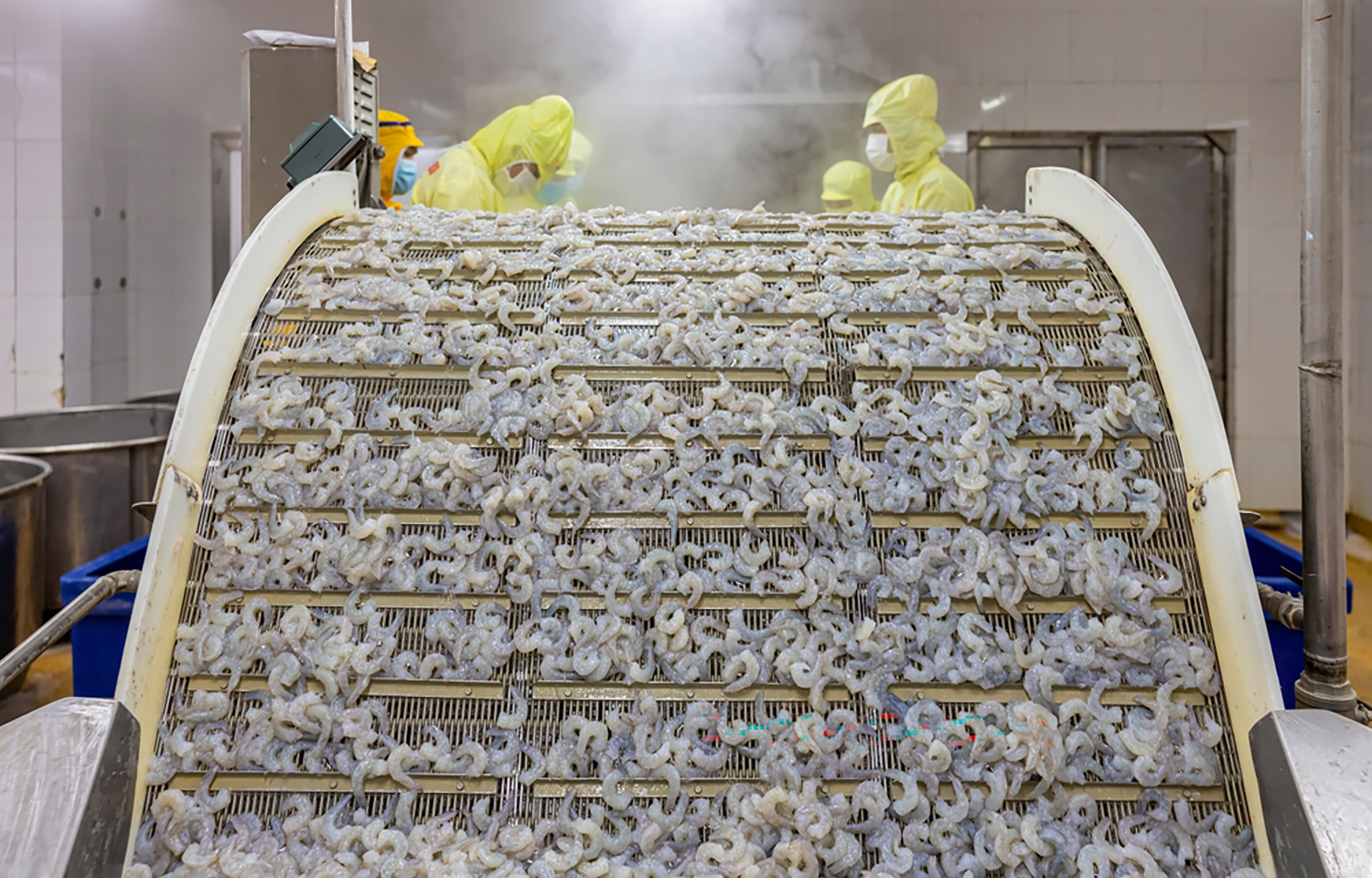
Shrimp remained Vietnam’s largest seafood export category, generating USD 478.5 million (EUR 420.6 million) in August and nearly USD 3.28 billion (EUR 2.9 billion) during the first eight months of the year, up 4.2 percent and 12 percent, respectively.
China, including Hong Kong, was the main growth market for shrimp over the eight-month period, with exports reaching nearly USD 1.12 billion (EUR 984.6 million), surging 35.9 percent year over year and accounting for 34.1 percent of Vietnam’s shrimp export value. By contrast, exports to the U.S. fell 11.7 percent to USD 436.1 million (EUR 383.4 million), while shipments to the E.U. declined 3.6 percent to USD 355.3 million (EUR 312.3 million).
This comes as domestic raw material conditions have tightened.
Minh Phu Seafood CEO Le Van Quang told SeafoodSource his company was facing a serious shortage of raw shrimp for contracts awaiting shipment. His firm currently has shipments for the U.S., Canada, and E.U. that need to be completed by the end of October, followed by Australia by mid-November and Japan and South Korea by mid-December.
Meanwhile, prices for shrimp have somewhat recovered from early August lows, but Quang said they still are not in an ideal spot as the year hits its final quarter.
“Prices are so low that Ecuadorian shrimp farmers are also losing money,” Quang said, describing the situation as a “paradox.” Prices for other food products, including marine fish, squid, octopus, chicken, pork, and beef, have surged by 20 to 50 percent, he said, while shrimp prices have not experienced meaningful increases.
Elsewhere, pangasius exports totaled about USD 1.52 billion (EUR 1.34 billion) in the first eight months of 2026, representing an increase of around 10 percent. Mainland China remained the largest market, with shipments reaching USD 417 million (EUR 366.6 million), marking an increase of 29 percent.
The U.S. market was much weaker, as pangasius exports from Vietnam to the U.S. fell 49.3 percent in August and were down 13.2 percent over the first eight months. Top exporter Vinh Hoan reported on 8 September that its sales to the U.S. also dropped 28 percent in August and 15 percent on the year to VND 231 billion (USD 8.9 million, EUR 7.8 million).
Tuna exports have experienced small year-over-year growth.
Vietnam shipped nearly USD 90 million (EUR 79.1 million) of tuna in August, which was up 2 percent year over year. The U.S. remained the nation’s largest tuna market, with exports reaching USD 248 million (EUR 218 million) over the first eight months, which was up 8 percent. Russia was among the fastest-growing destinations, with shipments increasing 56 percent to USD 38 million (EUR 33.4 million) over the same time frame.
The U.S. is likely to remain a key concern for the Vietnamese seafood sector as the year winds to a close.
Overall seafood exports to the market decreased 3.8 percent in August to USD 182 million (EUR 160 million). Cumulative exports were still 1.5 percent higher after eight months, but shrimp and pangasius were both lower than a year earlier, VASEP said.
VASEP pointed to weaker U.S. retail conditions, with sales of both fresh and frozen seafood down by more than 7 percent in August, while elevated inventories have prompted importers to limit new purchases and push harder on prices.
Trade measures are adding further pressure. VASEP said an additional 12.5 percent Section 301 tariff has applied to a range of Vietnamese seafood products since 24 July. Depending on the product and exporter, the tariff may be applied alongside most-favored-nation duties and, in some cases, antidumping or countervailing duties.
Pangasius exporters are also dealing with the final results of the latest U.S. antidumping duty administrative review announced in August, while shrimp exporters are awaiting the final results of another antidumping review expected in early November.
Regulatory requirements, including U.S. Marine Mammal Protection Act rules affecting some seafood products, forced labor controls, food safety requirements, and customs scrutiny, are further adding to compliance pressure.
Performance in other markets remains mixed. Vietnam’s seafood exports to the E.U. contracted 6.2 percent in August, with shrimp down 23.5 percent, tuna sliding 15.6 percent, and squid and octopus shrinking 32.4 percent. Pangasius was an exception, climbing 33.3 percent.
China, including Hong Kong, remained a major source of growth for the overall seafood sector, with export value exceeding USD 2 billion (EUR 1.76 billion) over the first eight months, up 32 percent, though August growth slowed to 16.5 percent.
ASEAN markets also continued to expand as a destination, with Vietnam’s seafood exports to the region rising 17.4 percent in August. Tuna, shrimp, squid, and octopus all contributed to the increase.
Vietnam is targeting seafood export value of around USD 12 billion (EUR 10.6 billion) in 2026 as a whole. With more than USD 8 billion already generated over the first eight months, achieving the target would require average monthly exports of close to USD 1 billion (EUR 879 million) over each of the final four months.
