






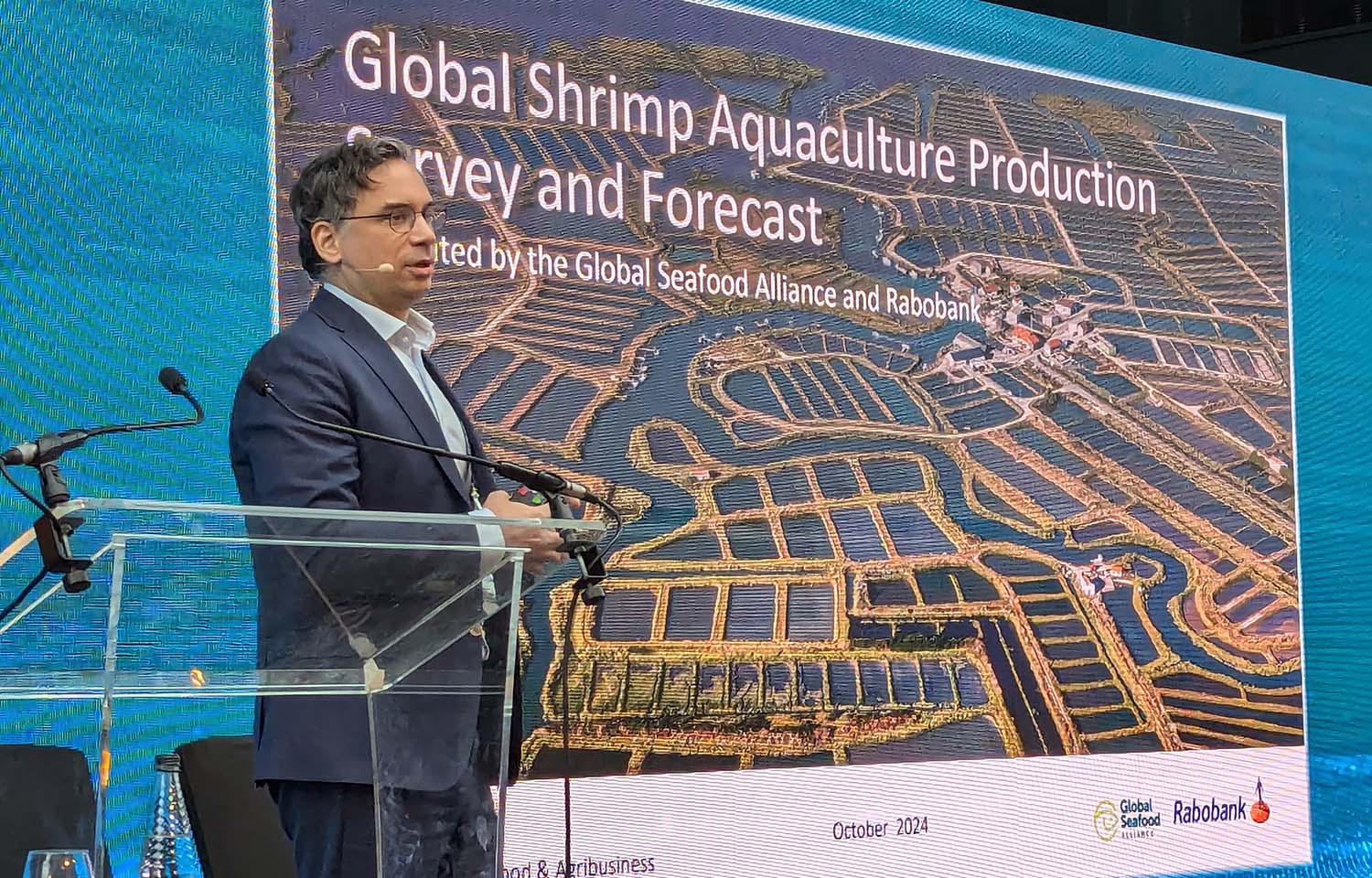
After several consecutive years of impressive growth, the global shrimp aquaculture industry is predicted to remain relatively flat in 2025 – largely due to slowed growth in Ecuador.
According to Rabobank Global Seafood Specialist Gorjan Nikolik, the results of a recent survey – performed for the Global Seafood Alliance – found Ecuador’s shrimp production is slowing after averaging an incredible 14 percent year-over-year growth rate for eight years. Nikolik shared the results at the Responsible Seafood Summit in St. Andrews Scotland, revealing that industry expects Ecuador’s growth will slow to around 3 percent as other major producers see production drops.
“As our survey indicates, 2024 is going to be a marked slowdown,” Nikolik said of Ecuador. “I called my contact in Ecuador to check just a few days ago if that’s still holding, and he said ‘yep, that’s pretty close.’”
Nikolik added that some of that could depend on whether demand for Ecuadorian shrimp rebounds in China. The survey was performed before China announced a major stimulus package which led to soaring seafood stocks. That could impact Ecuador’s production in 2025.
Mexico, the second-largest producer in the Americas, is also seeing slower growth. The GSA survey predicts it will increase by between 3 and 4 percent in 2024 and 2025.
In contrast to Ecuador and Mexico, Brazil is seeing fast growth.
“They had problems with disease back in 2016, '17 and '18, but they've recovered strongly,” Nikolik said.
The country saw 20 percent growth in its shrimp production last year, and will likely see 10 percent growth this year and next year to reach over 160,000 metric tons (MT) of production.
Even with strong performances in other countries, overall production in South America will remain relatively moderate because of Ecuador’s massive share of the industry.
“Ecuador absolutely dominates South American production for a country of that size. They’re an example of one of the great success stories in global aquaculture,” Nikolik said. “And largely because of them, the slowdown is happening.”
Nikolik credited that slowdown to weaker shrimp prices and the aforementioned lower demand from China.
As Ecuador’s massive shrimp production growth begins to slow, India’s shrimp production is starting to contract. According to the GSA survey, India is predicted to have lower production in 2024 and see moderate growth of around 2 percent in 2025. That will leave it roughly flat overall.
“I think everyone expects India to go down in 2024 – I’m not sure they actually did, but this is the survey response,” Nikolik said.
According to the GSA survey China’s production will increase slightly in 2024 and 2025, building on a big increase in production in 2023.
“After that big growth in 2023, they’re slowing down, but still relatively positive because of a lot of new technologies in China,” Nikolik said.
Vietnam continues to struggle. In 2023 the country had an 8 percent decline in production. That will recover somewhat, rising by 1 percent in 2024 and 4 percent in 2025, but the production will still be relatively flat.
“Vietnam really had a tough time in the low price environment,” Nikolik said.
Indonesia is largely facing the same struggles, with production contracting in 2023 and estimated to remain flat in 2024 and 2025.
“They were very exposed to the U.S. market, and they had really tough competition both in Bangalore and India and really low prices,” Nikolik said.
Thailand is also predicted to remain flat, with prodcution remaining well below historical levels.
“Years ago when the EMS crises came, they lost their market share and never really recovered,” Nikolik said.
Production there is estimated to increase 2 percent, to roughly 400,000 MT.
Other producing countries in Asia – Bangladesh, Philippines, and Malaysia – are predicted to have either relatively flat production or production declines in 2024 and 2025. Saudi Arabia and Iran, which both saw impressive growth from 2010 to 2022, are also predicted to remain flat or decline based on the GSA survey.
Overall, signs point to Asia remaining relatively stagnant.
“Asia had been growing pretty well historically, and now we are in a flat period,” Nikolik said.
That flat period is largely related to the low prices, which factors into the supply and demand equation on shrimp production, Nikolik said.
“In 2024, every major market contracted, so that, of course, results in the weakest growth that we’ve seen in a long time for the shrimp sector,” Nikolik said.
However the survey found some small glimmers of hope for the shrimp sector for 2025, and the entire industry may manage to see a 2.5 percent increase.
“I think we will see better years in the future, but this is just a consequence of the market dynamics that we’re seeing,” Nikolik said.
