






Global tilapia production is on track to surpass 7 million metric tons (MT) in 2024 as the species rebounds from Covid-19-related drops in production.
According to Rabobank Global Seafood Specialist Gorjan Nikolik, Rabobank data and a recent survey performed for the Global Seafood Alliance estimates that total tilapia production worldwide will reach 7 million MT in 2024, an increase of 4.2 percent over 2023. The data, revealed at the Responsible Seafood Summit in St. Andrews, Scotland, shows tilapia production has rebounded after it dropped below 6 million MT in 2020.
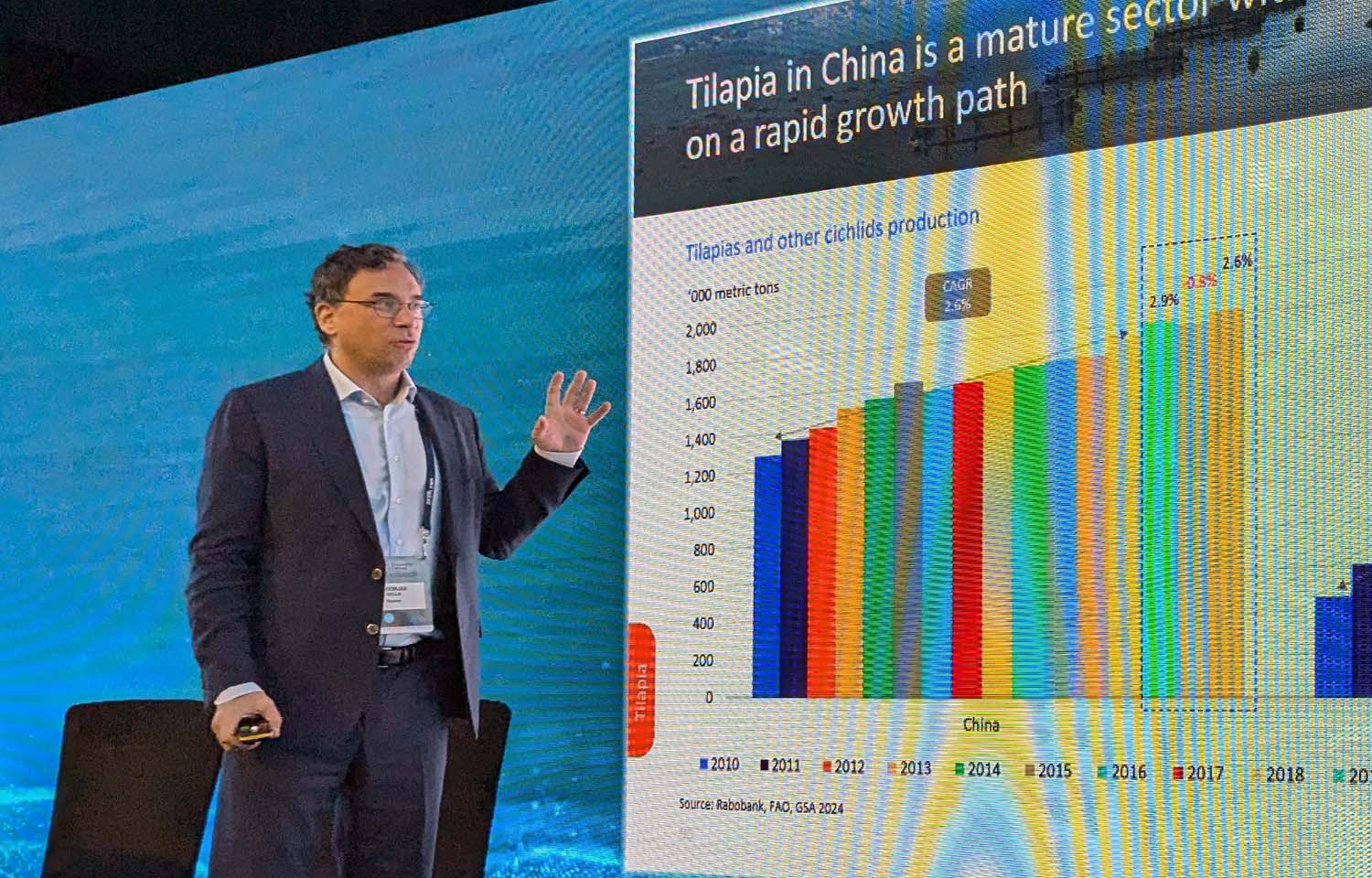
China, the largest producer of tilapia in the world, will see production drop slightly in 2024 but increase again in 2025, according to Nikolik's estimates.
“China and Indonesia are the two big producers of tilapia, and I have to say growth is still continuing,” Nikolik said. “I really thought that for a while Chinese tilapia was going to slow down.”
Indonesia, the second-largest producer in the world, will continue on a growth trajectory and build on a 6.6 percent increase in production in 2023. Based on Rabobank’s data, Indonesia could be approaching 1.6 million MT of tilapia production in 2025.
“Indonesia is truly impressive, a 9.6 percent historical growth rate,” Nikolik said.
Most of Indonesia’s production serves the domestic market, and despite its high growth rate and large supply, the country’s production is continuing to grow.
Bangladesh is also continuing to grow despite high growth, though at a slower rate. The country has an annual growth rate of 25 percent and is still predicted to grow 8 percent in 2023 and 3 percent in 2024 to reach 400,000 MT of production.
The Philippines is maintaining its production at around 250,000 MT, and Rabobank predicts it will remain flat or grow slightly in 2025.
Thailand, another big Asian producer, will grow by as much as 10 percent in 2024, and according to Rabobank, it could surpass 300,000 MT of tilapia production.
Vietnam is also seeing increased production, Nikolik said.
“Vietnam is interesting. They’re putting tilapia now alongside pangasius in parts of the country,” Nikolik said. “They have a huge aquaculture industry already, and it’s growing well.”
In Africa, production is also increasing. Egypt’s tilapia industry is projected to begin recovering from a big drop during 2020, when the country’s production dropped below 1 million MT and stayed there for three years.
“Tilapia is from the Nile originally, so no wonder the Egyptians are so good at making it,” Nikolik said. “For a while, I thought, ‘There’s a drop here. They’re going to be flat.’ But now, most of the respondents had a pretty good view of what was going to happen – 4 percent last year and then 2 percent to 3 percent growth the next year, so a pretty respectable return of the growth. I imagine the falling commodity prices could help this industry.”
The bigger story in African production is the rest of the continent, where tilapia production has become one of the fastest-growing aquaculture industries in the world. According to the survey and Rabobank’s data, tilapia production increased by 29 percent across the rest of Africa in 2023 and is projected to grow by 20 percent in 2024.
The leader in Africa outside Egypt is Zambia, which, referencing preliminary data, grew 36 percent in 2023 to over 100,000 MT and then by 43 percent again to reach over 140,000 MT in 2024.
Ghana, Kenya, Uganda, Nigeria, and Zimbabwe are also all showing increased growth.
“We’ve always said that that part of the world is perfect for tilapia. They have the water, and the population really likes the species,” Nikolik said. “They have all the requirements – both the market and the supply side conditions – to have a booming industry.”
Latin America, the last major tilapia-producing region, is also expected to see growth. Brazil is the dominant producer in the region, with an 8.4 percent compound annual growth rate over the last decade. Rabobank’s data indicates that growth will continue, with its tilapia production increasing 8 percent in 2023 and 9 percent in 2024. By 2025, Rabobank predicts the country will produce over 500,000 MT of tilapia.
“Brazil is similar to sub-Saharan Africa. We always knew they had the market, the capacity, and the cost of feed, so they could be a tilapia giant,” Nikolik said.
The two other major Latin American tilapia producers, Colombia and Mexico, will also see increases. Colombia will increase by 7 percent and Mexico by 1 percent, according to Nikolik.
All told, global production will now be over 7 million MT in 2025, with the industry adding 1 million MT of production from 2020 to 2024.
“These are big numbers here,” Nikolik said. “This is really the chicken of the sea, and it’s growing well.”
