



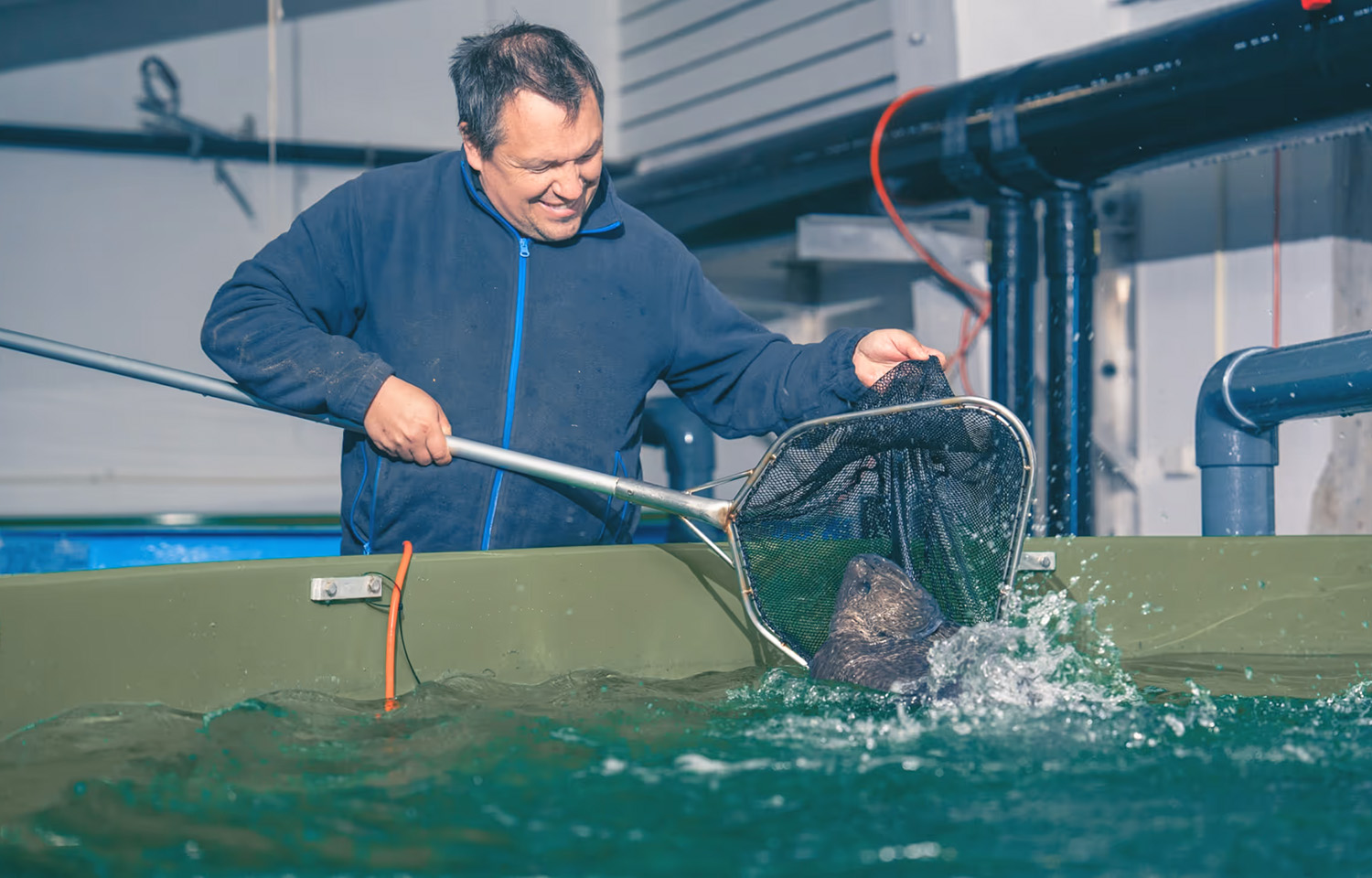
Avaldsnes, Norway-headquartered aquaculture firm Amar Seafood has been hard at work expanding a former hatchery facility into a full-fledged land-based farm in Prince Edward Island (PEI), Canada, that will eventually produce nearly 600 metric tons (MT) of halibut and spotted wolffish annually.
The only company in North America with a mature broodstock of both Atlantic halibut and spotted wolffish, Amar joins just one other company in the world – Norwegian aquaculture firm Aminor – in farming wolffish at scale.
While halibut will still remain a focus, Amar said wolffish in particular epitomizes its strategic bet on sustainability and market differentiation and is, simply, a remarkable whitefish, according to the firm.
“We’re going to continue supplying halibut, but our focus is on wolffish,” Amar President Knut Trellevik said.
Currently, global wolffish aquaculture production totals just under 100 MT, Trellevik said, with the majority coming from Aminor.
Amar’s current output is small – just 8 MT this year, with plans to double that total in 2026 and triple it again in 2027.
Rather than flood the market, Amar said it is taking a slow, strategic approach to its production, supplying a curated list of high-end restaurants in Toronto, Montreal, Vancouver, and Halifax, as well as select clients in South Korea and, soon, the U.S.
“Top chefs don’t need to be educated about this fish. It’s fatty, firm, easy to cook, and forgiving with heat. They love it,” Trellevik said. “There is little in the market since it cannot be caught in Canada or the U.S. It’s what the market wants, and we’re the only ones who can provide it fresh in North America.”
Native to the North Atlantic seafloor, the species is protected from wild harvest in Canada and the U.S. due to population concerns, and is mostly caught as bycatch in Norway and Iceland, making supplies of fresh wolffish almost nonexistent.
Spotted wolffish fillets offer yields of up to 55 percent, and the meat has drawn taste comparisons to premium species like Chilean sea bass, Amar said. The species is also uniquely suited to land-based aquaculture, according to Trellevik, who said they’re calm, social, and efficient growers.
“They eat, they sleep, and they don’t swim around nervously like salmon,” he said.
Another appealing factor for farmers is that spotted wolffish have high growth rates in captivity at high densities.
“You can keep them at higher densities with virtually no stress,” Trellevik said.
Wolffish larvae also hatch fully formed with functional digestive systems, eliminating the need for costly live feeds like rotifers or algae, according to the Global Seafood Alliance. Additionally, the fish carries an exceptionally low mortality rate.
Fertilization rates now exceed 90 percent for Amar, and survival from egg to larva has jumped from 45 percent to a projected 70 percent for the company’s next cohort. Amar also touts that it now experiences virtually no mortality events.
“We’ve cracked the code,” Scott Travers, the CEO of Amar Seafood PEI, said. “Now, it’s about scaling responsibly.”
Amar originally entered the wolffish space in 2017, taking over stock from a university project in Quebec after sources of funding dried up for the initiative. When a struggling halibut farm in PEI then went bankrupt in 2022, Amar acquired it and began developing strategies to modernize the site, including plans for new chillers, advanced water systems, and a two-site production flow: broodstock and hatchery on one side of the road at the existing facility and grow-out tanks on the other in a new facility that will be built starting this year.
The PEI location, Travers said, offers a key competitive advantage.
Beneath the surface of the eastern province lies porous sandstone with what are essentially fissures containing seawater from the Atlantic Ocean, Travers explained. By drilling wells in specific locations, Amar can access clean, cold seawater with minimal treatment, without having to use long pipes to the seashore.
“We don’t filter it. We don’t chlorinate it. It comes straight from the well and goes right into the system,” he said. “No microplastics, no heavy metals – and we return it to the ocean cleaner than it came in. There is also no impact on local freshwater.”
This water quality, combined with magnetic chillers and fine-tuned feed, is central to Amar’s goal of mimicking wild conditions while accelerating growth. Wolffish typically take three to four years to reach market size, which is longer than salmon, but Amar said its temperature stability and in-house diet formulation are cutting into that lag.
“Standard marine feed isn’t optimized for wolffish. We’re tweaking the recipe constantly to improve conversion and growth,” Trellevik said. “We’re now only two to three months slower than salmon, and we’re improving each cohort.”
To continue optimizing its wolffish production as much as possible, Amar collaborates with Aminor, Memorial University in Newfoundland, and Quebec research groups, sharing knowledge in an effort to boost the nascent aquaculture subsector.
Amar is pacing its expansion to match supply with demand, but if the company’s trajectory continues as planned, it believes wolffish could represent an exciting new chapter in North American whitefish production.
“It’s kind of a ‘build it and they will come’ model,” Travers said.
