


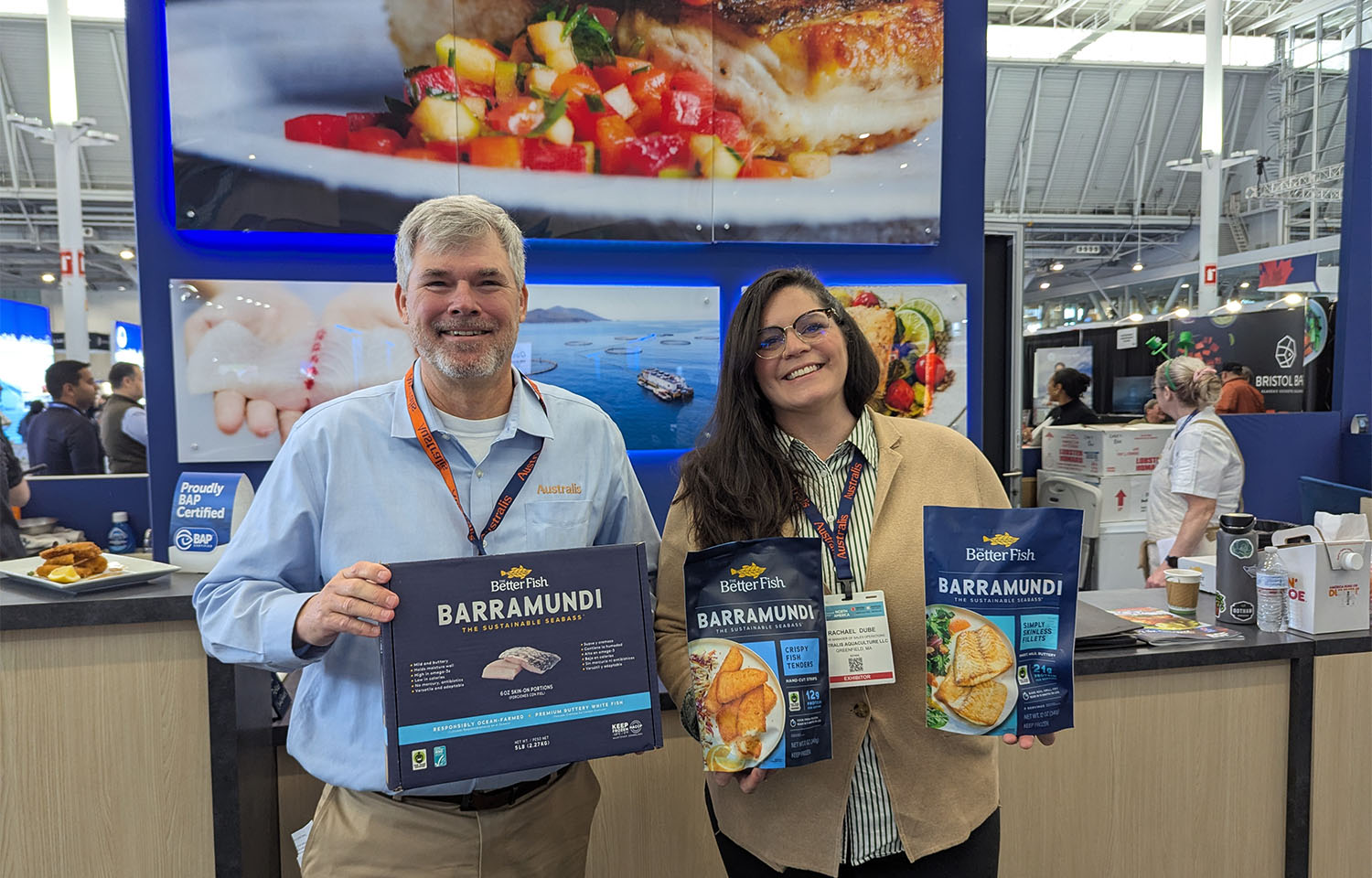
Barramundi producer Australis Aquaculture is continuing to scale up production as it closes in on finishing a customized processing plant that will make the firm a fully vertically integrated company.
Australis was founded in 2004 in Western Massachusetts as a recirculating aquaculture system (RAS) company producing barramundi.
Australis Aquaculture President Jason Paine told SeafoodSource at the 2026 Seafood Expo North America – which ran from 15 to 17 March in Boston, Massachusetts, U.S.A. – that demand for the company’s products quickly outpaced the 500-metric-ton (MT) capacity of the RAS facility.
In 2008, the company branched out to produce its barramundi at ocean-based cages in Vietnam and has steadily increased production to 7,500 MT – with the capacity to increase that to up to 50,000 MT per year.
Paine said the company uses a land-based hatchery where it sources all its seed stock for its net pens.
“They spawn every month. We grow them 60 to 90 days to about 60 to 100 grams, and then we transfer them to the marine sites where they grow about 18 months,” he said. “So, it’s just under two years for the full production cycle from egg stage to harvest.”
Harvests occur at night to minimize stress on its fish, and the company uses the "ikejime" method to ensure the highest quality possible.
Paine said the company is currently working on expanding in two ways – production growth and processing.
“We’re currently doing test growouts in the southern region of Vietnam, so we’re stocking fish. We expect to have over 1 million fish stocked by the end of this year,” Paine said. “In the southern region, we have slightly warmer water temperatures, and the fish really perform exceptionally there, so we’ll have two hubs where we’ll be growing fish.”
In addition to the new farming area, Australis Aquaculture is also actively building a new processing facility. The company broke ground on it in 2025, and it is nearing completion and will have it fully running by 2027.
“This week, they’re doing the insulation pads; it’s been moving along at a pretty good clip,” Paine said.
Paine said the new plant is custom-built and specifically tailored to processing barramundi, with the ability to create value-added products.
“It allows for capacity, it allows us better controls, and it allows us to scale even further,” Paine said. “It’s removing those bottlenecks as we’re growing.”
It will also help the company move closer to 100 percent fish utilization in order to optimize the use of any byproducts that it currently isn’t capitalizing on.
“In the pork business, they say, ‘We use everything except the oink.’ We want to use everything except the bubbles,” Paine said.
Paine said the company is seeing demand tailwinds as consumers increasingly focus on healthy protein options, while other major whitefish species like cod and halibut face supply challenges due to issues like low quotas.
“Foodservice operators are looking for alternatives, and we are the perfect choice for that,” he said. “Barramundi is just an ideal fish for aquaculture. It’s a hearty fish, it grows fast, it has good feed conversion ratios, it’s a social fish, and more importantly it’s delicious.”
Paine said barramundi is still a relatively unknown fish compared to major species like salmon and cod, and the company is working to show it off as an ideal option.
“We have to be a bit more innovative and work a bit harder than others,” Paine said.
The company has secured Best Aquaculture Practices, Aquaculture Stewardship Council, and Fair Trade certifications to highlight the company’s commitment to sustainability as it continues to work to responsibly grow markets for its species.
“It is an emerging species, so it does have a growth cycle within retail. One of the things we’ve seen is if we get people to try the fish, they come back and purchase it again,” Paine said. “We see a 77 percent repeat purchase [rate], so as we build that base, it stays pretty consistent.”
