






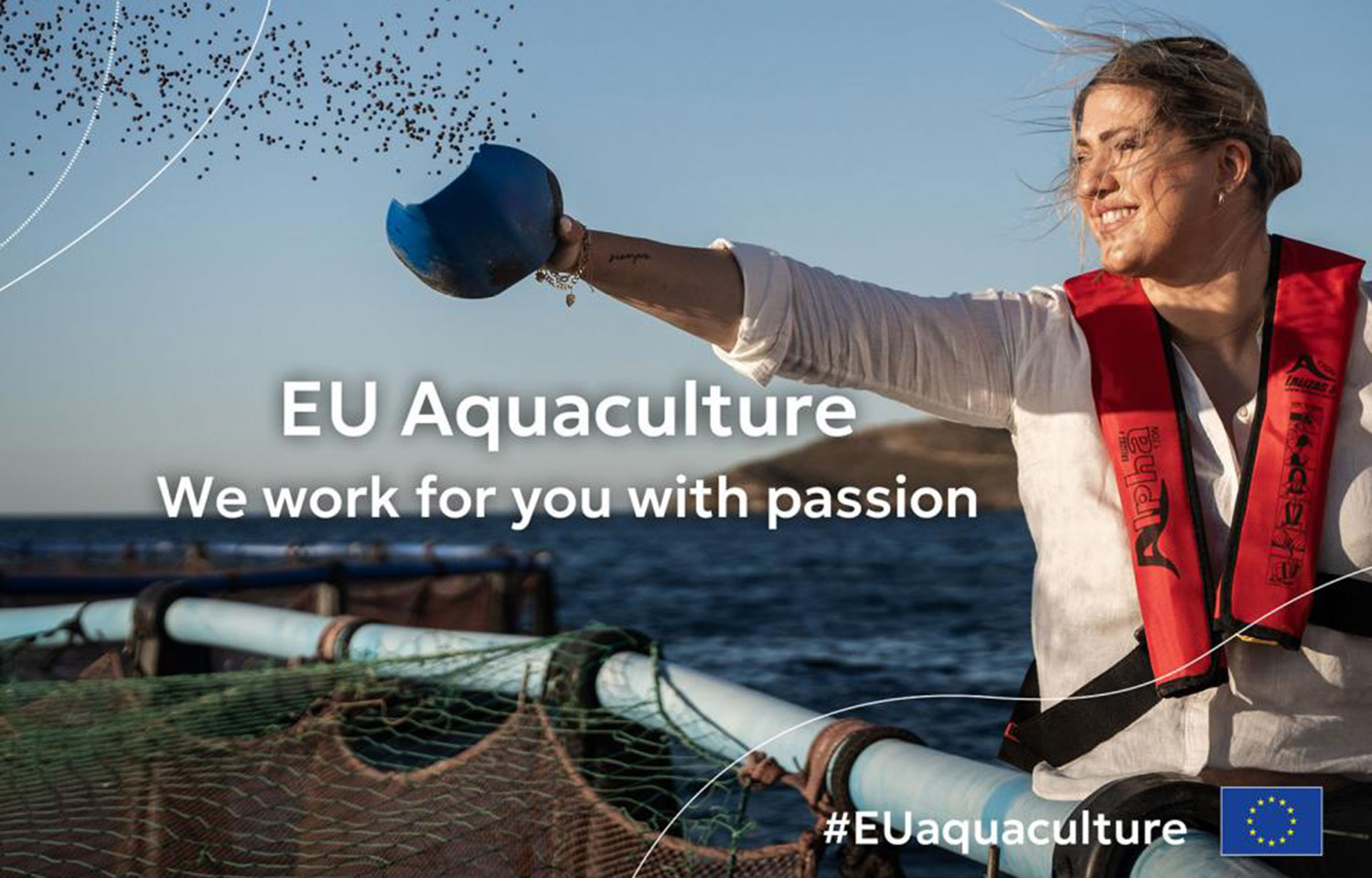
The European Commission has launched a new E.U.-wide campaign to raise awareness and change perceptions of aquaculture in the bloc.
Aquaculture output in the European Union has flatlined at 1.1 million metric tons (MT) – representing less than 1 percent of the globally-produced supply – and most of the bloc’s 450 million population has little understanding or affinity with the industry. The new campaign, titled "EU aquaculture: We work for you with passion" and unveiled by EU Commissioner for Fisheries and Oceans Costas Kadis, was developed in collaboration with member states, national aquaculture experts, and the Aquaculture Advisory Council to elevate support for the development of the region’s aquaculture and to help it return to growth.
It’s the result of “the significant steps the Union and its member countries have taken to ensure the sustainability and competitiveness of the sector,” Kadis said.
Kadis noted that research has confirmed that in the E.U., public awareness of the many benefits of aquaculture remains low, and that most citizens are not aware of how the fish, shellfish, and algae on their plates are being produced. They are also unaware of the rigorous standards that the region’s producers must follow to ensure food safety, animal health, and environmental responsibility; and a lot of people are apprehensive about having aquaculture farms or activities close to their homes.
“This campaign invites them to take a closer look and embrace the opportunities that aquaculture can bring to their communities,” Kadis said. “It is an invitation to learn more about and support aquaculture as an activity that is allowing them to eat healthy, local and sustainable food, while helping our coastal and rural communities thrive.”
Over the next three months, the campaign will showcase the dedication and commitment of E.U. producers to sustainable aquaculture and to providing high-quality food products. It will also show the benefits of developing the industry, such as reducing the Union’s dependence on imported seafood and boosting local economies. Initially, it will feature nine different species: mussels, trout, clams, seabream, oysters, carp, salmon, meagre, and seaweed, and profile several producers to give the general public a better understanding of how the sector works.
“This campaign gets behind E.U. aquaculture and our dedicated producers – often entire generations who bring their passion and their expertise to work every day. These are people who have dedicated their lives to food production, with a strong commitment to quality and sustainability,” Kadis said. “This is what makes European Union aquaculture stand out and we are proud this share this commitment, and this is also why producers are at the heart of the heart of this campaign.”
Kadis said the challenge facing the campaign is to afford aquaculture producers the same level of public recognition that agricultural farmers have, adding that at the moment, most people would draw a blank if they were asked what the former do.
“This is something we need to change. This campaign is giving our giving our producers, our aquaculture farmers a voice and visibility," Kadis said.
To this end, it has appointed four E.U. Aquaculture Ambassadors: Philipp Mohnen, a trout producer with Mohnen Aquaculture, Germany; Anna Kaloumenou, a seabass and seabream producer at Blue Farm AE, Greece; Paul and Caroline Scotti, oyster and mussel producers with Paul et Caroline huitres moule de Camargue, France; and Anna Pyc, a trout and carp producer with Pustelnia Fish Farm, Poland.
Moving forward, Mohnen, Kaloumenou, the Scottis, and Pyc will widely share their stories, challenges, and successes.
“Through their voices, aquaculture will [be seen as] more than just a profession. It is a way of life, a calling – driven by passion. Their stories will highlight how aquaculture keeps their families and communications working, keeping them alive. You will also see how aquaculture embraces tradition while constantly evolving through innovation, whether it is using advanced technology to improve the production process, embracing new techniques to reduce environmental impacts or preserving local species and ecosystems. You will see how E.U. aquaculture is at the forefront of sustainable and competitive food production,” Kadis said.
Speaking at the campaign launch, Mohnen described aquaculture as “a very diverse profession, that's both fun and challenging.”
For small- and medium-sized companies like family-run Mohnen Aquaculture, it’s not enough to only know about the fish it’s raising at its farms, every team member also must be a mechanic, an engineer, a salesperson, problem solver, entrepreneur, and a leader, he said.
“It's a great privilege to be part of a team where everyone is sharing the same passion and is willing to sacrifice a lot for it, because it is a sacrifice to be out there all the time and in all weather. [But] at the end of the day, our work can contribute to sustainable and healthy Europe. This is also a truly great feeling to me,” Mohnen said.
While fish farming has a significantly lower CO2 footprint than terrestrial animal farming, and modern production techniques have minimal impact on the environment, Mohnen said the industry nevertheless faces significant challenges.
“In Germany, the biggest challenge to our profession is its long-term economic viability as a whole. Farmers fear that increased costs put their economic viability at risk, there’s less and warmer water due to the climate crisis, while ever-increasing bureaucratic requirements and the resulting need for large investments is causing great uncertainty in some parts,” Mohnen said. “Thus, there's not a lot of young people going into fish farming as a profession. As a result, in Germany, there are already farms closing, and I think if the situation stays the same, the sad news is that this will continue as a trend for years to come.”
However, Mohnen said he remains confident that sustainable aquaculture has a future in Germany and in Europe as a whole.
“I'm convinced that we can address these challenges that the profession faces and form a political framework that helps aquaculture prosper. This campaign is a great first step,” he said.
Pyc, who runs the Pustelnia farm in southeastern Poland with her husband, is also concerned by the pressure that E.U. and national legislation is putting on the business created by her parents.
Rules, she said, are becoming increasingly detailed and are therefore giving firms like Pustelnia more and more challenges.
“The world of administrative rules, permissions and controls, the world of others’ expectations and others’ opinions are giving us a lot of hard work and new challenges that we do not always expect. On the other side, we have another huge world, much bigger than our own: the world of the market, where there’s very tough economic competition with low prices and growing costs,” she said. “In between those two huge worlds, there is a very small world, the world of a single fish farm…This is our life. In our small world, we are proud of the fish we offer. We are proud when we deliver the fish to a local restaurant, and we speak to the chef of this restaurant, so he knows the quality of what he's serving. We are proud and we are happy when we tell [our] story to local consumers, telling them where the fish comes from, and showing them the high quality of the products we serve. This little world, very local, was created by just a few – by my family today.”
Also at the campaign launch, Kadis insisted that the E.U. Strategic Guidelines for Aquaculture offer “a clear roadmap to go even further” and adopt good practices and innovations to boost sustainability and resilience through member states’ Multi-Annual National Strategic Plans. He said these countries have tailored the roadmap to their own specific needs and priorities, and have been supported by dedicated funding.
The Commissioner also acknowledged that in this regard, the campaign “comes at an interesting point in time,” with Brussels now in the process of evaluating the Common Fisheries Policy (CFP) regulation, which among other things, sets the strategic coordination of aquaculture. Also being assessed, four years after their implementation, are the aforementioned aquaculture strategic guidelines, while the new European Ocean Pact will soon be presented by the European Commission with the mandate to ensure coherence across all E.U. policy areas.
“Aquaculture and fisheries will be an important part of the pact,” he said. “I hope that this campaign will strengthen partnerships among European Union institutions, the aquaculture sector, and other stakeholders, in making the vision we have for this sector a reality. Together, we can support its growth, ensuring its continued competitiveness, sustainability and alignment with the European Union's political priorities.”
Kadis called on member states to be onboard in ensuring that aquaculture remains a priority in national policies.
“Let us continue to build the right framework for this sector to thrive, ensuring it receives the recognition and support it deserves," Kadis said.
