
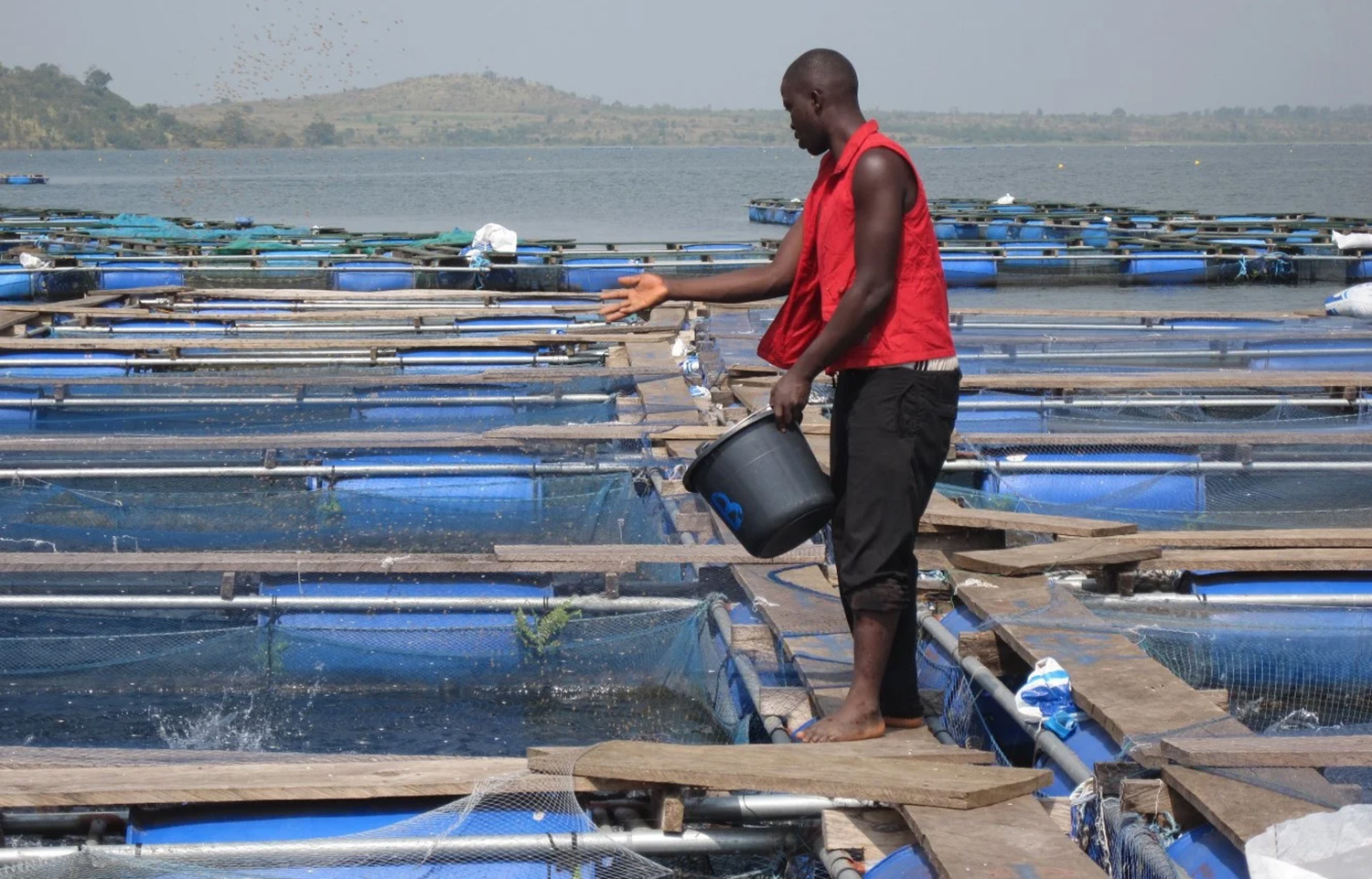
The Nigerian state of Lagos – home to the country’s most populous city of the same name – has established a subsidized program to support feed production and make it more readily accessible and affordable for farmers of both fish and poultry.
Lagos’s Ministry of Agriculture and Food Systems recently unveiled the Ounje Eko Farmers’ Subsidy Program to help farmers access feed from approved manufacturers at a discounted rate.
The subsidy, providing a 25 percent discount to applicable farmers, “is poised to reduce production costs and increase food supply throughout the state,” the Lagos state government said.
At least 1,000 fish farmers will benefit from the subsidy on a weekly basis, the government further explained, by having the ability to purchase a maximum of 10 25-kilogram bags of feed weekly.
“The subsidy scheme will prevent further fish farm closures and mitigate food insecurity while strengthening agricultural value chains,” Lagos State Commissioner of Agriculture and Food Systems Abisola Olusanya said.
According to aquatic food system nonprofit WorldFish, Nigeria produces an estimated 140,000 metric tons (MT) of pelleted feed annually but still has to import approximately 70,000 MT to meet growing demand from aquaculture practitioners mainly specializing in catfish and tilapia production.
With around one-third of the country’s feed being imported, feed costs have become a major constraint in expanding the nation’s aquaculture industry, with aquaculture entrepreneurs spending between 60 percent and 70 percent of their total production costs on feed, according to WorldFish.
Fish farmers pay an estimated NGN 42,000 (USD 27.80 EUR 26.78) for a bag of feed, which is nearly a 1,200 percent increase from the NGN 3,500 (USD 2.32 EUR 2.23) they paid around 2010.
Worldfish, which is supporting Nigeria’s aquaculture expansion through its Development and Scaling of Sustainable Feeds for Resilient Aquatic Food Systems in Sub-Saharan Africa (FASA) project, said that many small-scale fish farmers in Nigeria struggle to maintain profitable operations and initiatives but that projects like FASA and the subsidy scheme would enable producers to “overcome challenges, boost production, and contribute to a more resilient and prosperous food system.”
On a nationwide level, private sector investors are also working with Nigerian government agencies to develop various financing models that increase the availability of credit feed manufacturers and fish farmers can use. Additionally, the Nigerian federal government announced an initiative to construct new feed milling plants at at least six sites in Nigeria.
Fisheries Cooperative Federation of Nigeria President Mohammed Laminu said the latter initative “will help greatly because the major problem of fish farming in this country is the high cost of feed.”
“But, we pray the government will use our local raw materials for production, thereby reducing the cost of production and feed prices,” Laminu said.
Nigeria is not the only African country trying to tackle the issue of making fish feed more accessible and affordable.
Other African countries, like Namibia and Zambia, scrambled to find access to fish feed in 2024 amid historical drought conditions.
