
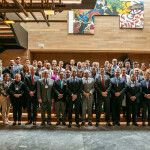


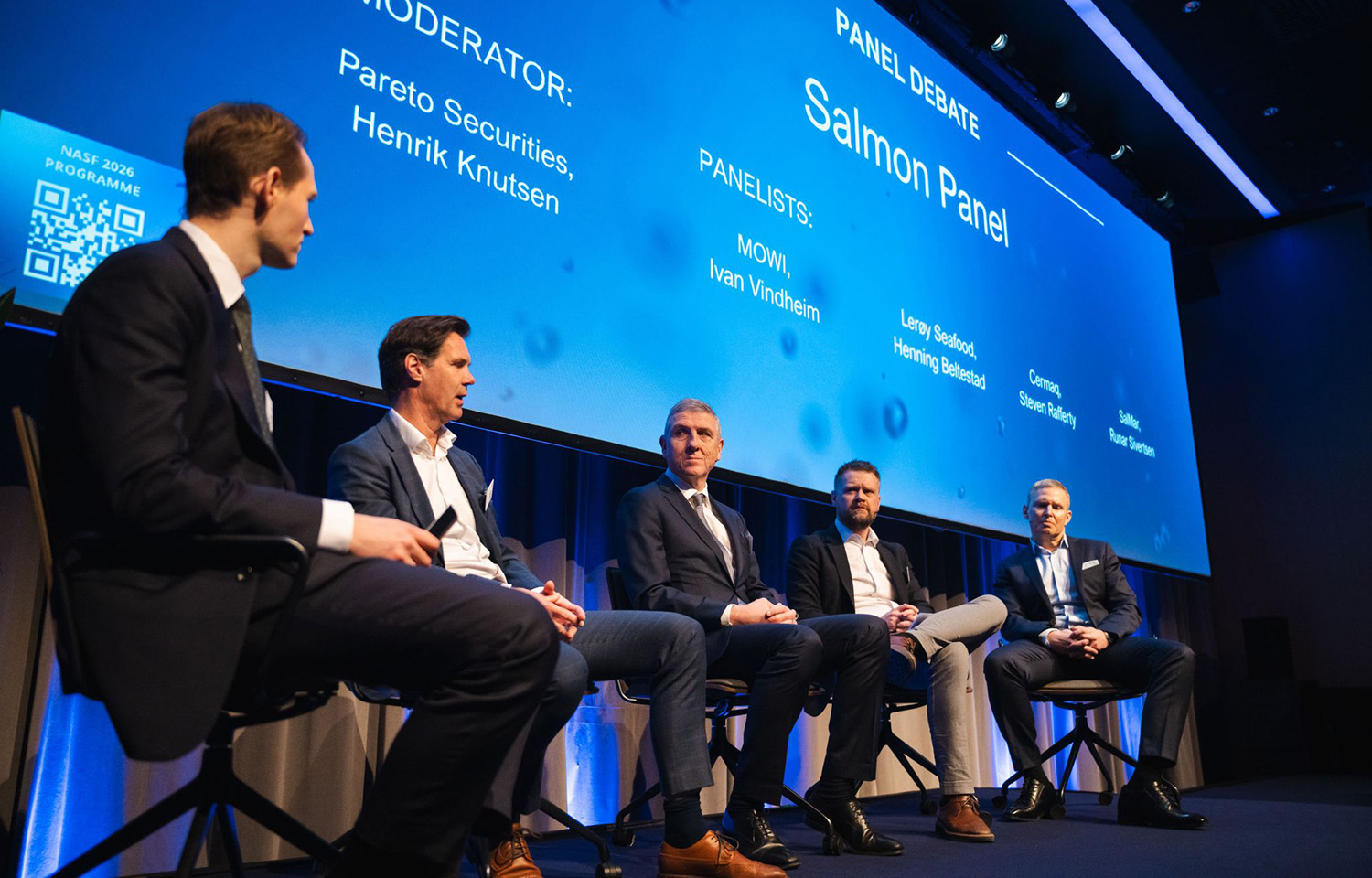
Salmon-farming executives at Norwegian aquaculture firms warned attendees at the 2026 North Atlantic Seafood Forum (NASF) that their industry faces growing regulatory uncertainty and the sector must be more involved in policy debates if it wants to secure long-term growth.
Speaking during a panel discussion at the event, which was held 3 to 5 March in Bergen, Norway, Mowi CEO Ivan Vindheim cautioned that dialogue shaping the country’s current regulatory landscape risks constraining the sector rather than supporting its sustainable expansion.
“The keyword is so-called sustainable growth, but what people put into sustainability is often in the eye of the beholder,” Vindheim said.
He pointed to Norway’s proposed aquaculture whitepaper as an example, arguing that while it has been billed as a way to achieve organic growth, the way it is currently interpreted could actually lead to reduced production in some areas.
“That’s why it’s somewhat surprising that we are talking about growth at the same time,” he said.
According to Vindheim, the industry may ultimately find itself fighting simply to maintain current production levels rather than expanding.
Fellow panelists echoed the need for a broader and more balanced regulatory framework, with the insistence that Norwegian policymakers often focus too narrowly on specific issues such as sea lice instead of taking a holistic view of aquaculture operations.
“Sea lice is, of course, a big issue, but the regulators have too much of a narrow focus on it. We believe the focus should be on the salmon because if you do that right, fish welfare and sea lice [efforts] will follow,” SalMar Chief Strategy Officer Runar Sivertsen said.
Sivertsen also stressed the importance of technology-neutral regulations that allow producers to pursue different innovations without being constrained by overly prescriptive rules.
Norway’s lengthy permitting process was highlighted as another obstacle toward development.
Cermaq CEO Steven Rafferty said he believes the governance structure of the industry “is not fit for purpose.” He explained that his company operates in Northern Norway, where there is significant space for expansion, yet gaining approval for new farming sites can take “years and years of effort.”
“There are conflicts between the central government, county authorities, and local politicians,” he said. “Something that could take six months often ends up taking several years.”
This regulatory complexity, the panel argued, risks slowing innovation and investment in the sector.
The executives also called for stronger incentives for companies that invest in new technologies aimed at improving fish health and environmental performance, such as submerged farming systems that have been shown to reduce sea lice pressure and improve fish welfare.
“These technologies are delivering results,” Beltestad said. “But, the system doesn’t always provide incentives for companies to adopt them.”
Rafferty agreed that there is currently a lack of incentives in the country.
“There should be rewards for good, sustainable practices, and the companies that are doing badly in terms of sustainability should not be rewarded,” he said. “This traffic light system, where it's generalized by region – green, yellow, and red – doesn't incentivize individual companies to do better.”
Despite frustrations with the regulatory process, Rafferty conceded that Norway remains one of the most transparent regulatory environments for aquaculture globally.
“In some other countries, the decision-making process is much less clear,” he said.
Panelists also acknowledged the industry itself must improve how it communicates with policymakers and the public.
“We have to be better at explaining what we actually do,” Lerøy Seafood Group CEO Henning Beltestad said, acknowledging that despite the sector’s advances in sustainability and technology, misconceptions about salmon farming remain widespread. “I think the best thing we can do is to get close to the politicians and to get them on the same level as us. We need to be better in this communication; it’s not been good enough because what we are doing is really great. We are doing a great job as an industry, with fantastic sustainable production.”
Moving forward, the panelists insisted the industry must take a more active role in shaping future regulations, especially with the government’s stated 1 January 2029 deadline for the introduction of a new, comprehensive aquaculture legal framework.
“This is 2026, so we don’t have much time,” Vindheim said. “We have to step up to the plate – all of us big and small – if we want a diverse farming industry in Norway. I can promise you one thing: If this whitepaper becomes reality and law, in the end, we will have just three or four companies in this industry.”
