

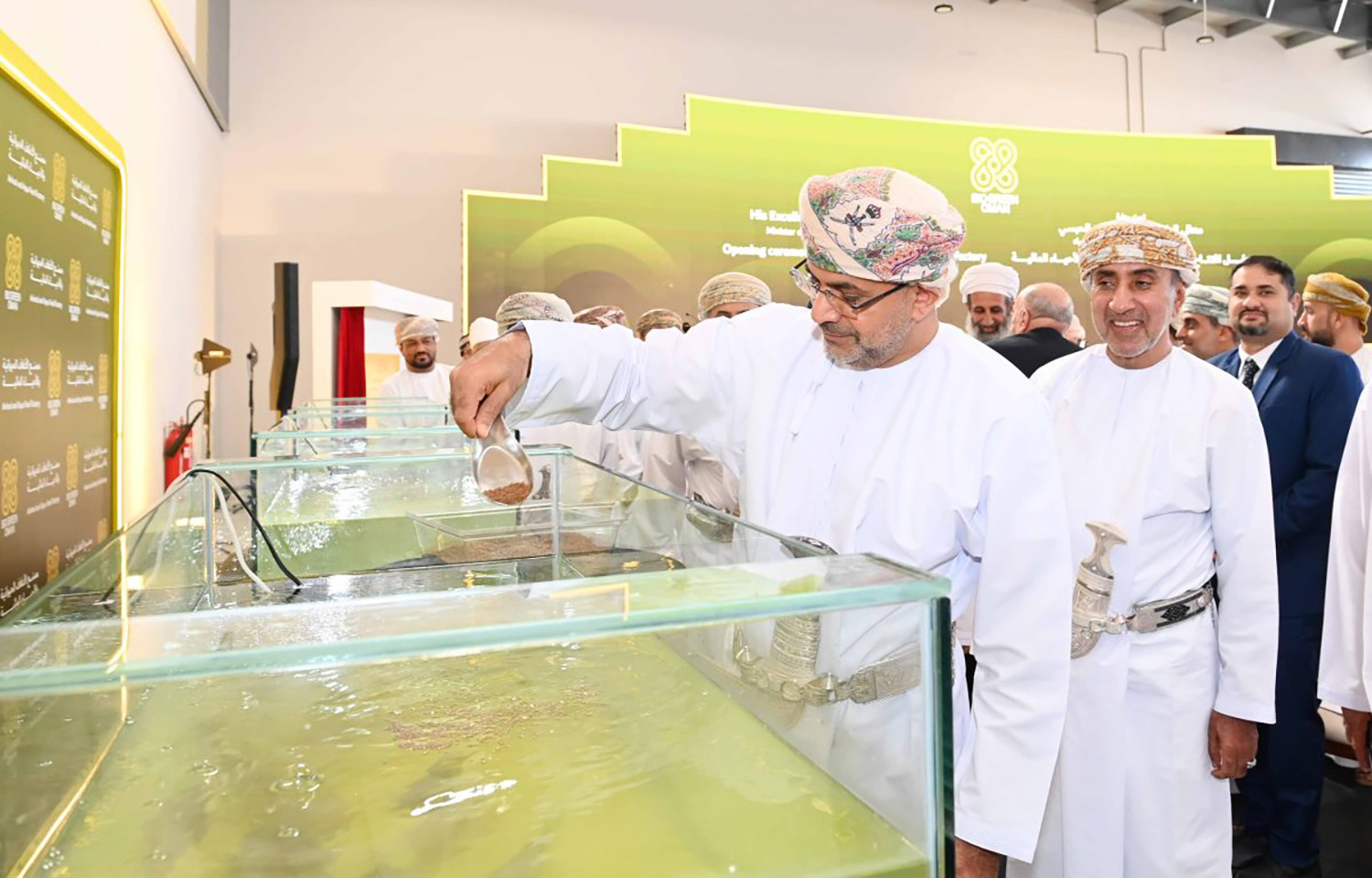
Khazaen, Oman-based Omani Bio Products Company (OBPC) has launched operations at its new OMR 37 million (USD 96 million, EUR 82 million) aquafeed manufacturing plant, which utilizes agricultural waste as feedstock to produce, before any expansion plans are undertaken, up to 15,000 metric tons (MT) of aquafeed annually.
OBPC will source an estimated 100 tons of green agricultural waste daily from the Barka landfill – the largest landfill in Oman, where municipalities dump an estimated 1 million tons of solid waste annually – to use as feedstock.
After a year of production, the firm is aiming to expand the plant by 2027 and again in 2030, respectively pushing production capacity to 100,000 MT for livestock feed and 300,000 MT for fish feed, mainly for shrimp and cage-farmed fish.
Oman Minister of Agriculture, Fisheries, and Water Resources Saud Al Habsi, who attended the inauguration of OBPC's new plant, said that the facility adds to an increasing number of fish feed research projects and production facilities currently underway in Oman.
For instance, a project in Oman aimed at developing fish feed featuring the aquatic fern azolla as its main ingredient moved closer to reality in early 2025 after the Zubair Enterprise Development Center, an Omani business management consultancy firm, completed an economic feasibility study on the initiative.
“The Sustainable Tuhlub Project marks a significant leap forward in innovation for the fish feed sector, providing environmentally friendly, high-quality nutrition for farmed fish,” Zubair said in a statement at the time. “By leveraging azolla, the project aims to enhance fish health and quality in aquaculture, reduce reliance on imported feed, and support sustainability goals by utilizing natural, renewable resources.”
The OBPC facility also aligns with national goals such as Oman Vision 2040 – a blueprint that has not only set a target of more than 220,000 MT in aquaculture production providing between USD 500 million (EUR 427 million) and USD 900 million (EUR 768 million) to the Middle Eastern country’s economy by 2040 but also calls for the promotion of alternative and concentrated feed production raw materials. In particular, it calls for finding effective local alternatives to fish oil and fishmeal, such as agricultural waste like OBPC’s new plant is leveraging.
Oman’s strategy of finding alternatives to traditional fishmeal is a prudent one, according to RaboResearch Seafood Analyst Novel Sharma, who highlighted in a September 2025 Rabobank report that aquaculture already uses up 90 percent of the world’s fishmeal and around 65 percent to 70 percent of global fish oil.
“This is not a sustainability issue. It’s a scarcity issue,” Sharma told SeafoodSource at the time his report was released. “That’s what the whole industry needs to understand.”
Sharma suggested that longer-term, industry-wide agreements and investments, such as the developments ongoing in Oman, can help better manage instability and fluctuation risks across the value chain. He also said that to support sustainable growth, the aquaculture sector as a whole must adopt proactive strategies to secure access to essential feed ingredients, with the analysis noting that novel feed sources are moving from experimental to commercial-scale, offering more predictable pricing and supply.
In a separate, recent report, experts warned that climate change and fishery management restrictions could affect wild catch of forage fish and lead to a 70 percent decline in the output of certain high-value farmed species if the production of alternative feed ingredients is not scaled up.
“This is a practical moment to secure feed supply and unlock new value streams,” said Ling Cao, the study’s lead author, a professor at Xiamen University, and a judge of the Future of Fish Feed (F3) Challenge. “Treating fishmeal and fish oil as strategic, finite resources, while accelerating alternative innovations, can help sustain aquaculture growth and reduce exposure to supply variability.”
