






Aquaculture company Barramundi Group reported a profit in FY 2025 after a restructuring scheme approved by the Singapore High Court allowed it to write off some of its debt.
The company reported a USD 1.84 million (EUR 1.58 million) profit for FY 2025, a significant increase compared to the USD 8.6 million (EUR 7.4 million) in losses it posted for FY 2024. That increase was entirely due to “other income,” as its revenue actually decreased slightly from USD 13.9 million (EUR 11.9 million) in FY 2024 to USD 13.1 million (EUR 11.3 million) in FY 2025.
That “other income” was largely thanks to the restructuring the company undertook, which allowed it to write off a significant portion of its payables. The company said it wrote off USD 8.76 million (EUR 7.53 million) in debt under a restructuring scheme, which comprised USD 8.68 million (EUR 7.46 million) from secured creditors and USD 84,000 (EUR 72,200) from unsecured creditors.
The positive financial result post-restructure marks a turnaround for the company, which spent multiple years on the Oslo Børs penalty bench after delaying its FY 2023 financial reports. Prior to that, multiple members of the company’s board resigned or stepped down due to posting poor results.
The company finally released its FY 2023 results in November 2024, revealing USD 8.7 million (EUR 7.5 million) in losses.
In September 2024, prior to revealing the extent of its financial crunch, the company announced a restructuring plan and, soon after, petitioned the Singapore High Court for a moratorium on any receivership proceedings against the company as it worked out the details. It eventually greenlit that plan in July 2025, and the plan was approved by the Singapore High Court later that same month.
Throughout its restructuring process, Barramundi Group has consistently posted losses, including in its most recent H1 2025 results.
Nevertheless, the company’s restructure helped it achieve a positive result for FY 2025, and it was removed from both the Oslo Børs penalty bench and the recovery box. The stock exchange places companies in the recovery box when pricing its securities is uncertain and places it on the penalty bench when companies fail to follow rules. With the fulfillment of its scheme and the recent results publication, it has successfully left both.
Barramundi Group CEO James Kwan acknowledged the long road the company has traveled on the past few years, which he said were “among the most challenging in the company’s history.”
“The group has had to confront operational disruption, financial pressure, legacy obligations, and a complex restructuring period. These conditions tested the resilience of our business, our people, and our stakeholders,” Kwan said. “Against that backdrop, the successful completion of the restructuring was a critical milestone.”
Kwan said the new restructure addressed a “significant” part of its legacy debt positions and gives it a more stable financial platform going forward. He said that platform will allow the company to focus on operational recovery and rebuilding the business, instead of the balance sheet.
Operationally, Kwan said the company remains anchored in Brunei. Barramundi Group pivoted toward its Brunei operations in 2023, and it sold all of its farms in Australia to Tassal that same year.
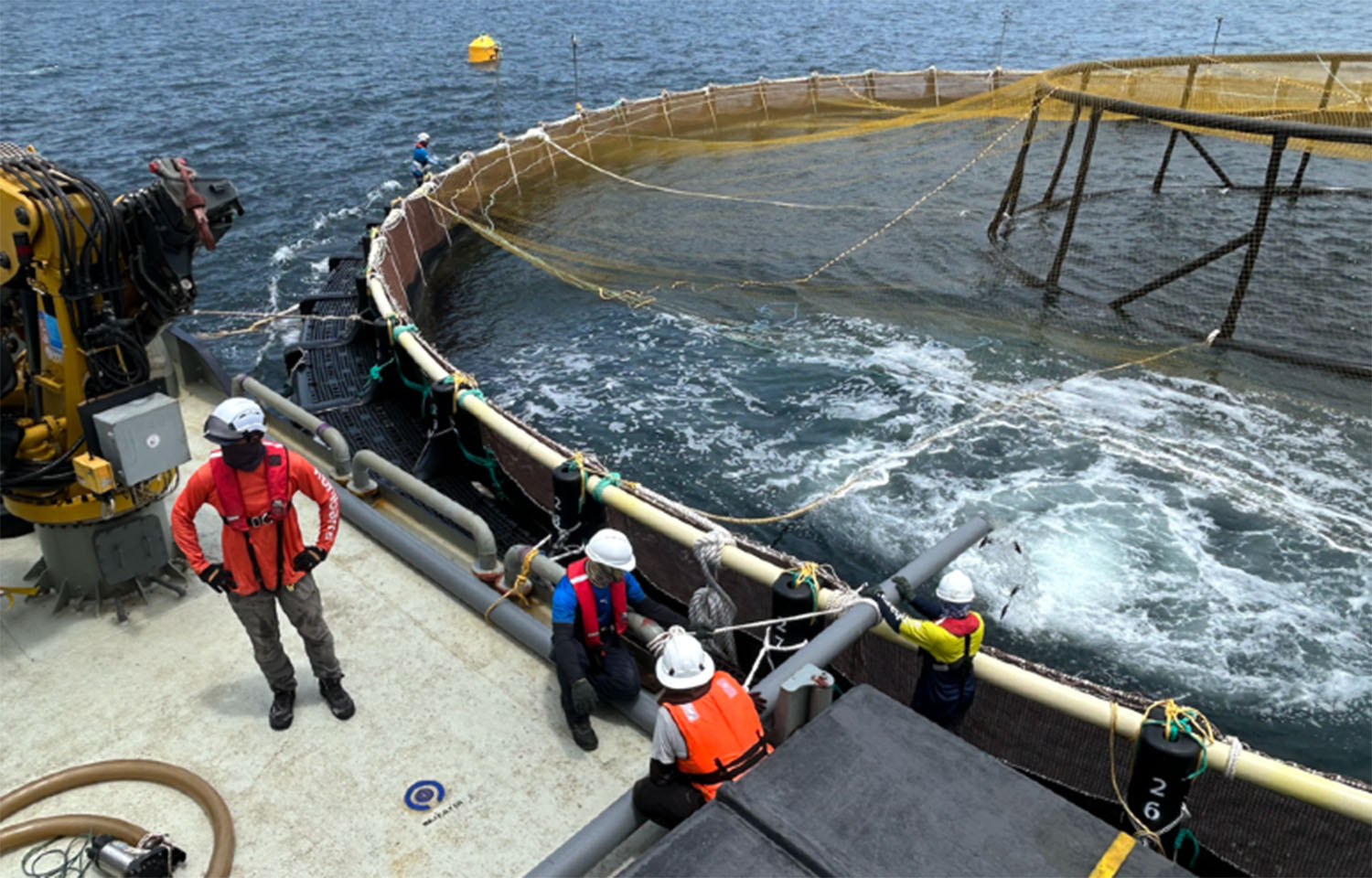
The company is currently building up its operations in Brunei by expanding its sea farming operations, developing additional recirculating aquaculture system (RAS) infrastructure, and planning on an eventual long-term plan for a land-based grow-out facility in Mengsalut, Brunei.
“We remain committed to a hybrid farming model that combines land-based recirculating aquaculture system capability with open-pen sea farming,” Kwan said. “We believe this approach provides the Group with a pragmatic balance between biological risk management, capital efficiency, production flexibility, and scalability.”
Kwan said the company has restarted workstreams to examine the facility in Mengsalut, including commissioning geotechnical investigations to review the site and facility design.
“Consultations with technical specialists are also ongoing to evaluate methods and technologies that may help optimize capital expenditure, improve energy efficiency, reduce operational carbon intensity, and enhance whole-life asset performance over the facility’s useful life,” Kwan said.
Its existing operations have also been improving, according to Kwan. He said feed conversion ratios are hovering near 1, and the company has deployed pens in deeper water at its Pelong Rocks location to take advantage of better conditions.
Kwan said Pelong Rocks has undergone animal health issues but that the teams are improving operations in multiple ways – including better husbandry, feeding, and pre-stock protocols to improve performance.
“This deployment forms part of our calculated and continued effort to rebuild biomass cautiously in support of the group’s phased Brunei growth strategy,” he said.
Kwan acknowledged that the restructuring has given a more firm foundation to build off but that the future is far from clear without continued improvements.
“Biological risk, including fish health and mortality events, continues to be a material consideration for any aquaculture business. These risks are not insignificant and must be managed continuously through husbandry discipline, site selection, biosecurity, diagnostics, and operational vigilance,” he said.
Kwan said external shocks like the conflict in Ukraine and the Middle East are also impactful but that the company plans to continue to focus on operational improvement.
“The path ahead will require patience and careful execution,” he said. “Our focus will be to rebuild the Group on a more resilient footing, while remaining realistic about the operational and external challenges.”
